
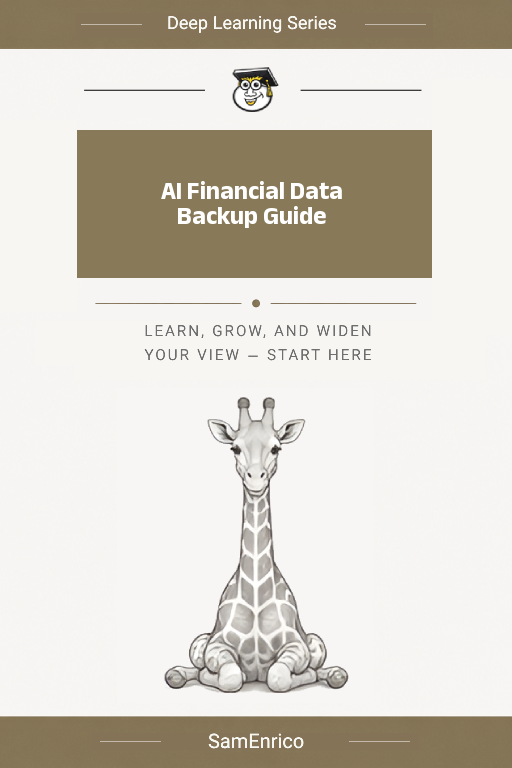
AI Financial Data Backup Guide eBook
Implement backup and recovery for AI-analyzed fina
Implement backup and recovery for AI-analyzed financial data and models.
Formats
Free sample
Chapter 1: The Vanishing Weights--–- On a Tuesday morning in March 2023, a quantitative hedge fund in London lost $47 million. Not through a bad trade, not through a market crash, and not through a rogue algorithm. They lost the money because a junior database administrator ran a routine cleanup script on the wrong server. The script deleted a directory containing model weights for their flagship volatility arbitrage system. The backups were intact.
The code was untouched. And yet, when they tried to restore operations, the model produced nonsense. The reason no one saw coming: they had backed up the weights but not the world those weights lived in.This is not a cautionary tale from the early days of artificial intelligence. It is a portrait of a systemic blind spot that persists today across banking, insurance, asset management, and fintech. Organizations have spent billions on cybersecurity, disaster recovery, and business continuity.
They have replicated databases across continents, archived trade logs for seven years, and tested failover scenarios for market data feeds. But when financial firms began feeding their transaction streams into neural networks, vector databases, and large language models, they carried over backup assumptions from a simpler era—an era when data was static, code was deterministic, and a file was just a file.That era is over. And the consequences are appearing in boardrooms, audit findings, and regulatory enforcement actions faster than most risk managers care to admit.The central argument of this chapter—and indeed of this entire book—is that traditional backup strategies fail catastrophically for AI-analyzed financial data and models. Not because they are poorly designed, but because they were built for a world that no longer exists. The 3-2-1 rule, the weekly full backup, the grandfather-father-son rotation, the assumption that restoring from tape will simply work—these are not merely outdated.
They are dangerous when applied to AI systems without fundamental rethinking.To understand why, we must first understand what makes AI artifacts fundamentally different from every other asset in your financial technology stack. Then we must confront a harsh truth: most organizations today are flying blind, believing they are protected when in fact they are one deleted directory away from a seven-figure loss.The Silent Divergence: Code Versus State Every software system has two components: the instructions that tell the computer what to do, which we call code, and the accumulated results of running those instructions, which we call state. In a traditional database, the state is the rows and columns of your tables. Backing up that state is straightforward—you take a snapshot, write it to durable storage, and move on. In a traditional application, the code lives in version control, and the state lives in a database.
The separation is clean, well-understood, and well-supported by backup tools.AI financial systems explode this separation.Consider a model that detects fraudulent credit card transactions. That model is not merely code. It is not merely a set of rules written by a programmer. Instead, it is a collection of numerical weights—often millions or even billions of them—that emerged from a training process involving historical transaction data, feature engineering logic, hyperparameter searches, and random seeds. Those weights are state, yes, but they are state that cannot be regenerated exactly from the training data alone.
The training process includes stochastic elements: random initialization of weights, dropout layers that randomly ignore neurons during training, and random shuffling of data batches. Even if you have the exact same data and the exact same code, retraining produces a different model with different weights, different decision boundaries, and different performance characteristics.Now add feature stores to the picture. That same fraud model does not consume raw transaction data. It consumes features—engineered representations that humans and automated systems have crafted to make patterns more detectable. Examples include "30-day average transaction amount," "velocity of merchant changes," "time since last high-risk flag," and "standard deviation of transaction amounts over the past week." These features are computed by pipelines that themselves evolve over time.
The definition of "high-risk flag" might change quarterly as new fraud patterns emerge. The rolling window for "30-day average" might exclude holidays in one version of the pipeline and include them in another. The feature calculation logic is not static configuration stored in a simple file. It is versioned business logic that lives alongside the model, often in separate repositories managed by separate teams.Now add vector databases to the already complex picture. Many modern fraud detection systems now use embeddings—numerical representations of transactions, merchants, or customer profiles—to find similar past events.
These embeddings are generated by an embedding model, which is itself a neural network that may be updated independently of the primary fraud model. Perhaps the embedding model is retrained monthly to capture new patterns in customer behavior. Perhaps it is fine-tuned weekly based on new fraud reports. The vectors stored in the vector database are completely meaningless without the exact embedding model that created them. Restore the vectors without restoring that specific model version, and your similarity search becomes cryptographic gibberish—random numbers that happen to be the same size as the original vectors but share no meaningful relationship with them.This tangled web of dependencies is what I call the divergence problem.
Traditional backup assumes that state is independent of the code that manipulates it. In AI financial systems, state and transformation logic are deeply entangled with each other. Backing up one without the other is not partial protection. It is an illusion of protection, a security blanket that keeps you warm while the fire spreads.The 3-2-1 Rule and Its AI Failure Modes The 3-2-1 backup rule is a gold standard in information technology disaster recovery. It states that you should maintain at least three copies of your data, stored on two different types of media, with at least one copy kept offsite.
For financial records, trade databases, customer account information, and even source code, this rule has served the industry well for decades. It is simple, memorable, and effective against a wide range of failure modes, from hard drive crashes to building fires to ransomware attacks.For AI systems, the 3-2-1 rule is necessary but wildly insufficient.Let me explain why by walking through a concrete scenario. Suppose you have faithfully implemented the 3-2-1 rule for your AI fraud detection system. Your three copies include the production model weights running on your primary servers, a replica of those weights on a secondary storage system in the same data center, and an offsite backup stored in a different geographic region. All three copies are perfectly intact.
All three have passed their integrity checks. And yet, all three could be completely useless for recovery. How?Because you might have backed up the model weights from last Tuesday, but your feature pipeline changed on Wednesday, and your embedding model changed on Thursday. Restoring the weights alone recreates a model that expects a world that no longer exists—a world where features were calculated according to old definitions and embeddings came from an obsolete model. Worse, if you restore the weights without realizing that the dependencies have drifted, the model might still…
This is the end of the free sample. Get the eBook to keep going. Buy now
About this book
Details
- Author
- Belanger Afton
- Publisher
- SamEnrico
- Language
- English
- Genre
- Non-Fiction, AI Operator, Backup
- Released
- 2026-05-30
- Pages (approx.)
- 151
- Available as
- eBook, Audiobook

Read better in the ZLOADR app
Your eBooks on your phone or tablet. Sign in with your SamEnrico account and start reading.
More by Belanger Afton
 RNA Vaccine Future ProspectsBelanger Afton$11.99
 TM And Religion Compatibility GuideBelanger Afton$11.99
 Yahoo's Oath Brand DamageBelanger Afton$11.99
 Self Esteem After Partner's SuccessBelanger Afton$11.99
 Remote Team EQ ManagementBelanger Afton$11.99
 The Maestro of Medicine: Ignaz Semmelweis and the Birth of Antiseptic SurgeryBelanger Afton$11.99
 Understanding Myasthenia Gravis CongenitalBelanger Afton$17.99
 Nestle SWOT Analysis GuideBelanger Afton$12.99
 A 3-Part Series Each Part the Length of an Election Cycle's Final PushBelanger Afton$11.99
 How to Start a Mushroom Growing (cultivated) Business (Beginners Guide)Belanger Afton$11.99
You may also like
 Hong Kong Handover 1997Dunn Johnnie$11.99
 Zumba For Postnatal Recovery CourseNeal Christian$11.99
 Zumba for BeginnersLadner Nikia$11.99
 YouTube Comment Mining GuideHumes Pandora$12.99
 Worry Box MeditationCarlin Rudy$11.99
 Workplace Stress MeditationNguyen Lynn$11.99
 Workplace Stress and Sleep RepairHawley Ivory$11.99
 Workplace Perfectionism CureDelaney Jeffry$11.99
 Workplace Injustice Anger GuideWallen Isabelle$11.99
 Work Addiction and Burnout LinkGreenwood Ester$11.99
 Women in Yoga and WellnessBeattie Galina$11.99
 Women in Stand Up ComedyChun Evangeline$11.99