
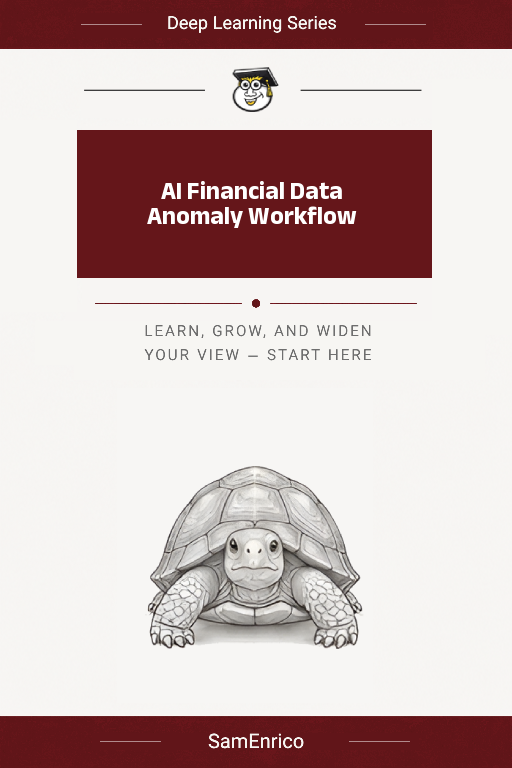
AI Financial Data Anomaly Workflow eBook
Design escalation workflows when AI detects unusua
by Foss Narcisa
Design escalation workflows when AI detects unusual financial transactions or patterns.
Formats
Free sample
Chapter 1: The Alert Tsunami...–- It begins the same way every time. A junior compliance analyst named Sarah arrives at her desk at 8:47 AM, coffee in hand, ready to face the 847 alerts that accumulated overnight. Her bank processes approximately 2.3 million transactions daily, and their legacy rule-based system—built over fifteen years and patched countless times—has flagged nearly one thousand of them as "suspicious." Sarah knows, with the weary certainty of someone who has done this job for three years, that exactly twelve of those alerts might be actual fraud. The other 835 are false positives. She will spend her entire day chasing ghosts.This is not a failure of effort or talent.
Sarah's bank spends 4.2millionannuallyonhertwenty−personcomplianceteam.Theyaresmart,dedicatedprofessionalswhotaketheiranti−moneylaunderingandfrauddetectionresponsibilitiesseriously.Buttheyaredrowning.Therules−basedsystemtheyinheritedwasdesignedforadifferentera—onewherecriminalsmovedmoneyslowly,wheretransactionstookdaystosettle,wherea"suspicious"patternmeantsomethingobviouslikeasingle4.2 million annually on her twenty-person compliance team. They are smart, dedicated professionals who take their anti-money laundering and fraud detection responsibilities seriously. But they are drowning. The rules-based system they inherited was designed for a different era—one where criminals moved money slowly, where transactions took days to settle, where a "suspicious" pattern meant something obvious like a single 4.2millionannuallyonhertwenty−personcomplianceteam.Theyaresmart,dedicatedprofessionalswhotaketheiranti−moneylaunderingandfrauddetectionresponsibilitiesseriously.Buttheyaredrowning.Therules−basedsystemtheyinheritedwasdesignedforadifferentera—onewherecriminalsmovedmoneyslowly,wheretransactionstookdaystosettle,wherea"suspicious"patternmeantsomethingobviouslikeasingle10,000 cash deposit. Today, criminals use hundreds of small transactions just below reporting thresholds, launder money through legitimate-looking businesses, and move funds across borders in seconds.
The rules cannot keep up.Every time the compliance team adds a new rule to catch a novel fraud pattern—say, "flag any transaction over 8,000fromnewaccountslessthan14daysold"—thecriminalsadaptwithinweeks.Theystartsending8,000 from new accounts less than 14 days old"—the criminals adapt within weeks. They start sending 8,000fromnewaccountslessthan14daysold"—thecriminalsadaptwithinweeks.Theystartsending7,999. The false positive rate climbs higher. The analysts get more alerts. The real fraud slips through because no human can review ten thousand alerts per day with perfect accuracy.This is the reality of financial compliance in the 2020s, and it is completely unsustainable.
The industry spends an estimated $200 billion annually on financial crime compliance, yet the United Nations estimates that only 0.1% to 0.3% of global criminal proceeds are actually seized. We are spending enormous sums to generate noise, not results. And the problem is getting worse. Real-time payment systems like Fed Now and the European Union's instant payments regulation are eliminating the overnight delay that used to give compliance teams breathing room. Within five years, most financial transactions will settle in seconds.
There will be no "batch processing overnight" safety net.The solution to this crisis is not a better rule. It is not a slightly more sophisticated threshold. It is not hiring more Sarahs—there are not enough qualified compliance professionals in the world to review the volume of alerts that modern payment systems generate. The solution is to fundamentally redefine what an "AI analyst" does, moving from a system that simply flags transactions to one that actively investigates them. And crucially, to build intelligent workflows that know what to do with those investigations once they are complete.This book is called "The Adaptive Edge" because the competitive advantage in financial compliance no longer comes from having the most accurate detection model.
It comes from having the most intelligent escalation workflow. Two banks can use identical AI models to detect anomalies. Bank A will drown in alerts because they have not redesigned their triage, case management, and human review processes. Bank B will process ten times the volume with the same headcount because they have built an adaptive workflow that knows when to auto-close, when to escalate, when to involve a human, and when to call the customer relationship manager. The model is table stakes.
The workflow is the differentiator.Before we dive into the technical architecture of these workflows, we need to understand the enemy. Not the criminals—though they are certainly adversaries—but the legacy systems and legacy thinking that have created the alert tsunami.The False Positive Epidemic Let us put some numbers on this problem, because they are almost too staggering to believe without seeing them written down. A typical large bank processes between 5 and 10 million transactions per day. A properly calibrated AI anomaly detection system might flag between 0.5% and 2% of those transactions as potentially suspicious. That sounds reasonable until you do the multiplication: 2% of 10 million transactions is 200,000 alerts per day.
Even at the lower end, 0.5% of 5 million is 25,000 alerts daily.Now consider the false positive rate. Industry data consistently shows that rule-based systems—which still dominate most financial institutions—have false positive rates between 95% and 99%. That means for every legitimate fraud detected, between 19 and 99 false alarms are raised. A mid-sized bank with 25,000 daily alerts and a 95% false positive rate will have 23,750 false alarms every single day. Their analysts will spend approximately 80% of their time chasing alerts that should never have been created.The cost of this is not just measured in wasted salary dollars, though that is substantial.
A fully loaded compliance analyst (salary, benefits, overhead, systems access, training) costs a bank between 75,000and75,000 and 75,000and150,000 per year. If that analyst spends 80% of their time on false positives, the bank is effectively paying 60,000to60,000 to 60,000to120,000 per analyst for nothing. A twenty-person team wastes 1.2millionto1.2 million to 1.2millionto2.4 million annually on false alarms.But the real cost is invisible. It is measured in missed fraud. When analysts are overwhelmed with false positives, they rush.
They take shortcuts. They develop heuristic rules of thumb—"accounts with names starting with 'M' are usually fine," "anything under $500 isn't worth my time"—that are not documented, not consistent, and often wrong. Sophisticated criminals know this. They deliberately structure their transactions to look like the 95% of false positives that analysts ignore. The system that generates too many alerts has, paradoxically, become blind to the alerts that matter.Why Rules Fail: The Brittleness Problem To understand why AI must replace—or at least dramatically augment—rule-based systems, we need to understand why rules are fundamentally brittle in the face of adaptive adversaries.A rule-based system is a collection of "if-then" statements.
If the transaction amount exceeds $10,000, then generate an alert. If the transaction originates from a high-risk country code, then generate an alert. If the customer has made more than five transactions in an hour, then generate an alert. These rules are simple, transparent, and easy to implement. They are also catastrophically easy to bypass.Criminals engage in a practice called "threshold shopping." They learn the rules—often by testing small transactions and seeing which ones get blocked—and then operate just below the thresholds.
A bank that flags all transactions over 10,000willseecriminalssend10,000 will see criminals send 10,000willseecriminalssend9,999. A bank that flags more than five transactions per hour will see criminals send four transactions per hour, spread across multiple accounts. A bank that flags high-risk country codes will see criminals route payments through intermediary jurisdictions that are not on the list.The compliance team responds by adding more rules, creating what is known in the industry as a "Christmas tree" system. Each new rule is like an ornament hung on an already overloaded tree. The system becomes more complex, less performant, and harder to maintain.
False positives increase because the rules inevitably capture legitimate behavior that happens to match a criminal pattern. The bank that flags all…
This is the end of the free sample. Get the eBook to keep going. Buy now
About this book
Details
- Author
- Foss Narcisa
- Publisher
- SamEnrico
- Language
- English
- Genre
- Non-Fiction, AI Operator
- Released
- 2026-05-30
- Pages (approx.)
- 150
- Available as
- eBook, Audiobook

Read better in the ZLOADR app
Your eBooks on your phone or tablet. Sign in with your SamEnrico account and start reading.
More by Foss Narcisa
 Date Night Stress Relief GuideFoss Narcisa$11.99
 EQ For Clergy And Pastors GuideFoss Narcisa$11.99
 Drug Dependency and Mental HealthFoss Narcisa$11.99
 Loci for Song LyricsFoss Narcisa$11.99
 The Academic Advisor AnxietyFoss Narcisa$11.99
 Independent Contractor ReclassificationFoss Narcisa$11.99
 Self Worth And Military FamilyFoss Narcisa$11.99
 Diabetic Neuropathy HandbookFoss Narcisa$11.99
 Atypical Antipsychotics for BipolarFoss Narcisa$11.99
 The Magnificent Madam C.J. Walker: From Washtub to Wall StreetFoss Narcisa$11.99
 Rihanna's Savage X Fenty: The Revolution of InclusivityFoss Narcisa$11.99
 Growing EnseteFoss Narcisa$11.99
You may also like
 Hong Kong Handover 1997Dunn Johnnie$11.99
 Zumba For Postnatal Recovery CourseNeal Christian$11.99
 Zumba for BeginnersLadner Nikia$11.99
 YouTube Comment Mining GuideHumes Pandora$12.99
 Worry Box MeditationCarlin Rudy$11.99
 Workplace Stress MeditationNguyen Lynn$11.99
 Workplace Stress and Sleep RepairHawley Ivory$11.99
 Workplace Perfectionism CureDelaney Jeffry$11.99
 Workplace Injustice Anger GuideWallen Isabelle$11.99
 Work Addiction and Burnout LinkGreenwood Ester$11.99
 Women in Yoga and WellnessBeattie Galina$11.99
 Women in Stand Up ComedyChun Evangeline$11.99