
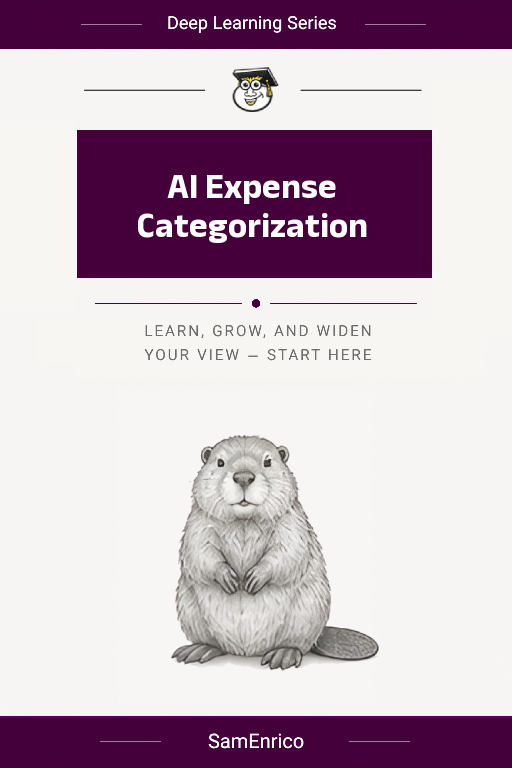
Non-FictionBusiness BriefExpense AI
AI Expense Categorization Audiobook
Train machine learning models to auto-classify exp
Train machine learning models to auto-classify expenses and learn business spending patterns.
Formats
Free sample
Chapter 1: The Receipt Graveyard--–- The email arrived at 4:47 PM on a Friday, which is how you know it was bad news. Sarah, the finance director for a mid-sized software company, stared at her screen. Her CEO had just asked for a real-time budget update before Monday’s board meeting. Not the usual “we’re fine” answer. Actual numbers.
Actual category-level spend. Actual understanding of where the money went.Sarah opened Quick Books. Then Excel. Then the corporate card portal. Then the expense management system.
Then the three separate spreadsheets that different departments used because nobody liked the “official” system. Then she did what finance people have done since the invention of the double entry: she started manually copying, pasting, and categorizing.At 11:47 PM, three hours after her kids went to bed, she found it. A single transaction from six months ago: “MORGAN STANLEY PARKING GARAGE” for $847. The rule-based system had no idea what to do with that. Was it Travel?
Parking rarely is. Was it Meals? No. Office Supplies? Definitely not.
The system, following its programmed logic, had shoved it into “Miscellaneous Expense” — the digital equivalent of sweeping dirt under the rug.That one miscategorized transaction had cascaded. The parking charge belonged to a client visit that should have been billed back. It wasn’t. The travel budget for Q2 showed a mysterious 847overrunthatnobodycouldexplain.The CEO,lookingatthedashboard,hadcutthetravelbudgetfor Q3basedonfaultydata.Thesalesteam,deprivedofclientvisitfunds,hadmissedthreemeetings.Threemeetingsthatwouldhaveclosed847 overrun that nobody could explain. The CEO, looking at the dashboard, had cut the travel budget for Q3 based on faulty data.
The sales team, deprived of client visit funds, had missed three meetings. Three meetings that would have closed 847overrunthatnobodycouldexplain.The CEO,lookingatthedashboard,hadcutthetravelbudgetfor Q3basedonfaultydata.Thesalesteam,deprivedofclientvisitfunds,hadmissedthreemeetings.Threemeetingsthatwouldhaveclosed120,000 in pipeline deals.All because a machine followed its rules perfectly.The Myth of Perfect Rules Here is the first hard truth this book will teach you: rules-based accounting works beautifully until it fails catastrophically. And it will fail. Not because the rules are badly written, but because expense data is fundamentally adversarial to rules. The messiness is not a bug in the data—it is a feature of reality.Let me show you what I mean.Take a simple rule: IF merchant_name CONTAINS “Uber” THEN category = “Ground Transportation”Works fine, right?
Now watch what happens when real data arrives:Merchant Name as It Appears in Bank Feed Does “Uber” Rule Fire?“Uber *Trip”Yes“Uber BV”Yes“Uber…
This is the end of the free sample. Get the Audiobook to keep going. Buy now
About this book
Details
- Author
- Lawton Glynis
- Publisher
- SamEnrico
- Language
- English
- Genre
- Non-Fiction, Business Brief, Expense AI
- Released
- 2026-05-29
- Pages (approx.)
- 146
- Available as
- eBook, Audiobook

Listen in the VoxFlicks app
Audiobooks and audio dramas wherever you go. Sign in with your SamEnrico account and press play.
More by Lawton Glynis
 Thunberg Passive Resistance Training GuideLawton Glynis$11.99
 Menopause Joint Pain ReliefLawton Glynis$11.99
 Medical Practice Failure FearLawton Glynis$11.99
 The Caregiver Heart Disease GuideLawton Glynis$11.99
 Learning New Skills NeuroprotectionLawton Glynis$11.99
 The Stone Age Astronomers: Decoding the Cosmic Secrets of Gobekli TepeLawton Glynis$11.99
 Ashes to Ashes, Dust to Stars: The Phoenix Code of the Ancient Library of AlexandriaLawton Glynis$11.99
 Underground Storage Tank RemoverLawton Glynis$11.99
 Bootstrap PR Media List WorkbookLawton Glynis$12.99
 How to Become a Scrubber Machine TenderLawton Glynis$11.99
You may also like
 Hong Kong Handover 1997Dunn Johnnie$11.99
 Zumba For Postnatal Recovery CourseNeal Christian$11.99
 Zumba for BeginnersLadner Nikia$11.99
 YouTube Comment Mining GuideHumes Pandora$12.99
 Worry Box MeditationCarlin Rudy$11.99
 Workplace Stress MeditationNguyen Lynn$11.99
 Workplace Stress and Sleep RepairHawley Ivory$11.99
 Workplace Perfectionism CureDelaney Jeffry$11.99
 Workplace Injustice Anger GuideWallen Isabelle$11.99
 Work Addiction and Burnout LinkGreenwood Ester$11.99
 Women in Yoga and WellnessBeattie Galina$11.99
 Women in Stand Up ComedyChun Evangeline$11.99