
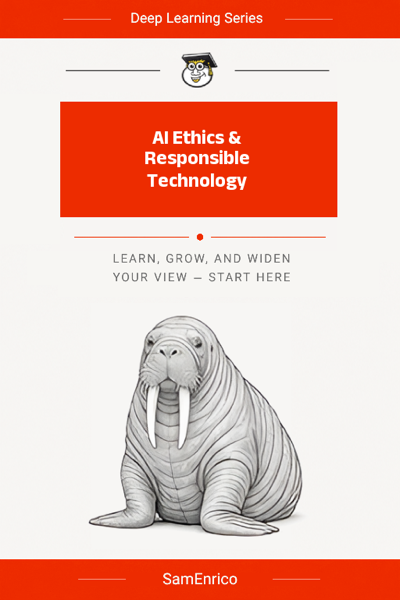
Non-FictionInformativeEducational
AI Ethics & Responsible Technology eBook
A Coursebook on AI Ethics & Responsible Technology
A Coursebook on AI Ethics & Responsible Technology
Formats
Free sample
Chapter 1: The Responsibility Paradox--Let us begin with a confession that most technology leaders will never make publicly: they are terrified of the systems they are building. Not of the code failing—that is an engineering problem with known solutions. Not of the algorithms being mathematically incorrect—that is a debugging problem with established protocols. What keeps them awake at 3:00 AM is something far more unsettling. They are terrified that their creation might work exactly as designed and still cause catastrophic harm.
They are terrified that the spreadsheet they are staring at, which shows perfect accuracy metrics and soaring user engagement, might be hiding the quiet suffering of thousands of people who will never know that an algorithm decided their fate. They are terrified because they have begun to suspect that the real danger of artificial intelligence is not that it will become suddenly, violently evil, but that it will become routinely, invisibly unjust.This is the responsibility paradox of the AI age. The very properties that make machine learning so powerful—its ability to find patterns that no human could see, to operate at scales no human could match, to optimize outcomes no human could compute—are the same properties that make it ethically dangerous. We build systems to automate decisions precisely because human judgment is flawed, biased, and inconsistent. Then we discover that our automated systems are flawed, biased, and inconsistent in ways that are harder to detect, harder to contest, and harder to correct.
We delegate authority to algorithms because we believe they will be more objective than people. Then we learn that algorithms inherit the subjectivity of their training data, the blindness of their designers, and the values of their optimization functions. We accelerate development because speed is a competitive advantage. Then we realize that speed without ethical scaffolding is not progress but sabotage.This book is written for everyone who has felt that tension. For the product manager who knows that their fairness dashboard looks good but suspects the metrics are hiding something important.
For the software engineer who wants to write better code but has never been taught what "better" means when fairness and accuracy conflict. For the policy advisor who needs to translate ethical principles into enforceable regulations. For the student who wants to build a career in technology without becoming complicit in harm. For the citizen who wants to understand what is at stake in the algorithms that increasingly govern their life. This book will not tell you that artificial intelligence is evil and must be stopped.
It will not tell you that artificial intelligence is salvation and must be accelerated without limit. Both of those positions are intellectually lazy and practically useless. Instead, this book will argue a more difficult thesis: artificial intelligence is a tool, and like every powerful tool in human history, it amplifies both our best intentions and our worst failures. The goal is not to stop AI but to steer it. And steering requires an ethical compass, not a crystal ball.The False Choice That Paralyzes Progress Walk into any conference room where AI policy is being debated, and within fifteen minutes you will hear the same argument rehearsed with the weary familiarity of a script that everyone has memorized and no one believes.
On one side stands the accelerationist, who insists that any regulation of artificial intelligence is a form of luddism that will cede technological leadership to authoritarian regimes. On the other side stands the doomer, who insists that artificial intelligence is an existential threat that must be halted before it escapes all human control. Both sides have staked out positions that are internally consistent, emotionally satisfying, and completely detached from the reality of how technology actually develops and how societies actually govern themselves.The accelerationist position sounds bold and visionary. It invokes the spirit of innovation, the necessity of risk-taking, and the historical record of technologies that were feared before they were embraced. The accelerationist will tell you that people once feared electricity, automobiles, and the internet.
They will tell you that every generation believes its own technologies are uniquely dangerous. They will quote famous predictions that turned out to be wrong, from the lawyer who said the telephone would never catch on to the expert who said the internet was a fad. Then they will conclude that the only responsible response to artificial intelligence is to build as fast as possible, break as much as necessary, and let the market sort out the consequences later.The problem with the accelerationist position is not that it is entirely wrong. The problem is that it ignores the specific properties that make artificial intelligence different from previous technologies. Electricity did not learn from its users.
Automobiles did not optimize for their own objectives. The internet did not generate content that could not be distinguished from human communication. When a toaster fails, it burns your bread. When a generative AI model fails, it might destroy your reputation, steal your identity, or manipulate your beliefs without you ever knowing that you were interacting with a machine. The "move fast and break things" ethos that worked for social media platforms in 2010 is catastrophic for artificial intelligence in 2026 because the things being broken are not code but trust, privacy, fairness, and human agency.
You can patch a software bug. You cannot patch a person whose loan was denied, whose job application was rejected, whose bail was revoked, or whose medical diagnosis was missed because an algorithm made a mistake that no one could explain and no one could contest.The doomer position sounds cautious and wise. It invokes the precautionary principle, the history of unintended consequences, and the genuinely unprecedented nature of superintelligent systems. The doomer will tell you that the alignment problem is unsolved, that we do not know how to guarantee that a sufficiently advanced AI will share human values, and that the risk of extinction is non-trivial. They will point to thought experiments about paperclip maximizers and treacherous turns.
They will argue that we should pause development until we have better safety guarantees, perhaps through international treaties or voluntary moratoriums.The problem with the doomer position is not that it is wrong about the risks. The problem is that it conflates two very different categories of danger and thereby proposes a solution that addresses neither. The existential risk of superintelligent AI escaping human control is a real concern, but it is a concern for the medium-to-long term. The immediate harms of algorithmic bias, privacy erosion, labor displacement, and information pollution are happening right now, to real people, in systems that are not remotely superintelligent. A moratorium on advanced AI research does nothing to help the person who was wrongly arrested because a facial recognition system made a mistake today.
More importantly, a blanket call to "pause" is politically impossible and practically unenforceable. Nations will not agree to halt development when they believe their competitors are forging ahead. And even if they did, the open-source community would continue building. The doomer position is correct about the destination but has no map for the journey.Three Categories of Risk, Not One What we need instead is a more nuanced framework that…
This is the end of the free sample. Get the eBook to keep going. Buy now
About this book
Details
- Author
- Tidwell Felton
- Publisher
- SamEnrico
- Language
- English
- Genre
- Non-Fiction, Informative, Educational
- Released
- 2026-06-02
- Pages (approx.)
- 144
- Available as
- eBook, Audiobook

Read better in the ZLOADR app
Your eBooks on your phone or tablet. Sign in with your SamEnrico account and start reading.
More by Tidwell Felton
 Lake Clark MissingTidwell Felton$11.99
 Jack Dorsey SquareTidwell Felton$11.99
 Drug Dependency Aftercare PlanningTidwell Felton$11.99
 The Economics Nobel PovertyTidwell Felton$11.99
 Nobel Prize Superconductivity PioneersTidwell Felton$11.99
 Seated Body Scan WorkbookTidwell Felton$11.99
 Hair Adjustment as PreeningTidwell Felton$11.99
 Beginner Mindfulness AppsTidwell Felton$11.99
 The Silk Road of Sound: How Jazz Found Its Voice in 18th-Century Ottoman IstanbulTidwell Felton$11.99
 The Phantom of Monaco: The $3.5M Ferrari Heist That Shocked the WorldTidwell Felton$11.99
 Rust & Rain: The Last Ride of the Thunder CoasterTidwell Felton$11.99
 The Mineral Guide to AerugiteTidwell Felton$11.99
You may also like
 Hong Kong Handover 1997Dunn Johnnie$11.99
 Zumba For Postnatal Recovery CourseNeal Christian$11.99
 Zumba for BeginnersLadner Nikia$11.99
 YouTube Comment Mining GuideHumes Pandora$12.99
 Worry Box MeditationCarlin Rudy$11.99
 Workplace Stress MeditationNguyen Lynn$11.99
 Workplace Stress and Sleep RepairHawley Ivory$11.99
 Workplace Perfectionism CureDelaney Jeffry$11.99
 Workplace Injustice Anger GuideWallen Isabelle$11.99
 Work Addiction and Burnout LinkGreenwood Ester$11.99
 Women in Yoga and WellnessBeattie Galina$11.99
 Women in Stand Up ComedyChun Evangeline$11.99