
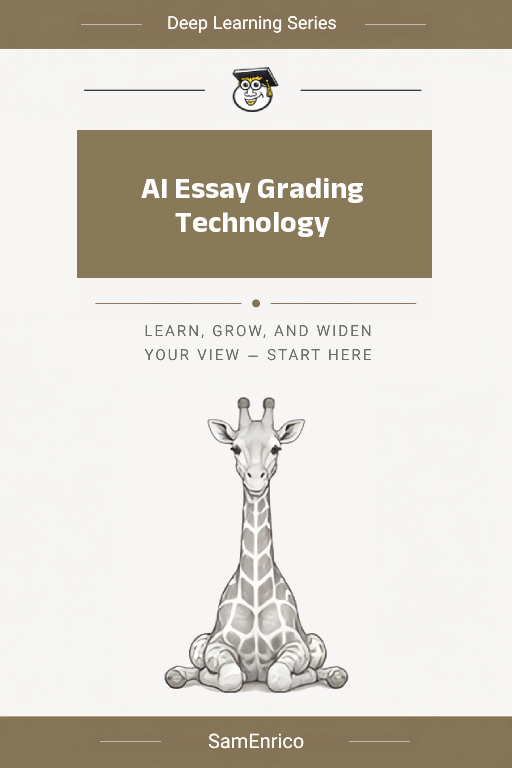
essaysForecast & OutlookAutomated Grading
AI Essay Grading Technology eBook
Learn natural language processing for automated sc
by Lanham Jin
Learn natural language processing for automated scoring of written assignments with rubric alignment.
Formats
Free sample
Chapter 1: The Grading Trap--Every evening, in thousands of schools across the world, a familiar ritual unfolds. A teacher carries home a canvas bag stuffed with student essays. She makes dinner, helps her own children with homework, and then, at 10:00 PM, pours a cup of coffee and begins to read. By the twelfth essay, her eyes blur. By the twentieth, she recognizes that she is no longer grading consistently—the third essay would have received a different score if she had read it now, but she cannot go back.
She writes comments that grow shorter and less specific: "Good point," "awkward," "needs work." She falls asleep with a red pen still in her hand.This is the Grading Trap. It is not a failure of teacher effort, dedication, or skill. It is a structural failure of a system that asks human beings to perform a task for which human beings are fundamentally ill-suited: the reliable, consistent, rapid, and scalable evaluation of extended written prose. And it is a trap that has consequences far beyond teacher burnout.The Grading Trap affects students too. The student who submits an essay on Monday does not receive feedback until Friday of the following week—too late to apply those insights to the next assignment.
The student whose essay lands at the bottom of a stack of sixty receives marginal comments that are perfunctory and unhelpful. The student whose writing style deviates subtly from the teacher’s expectations receives a lower score not because the writing is worse but because the teacher was tired. Every teacher knows this happens. Every teacher hates that it happens. And every teacher feels powerless to stop it.This book argues that the Grading Trap can be escaped—not by replacing teachers with machines, but by building intelligent systems that handle what machines handle well (consistency, speed, pattern recognition) and defer to humans what humans handle well (judgment, nuance, encouragement).
But before we can build those systems, we must understand exactly why manual grading fails at scale, how automated essay scoring (AES) emerged as a response, and why previous attempts at automation have been rejected by educators who rightly distrust black boxes. This chapter lays that foundation.The Three Burdens of Manual Grading The Grading Trap is constructed from three distinct burdens, each of which compounds the others. Understanding these burdens is essential because the entire technical architecture of this book—every prompt template, every agent, every concept bottleneck model—is designed to alleviate them.The Fatigue Burden Human attention is a limited resource. Psychological research has consistently demonstrated that sustained cognitive effort leads to decision fatigue: a measurable decline in the quality and consistency of judgments over time. For essay grading, this manifests as a predictable deterioration after approximately twenty essays.
The first ten essays receive careful attention, thoughtful marginal comments, and consistent application of the rubric. Essays eleven through twenty receive somewhat less attention. Essays twenty-one through thirty are graded in a state of cognitive depletion.This is not a character flaw. It is neurobiology. The prefrontal cortex, responsible for executive function and sustained attention, consumes glucose at a prodigious rate.
After extended periods of concentrated work, neural efficiency declines. Studies of standardized test scoring—where professional human raters grade essays under controlled conditions—have documented that scoring accuracy drops by approximately 15 percent after two hours of continuous work, and inter-rater agreement declines even more steeply.For classroom teachers, the fatigue burden is worse than for professional raters because classroom teachers are not grading essays in controlled conditions. They are grading after a full day of teaching, after meetings, after emotional labor with students and parents. The coffee is cold. The house is quiet but the mind is exhausted.
Under these conditions, even the most dedicated teacher produces grading that is, by objective measures, inconsistent.The Reliability Burden Even without fatigue, human raters disagree with each other. This is the reliability burden, and it is more troubling than fatigue because it persists even under ideal conditions. Give the same five-paragraph essay to ten experienced English teachers, each rested and motivated, and you will receive ten different scores. This is not a speculation; it has been measured repeatedly.In one landmark study of Advanced Placement English essays, the same essays were scored by two different trained readers. The correlation between their scores was approximately 0.70 on a 1-6 scale.
A correlation of 0.70 means that about half the variance in scores is attributable to the rater rather than the essay. Another way to say this: if you submitted the same essay to a school district with multiple graders, your score could vary by a full point or more depending on which grader you drew.Why does this happen? Because rubrics, no matter how carefully written, are ambiguous. The phrase "clear and compelling thesis" means something slightly different to every reader. One teacher interprets "clear" as explicit and direct ("In this essay, I will argue that…"); another teacher values subtlety and prefers an implicit thesis.
One teacher interprets "compelling" as surprising or provocative; another interprets it as well-supported and reasonable. These differences are not errors. They are legitimate pedagogical disagreements. But for students, they are noise.The reliability burden is not solved by better teacher training. Decades of professional development have improved but never eliminated inter-rater disagreement because the disagreement is not purely about skill—it is about the irreducible subjectivity of human judgment applied to complex artifacts.
The only way to achieve perfect inter-rater reliability is to have one rater. But one rater brings us back to the fatigue burden.The Scalability Burden The fatigue and reliability burdens become catastrophic when multiplied across large systems. Consider a university with 10,000 students enrolled in a writing-intensive course. Each student writes four essays per semester. That is 40,000 essays to grade.
If each essay requires fifteen minutes of reading and commenting—and fifteen minutes is optimistic for substantive feedback—the total grading load is 10,000 hours per semester. That is the equivalent of more than six full-time faculty members doing nothing but grading.In practice, universities solve this problem by reducing the amount of writing students produce, by reducing the quality of feedback they provide, or by shifting grading onto poorly compensated teaching assistants who are even more vulnerable to fatigue than experienced faculty. Scalability is not an abstract administrative concern; it is a direct constraint on student learning. The less writing students do, the less they improve. The less feedback they receive, the less they learn.Online education has made the scalability burden urgent.
Massive Open Online Courses (MOOCs) routinely enroll tens of thousands of students in a single offering. If each student writes even one essay, the grading problem is mathematically impossible to solve with human raters alone. The result has been a retreat from writing assessment: many MOOCs have eliminated essays entirely, replacing them with multiple-choice questions that assess recognition rather than production. This is not education. This is the abandonment of writing instruction because the grading system cannot handle it.The Birth of Automated Essay Scoring The Grading Trap is not new.
Educators have complained about grading burden for centuries. But the first serious attempt to escape the trap through technology emerged in…
This is the end of the free sample. Get the eBook to keep going. Buy now
About this book
Details
- Author
- Lanham Jin
- Publisher
- SamEnrico
- Language
- English
- Genre
- essays, Forecast & Outlook, Automated Grading
- Released
- 2026-06-01
- Pages (approx.)
- 130
- Available as
- eBook, Audiobook

Read better in the ZLOADR app
Your eBooks on your phone or tablet. Sign in with your SamEnrico account and start reading.
More by Lanham Jin
 Course Launch Email StrategyLanham Jin$11.99
 Facebook Birthday ComparisonLanham Jin$11.99
 Swedish Green Tax Deduction GuideLanham Jin$11.99
 Low Self Esteem Dating PatternsLanham Jin$11.99
 The Last Light of Icarus: The Generation Ship That Never Reached HomeLanham Jin$11.99
 The Golden Lion of Ethiopia: Emperor Haile Selassie I and the Glory of the Solomonic DynastyLanham Jin$11.99
 Ferberite MiningLanham Jin$11.99
 Understanding Hypospadias FamilialLanham Jin$17.99
 GDPR Impact On Ad Targeting ManualLanham Jin$12.99
 How to Become a Multifocal-lens AssemblerLanham Jin$11.99
You may also like
 YouTube Video Essay DepthLeon Lala$11.99
 TOEFL Independent Essay GuideMintz Alex$11.99
 Music Theory Essay GuideWilkinson Maisha$11.99
 Expository Essay AI PromptsApplegate Dalia$11.99
 Exam Essay MemorizationMcgovern Johna$11.99
 Compare Contrast Essay PromptsOntiveros Marx$11.99
 College Application Essay GuideSisson Aimee$11.99College Application Essay GuideSisson Aimee$11.99
 The 100 Word Essay ChallengeAli Luciana$11.99
 Journalism Essay PromptsThatcher Williemae$11.99
 Finance Essay PromptsShrader Lamont$11.99
 Cause Effect Essay GPT GuideBland Jacelyn$11.99