
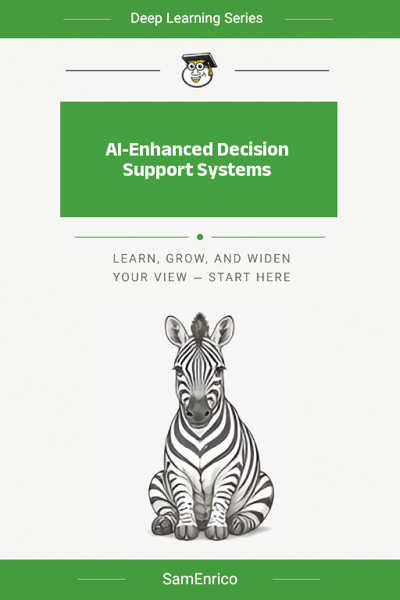
Non-FictionInformativeEducational
AI-Enhanced Decision Support Systems eBook
A Coursebook on AI-Enhanced Decision Support Syste
by Morse Wes
A Coursebook on AI-Enhanced Decision Support Systems
Formats
Free sample
Chapter 1: The Augmentation Imperative--– In a windowless conference room on the forty-second floor of a Manhattan skyscraper, eleven executives sat around a mahogany table debating a 200millioninventorydecision.Thechieffinancialofficerhadbuiltaspreadsheetmodel.Thesupplychaindirectorhadherownspreadsheet,whichconflictedwiththe CFO′sby200 million inventory decision. The chief financial officer had built a spreadsheet model. The supply chain director had her own spreadsheet, which conflicted with the CFO's by 200millioninventorydecision.Thechieffinancialofficerhadbuiltaspreadsheetmodel.Thesupplychaindirectorhadherownspreadsheet,whichconflictedwiththe CFO′sby47 million. The chief executive, having listened to ninety minutes of conflicting arguments, finally made a call based on which vice president he trusted more. Three months later, the company wrote off $63 million in obsolete stock.This scene repeats itself thousands of times every day, in every industry, on every continent.
Corporations spent more than $2.4 trillion on digital transformation in 2024 alone. They installed enterprise resource planning systems, customer relationship management platforms, data warehouses, and business intelligence dashboards. They hired chief data officers, analytics leads, and AI directors. And yet, the fundamental process of making consequential decisions remains stubbornly, almost defiantly, human. Not human in the admirable sense of creativity and judgment, but human in the fallible sense of fatigue, politics, anchoring bias, recency bias, confirmation bias, and the simple biological limitation that the human brain can hold only about four to seven discrete pieces of information in working memory at any given moment.This is not a technology problem.
It is a decision problem dressed in technology's clothing.The historical paradox that opens this book is simple and uncomfortable: we have built more digital infrastructure than any civilization in history, but our most important decisions are still made with cognitive tools that have not fundamentally improved since Homo sapiens first gathered around a fire. The spreadsheet, for all its virtues, is essentially an electronic version of the columnar tablet. The executive meeting is a ritual older than democracy. The Power Point deck, introduced in 1987, remains the primary vehicle for presenting evidence before a decision – despite abundant research showing that bullet points are among the least effective ways to communicate probabilistic information.Something has to change. And for the first time, the tools for that change exist not as science fiction but as deployable, affordable, increasingly reliable technology.
This book is about those tools: AI-Enhanced Decision Support Systems. But before we can build them, before we can implement them, before we can even evaluate vendor pitches, we must understand what they are replacing, why that replacement is necessary, and what fundamental shift in thinking must occur for the replacement to succeed.The shift is this: from Decision Support to Decision Augmentation. And the difference between those two words is the difference between giving a pilot a better altimeter and giving the pilot an autopilot that handles altitude while the pilot watches for traffic. Both are support. Only one changes the nature of the work.The Origins of a Broken Contract The story of Decision Support Systems begins in the 1960s, not with a bang but with a batch job.
Management Information Systems, or MIS, emerged from the marriage of mainframe computing and organizational accounting. The premise was seductive: if we could just capture all the transactions flowing through a company – every sale, every purchase, every payroll check – and aggregate them into regular reports, managers would finally have the visibility they needed to make rational decisions.The MIS delivered exactly what it promised: reports. Monthly sales summaries. Quarterly inventory turnover. Annual profit-and-loss statements.
These were revolutionary improvements over the manual ledgers they replaced. A controller in 1970 could know, within a few weeks of month-end, whether the company had made money. That was unimaginable a decade earlier.But the MIS had a fatal limitation baked into its architecture: it was descriptive. It told you what happened. It could not tell you why it happened, what might happen next, or what you should do about it.
The reports arrived after the fact, often weeks after the fact. By the time a manager learned that a product line was losing money, the quarters had already been ordered, the marketing budget had already been spent, and the sales team had already moved on to next month's targets.The 1980s brought the Decision Support System proper. The key innovation was interactivity. Where MIS was a batch report, DSS was a conversation. A manager could ask "what if?" What if we raised prices by 5 percent?
What if we added a second shift? What if we reduced inventory levels? The DSS would recalculate, often using the same underlying data as the MIS but with the crucial addition of a model – a set of mathematical relationships that described how changing one variable affected others.The spreadsheet was, and remains, the iconic DSS. Visi Calc, released in 1979 for the Apple II, is widely credited as the first "killer app" for personal computers. Lotus 1-2-3 followed in 1983.
Excel arrived in 1985. By 1990, spreadsheets were ubiquitous in corporate finance, operations, and strategy. A manager could build a model of her business unit, link it to actual performance data, and run scenarios in real time. This was genuine decision support.But spreadsheets, for all their power, have three structural problems that become catastrophic as organizations grow larger and markets move faster.First, spreadsheets are fragile. A single wrong formula, a single miscopied cell reference, a single hardcoded number buried in a sea of calculations – any of these can produce output that appears perfectly reasonable but is utterly wrong.
Research from the University of Hawaii found that 88 percent of spreadsheets contain errors. A study of actual corporate spreadsheets found that half contained material errors. And these errors propagate. One investment bank discovered that a $2.4 billion trading loss had been partially caused by a spreadsheet error in which a cell reference was off by one row.Second, spreadsheets are manual. Even the most sophisticated Excel model requires a human to update inputs, run scenarios, and interpret outputs.
As the pace of business accelerates, the lag between data generation and spreadsheet update becomes a liability. A retailer updating its markdown optimization spreadsheet weekly will consistently be outperformed by a competitor updating daily, even if the spreadsheet's underlying logic is identical.Third, and most fundamentally, spreadsheets scale with human cognitive limits. The human brain can process about 120 bits of information per second. A busy executive is exposed to millions of bits. Even the most dedicated analyst can only consider a handful of variables in any scenario.
The spreadsheet does not overcome this limit; it merely organizes the limited information the human chooses to include. The rest of the data – the majority of it – is simply ignored.The Big Data Wall The 1990s and 2000s brought a new category of tools: Business Intelligence, or BI. Where MIS was batch reporting and DSS was interactive modeling, BI promised something closer to real-time awareness. Dashboards replaced printed reports. Data warehouses consolidated information from across the enterprise.
Online Analytical Processing, or OLAP, allowed managers to "slice and dice" data along multiple dimensions – by region, by product, by customer segment, by time period.BI was, and remains, genuinely useful. A well-designed dashboard can alert a supply chain manager to a developing shortage. A data warehouse can answer questions that would have taken weeks of manual data pulling a decade earlier.…
This is the end of the free sample. Get the eBook to keep going. Buy now
About this book
Details
- Author
- Morse Wes
- Publisher
- SamEnrico
- Language
- English
- Genre
- Non-Fiction, Informative, Educational
- Released
- 2026-05-04
- Pages (approx.)
- 147
- Available as
- eBook, Audiobook

Read better in the ZLOADR app
Your eBooks on your phone or tablet. Sign in with your SamEnrico account and start reading.
More by Morse Wes
 Long COVID Fatigue Sleep AidMorse Wes$11.99
 Forensic Odontology TextbookMorse Wes$11.99
 Francis Love for AnimalsMorse Wes$11.99
 From Isolation To BelongingMorse Wes$11.99
 The Opioid Pain Management GuideMorse Wes$11.99
 The Divine Harmonies: Bach’s Baroque RevolutionMorse Wes$11.99
 Learn to Play the Tambor HuacanaMorse Wes$11.99
 Pivot Success MetricsMorse Wes$12.99
 Free Code Camp CertificationsMorse Wes$12.99
 How to Start a Fire Service Business (Beginners Guide)Morse Wes$11.99
You may also like
 Hong Kong Handover 1997Dunn Johnnie$11.99
 Zumba For Postnatal Recovery CourseNeal Christian$11.99
 Zumba for BeginnersLadner Nikia$11.99
 YouTube Comment Mining GuideHumes Pandora$12.99
 Worry Box MeditationCarlin Rudy$11.99
 Workplace Stress MeditationNguyen Lynn$11.99
 Workplace Stress and Sleep RepairHawley Ivory$11.99
 Workplace Perfectionism CureDelaney Jeffry$11.99
 Workplace Injustice Anger GuideWallen Isabelle$11.99
 Work Addiction and Burnout LinkGreenwood Ester$11.99
 Women in Yoga and WellnessBeattie Galina$11.99
 Women in Stand Up ComedyChun Evangeline$11.99