
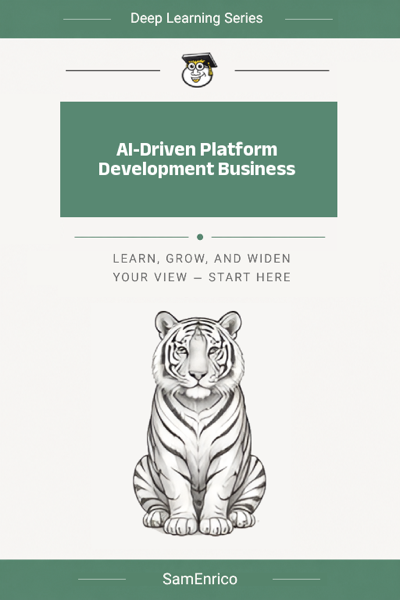
Non-FictionInformativeEducational
AI-Driven Platform Development Business eBook
A Coursebook on AI-Driven Platform Development Bus
A Coursebook on AI-Driven Platform Development Business
Formats
Free sample
Chapter 1: The Scaffolding Lie--“Prompting isn’t programming. And if you think it is, your platform will die before it launches.”This is not hyperbole. It is a postmortem.Between 2023 and 2025, over 70% of funded AI platform startups either pivoted away from their core agentic offering or shut down entirely. The postmortems read like copies of the same confession: “We thought we could prompt our way to intelligence. We were wrong.”The engineers who built those platforms made the same seductive error.
They mistook the surface simplicity of talking to an LLM—the natural language interface, the seemingly magical responses—for a fundamental shift in how software should be architected. They threw out decades of deterministic engineering wisdom because it felt old, rigid, and unsexy compared to the fluid promise of generative AI.This chapter dismantles that error. It introduces the scaffolding framework, resolves the cold start problem that kills most AI platforms before they see real users, and gives you a three-layer stack that actually works. By the end of this chapter, you will understand why deterministic systems are not the enemy of AI platforms—they are the only thing that makes AI platforms safe, scalable, and investable.But first, let’s talk about the lie that gets repeated in every founders’ meetup, every VC pitch, and every “how we built it” Medium post.The lie sounds like this: “We just prompt-engineered our way to a working platform.”It sounds humble. It sounds agile.
It sounds like the future.It is a lie.Prompt engineering is not software architecture. It is not a deployment strategy. It is not a security model. And it is most certainly not a way to build a platform that can survive its first hundred concurrent users.The Probabilistic Trap: Why Your LLM Will Betray You Here is the fundamental truth that every AI platform builder must internalize on day one: traditional software is deterministic, and LLMs are probabilistic.Deterministic code means given the same input, you will always get the same output. You write 2 + 2 and your program returns 4.
Every time. For eternity. This predictability is the bedrock upon which every reliable system—from your bank’s backend to the software in an airplane’s flight computer—is built.Probabilistic systems, by contrast, return different outputs for the same input. Ask an LLM “What is the capital of France?” and it might say “Paris” 98 times out of 100. But twice, it might say “Lyon” or “Marseille” or “The capital of France is a city of light and romance located on the Seine.” Three times it might add an emoji.
Once, it might hallucinate a completely fictional city.This is not a bug. It is the feature that makes LLMs creative, useful, and occasionally magical.But it is also a catastrophe waiting to happen if you design your platform as if the probabilistic LLM is the entire system. The founders of the 70% of failed platforms treated the LLM as the source of truth, the orchestrator, the decision-maker, and the output generator all in one. They built a god object with an API key.And when that god object hallucinated, they had no scaffolding to catch it. When it slowed down, they had no fallback.
When a user jailbroke it with a clever prompt, they had no guardrails. When their token bill hit $50,000 in a single month, they had no cost controls because they had never designed a system that could route cheap models for cheap tasks.The probabilistic trap looks like this: you build a prototype with a single LLM call. It works beautifully in demo. You show investors. They are excited.
You launch. Real users arrive. Real edge cases appear. Real adversaries try to break your system. And your single LLM—your beautiful, magical, terrifyingly unpredictable LLM—becomes the single point of failure for everything.You do not escape the probabilistic trap by trying to make LLMs more deterministic.
You can fine-tune, you can adjust temperature, you can craft elaborate system prompts. These help. They do not solve.You escape the probabilistic trap by building deterministic scaffolding around your probabilistic core. You accept that the LLM will sometimes be wrong, sometimes be slow, sometimes be exploited. Then you design a system that anticipates those failures and handles them gracefully.This is the scaffolding framework.The Scaffolding Framework: Deterministic Rails, Probabilistic Trains Imagine a train traveling at high speed from New York to Chicago.
The train is powerful, intelligent, capable of navigating complex terrain. But you would not let it drive without rails.The rails are deterministic. They are fixed. They guarantee that no matter what the train does—no matter how it accelerates or brakes—it stays on the path. The rails are not exciting.
They are not magical. They are the reason the train reaches Chicago instead of crashing into a cornfield in Ohio.In your AI platform, the LLM is the train. It is probabilistic, creative, and occasionally unpredictable. The deterministic scaffolding—the routing logic, the guardrails, the fallbacks, the cost controls, the observability layer—are the rails. They guarantee that even when the LLM hallucinates, your platform does not break.
Even when the LLM is slow, your user gets a response. Even when a malicious user tries to jailbreak your system, the guardrails stop the attack before it reaches the model.The scaffolding framework has three layers, each of which will be explored in depth throughout this book. But you need the high-level map before you build anything.Layer One: The Interface Layer (Conversational UX with Deterministic Boundaries)This is what your user sees and interacts with. It includes the chat window, the input field, the confidence displays, and the fallback options. The interface layer is deterministic in that it always behaves predictably—buttons always appear in the same place, the chat history always scrolls predictably, and the “submit” button never randomly changes color.But the critical deterministic element in the interface layer is the Trust Threshold—a number between 0 and 1 that determines when the AI acts autonomously and when it defers to a human.
A Trust Threshold of 0.95 means the AI must be 95% confident before it takes action. Below that, the interface layer shows the user the AI’s reasoning, the confidence score, and alternative answers, then asks for human confirmation.The Trust Threshold is deterministic. It is a hard line. It does not care how creative the LLM feels today. It is the first rail.Layer Two: The Orchestration Layer (Where Agents Decide)This is the brain of your platform.
It receives the user’s input, classifies the intent, decides which agent (or sequence of agents) should handle it, routes the request, and aggregates the response. The orchestration layer uses a mix of deterministic rules and LLM-based classification.Deterministic routing might look like this: if the user’s input contains the word “refund” AND the word “order” AND the user has an order in the last 30 days, route directly to the Returns Agent. No LLM needed. Fast, cheap, predictable.LLM-based routing is for the ambiguous cases: “I’m really unhappy with my purchase and I don’t know what to do.” That input needs classification. But even here, the orchestration layer applies deterministic constraints: the LLM classifier…
This is the end of the free sample. Get the eBook to keep going. Buy now
About this book
Details
- Author
- Smoot Genevive
- Publisher
- SamEnrico
- Language
- English
- Genre
- Non-Fiction, Informative, Educational
- Released
- 2026-05-11
- Pages (approx.)
- 160
- Available as
- eBook, Audiobook

Read better in the ZLOADR app
Your eBooks on your phone or tablet. Sign in with your SamEnrico account and start reading.
More by Smoot Genevive
 Saint Francis Joyful AsceticSmoot Genevive$11.99
 Dental Daubert ChallengesSmoot Genevive$11.99
 Digital Declutter RemoteSmoot Genevive$11.99
 Teresa's Last IllnessSmoot Genevive$11.99
 The Sudden Severe Headache GuideSmoot Genevive$11.99
 The Forgotten Knights of the Hardwood: Japan's First Basketball CrusadeSmoot Genevive$11.99
 How to Start a Fire Tender Business (Beginners Guide)Smoot Genevive$11.99
 Local to Global PivotSmoot Genevive$12.99
 DataCamp Career Tracks ReviewSmoot Genevive$12.99
 Learn to Play the TsuzumiSmoot Genevive$11.99
You may also like
 Hong Kong Handover 1997Dunn Johnnie$11.99
 Zumba For Postnatal Recovery CourseNeal Christian$11.99
 Zumba for BeginnersLadner Nikia$11.99
 YouTube Comment Mining GuideHumes Pandora$12.99
 Worry Box MeditationCarlin Rudy$11.99
 Workplace Stress MeditationNguyen Lynn$11.99
 Workplace Stress and Sleep RepairHawley Ivory$11.99
 Workplace Perfectionism CureDelaney Jeffry$11.99
 Workplace Injustice Anger GuideWallen Isabelle$11.99
 Work Addiction and Burnout LinkGreenwood Ester$11.99
 Women in Yoga and WellnessBeattie Galina$11.99
 Women in Stand Up ComedyChun Evangeline$11.99