
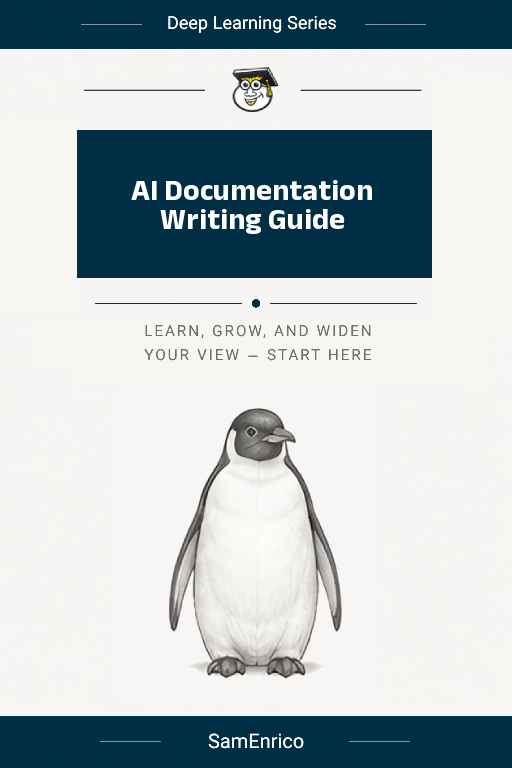
AI Documentation Writing Guide eBook
Use AI to write docstrings READMEs and technical d
Use AI to write docstrings READMEs and technical documentation efficiently.
Formats
Free sample
Chapter 1: The Rot Beneath...--The documentation sprint was supposed to be the great salvation. Your team just spent two weeks locked in a conference room, emerging with 300 pages of pristine Markdown files, beautifully formatted API references, and a README that could make a poet weep. The launch happens on a Tuesday. Everyone high-fives. The documentation debt clock reads zero.By Thursday, the code has changed three times.
A critical function was renamed. Two endpoints were deprecated. The configuration file now expects YAML instead of JSON. But the documentation still sings its beautiful, wrong song. No one noticed because no one reads documentation they know is stale.
By Friday, a new developer spends four hours trying to figure out why the --port flag doesn't work anymore. The answer is buried in a Slack thread from Wednesday afternoon that 47 people saw and zero people remembered.This is not a failure of effort. This is a failure of model. The "documentation sprint" was designed for a world where software shipped on CD-ROMs and version 2.0 came out eighteen months later. That world is dead.
In 2025–2026, your continuous integration and continuous deployment pipeline pushes code multiple times per day. Your documentation cannot be a snapshot. It must be a living artifact that breathes, changes, and rots if you ignore it.The problem is not that developers are lazy. The problem is that documentation has been treated as a separate phase—something you do after the code is "done." But in agile environments, code is never done. It is only ever temporarily acceptable.
Every commit creates a gap between what the code actually does and what the documentation says it does. That gap has a name. It is called Documentation Debt, and it is the single most expensive hidden cost in modern software engineering.The Anatomy of Documentation Debt Documentation Debt is the difference between reality and record. When a function's parameter list changes but the docstring still shows the old signature, that is debt. When a README promises a docker-compose up workflow but the project now requires Kubernetes, that is debt.
When a Slack thread contains the only copy of a critical architectural decision, that is debt waiting to metastasize.In 2010, documentation debt accumulated slowly. You could afford a quarterly documentation sprint. In 2025, with trunk-based development, feature flags, and continuous deployment, debt accumulates in hours. Every engineer has felt this: the sinking realization that you are reading documentation written for a codebase that no longer exists. You spend fifteen minutes debugging a problem that the documentation itself created.Here is the cruel math that no one talks about.
For every hour an engineer spends writing documentation, the team spends three hours reading and correcting outdated documentation. The ratio is inverted. We optimize for the wrong thing. We celebrate the 300-page documentation dump without ever measuring how much of it is already wrong.Documentation Debt has three distinct types, and understanding these types is the first step toward fixing them.Type 1: Syntactic Debt. This is the easiest to spot and the easiest to fix.
The docstring says the function returns a string, but the code returns an integer. The README says to install via pip, but the project now uses poetry. AI can catch and fix syntactic debt with near-perfect accuracy because it requires only surface-level comparison between the code and the documentation. We will automate this entirely in Chapter 10.Type 2: Structural Debt. This is more insidious.
The documentation describes an architecture that no longer reflects reality. The sequence diagram shows three services, but there are now seven. The "Getting Started" guide assumes a local database, but production uses a cloud replica. Structural debt emerges when the system evolves but the mental model in the documentation does not. AI can help here, but it requires understanding relationships between files—something RAG (Retrieval-Augmented Generation, defined in Chapter 2) enables.Type 3: Intentional Debt.
This is the most expensive and the most invisible. The documentation says what the code does but never says why a decision was made. Why did the team choose Redis over Memcached? Why is the rate limit set to 100 requests per minute? Why does this function have a seemingly unnecessary sleep call?
The answer lives in a Jira ticket that was closed six months ago, a Slack thread that scrolls forever, or the memory of an engineer who just left the company. Intentional debt cannot be recovered by scanning code. It must be retrieved from human conversations and deliberately documented. We will dedicate all of Chapter 7 to solving this problem.The 80/20 Rule for AI-Assisted Documentation The single most important principle in this book is the 80/20 Rule for AI Documentation. It is simple, powerful, and counterintuitive to anyone who thinks AI will replace technical writers.AI reliably generates 80 percent of documentation with no human help.
Parameter descriptions, installation steps, syntax examples, basic usage patterns—these are mechanical tasks. They require pattern recognition, not judgment. A well-prompted LLM can look at a function signature and write a docstring that is correct 99 percent of the time. It can scan a Dockerfile and a requirements.txt and produce installation instructions that work.Humans must provide the remaining 20 percent. The AI cannot infer trade-offs.
It cannot recover historical rationale. It cannot know that you chose Web Sockets over Server-Sent Events because your compliance team required bi-directional authentication. It cannot know that the max_retries parameter is set to 3 because anything higher causes a cascading failure in a downstream service. These are the intentional elements of documentation, and they are the only parts that survive the test of time.Here is the paradox that will save your career. The 80 percent that AI generates is the part that changes most frequently.
Every commit potentially changes function signatures, environment variables, and API endpoints. The 20 percent that humans write is the part that rarely changes. The "why" of an architecture decision is stable for months or years. The "what" changes daily.This inversion means that AI is not a replacement for human writers. It is a replacement for mechanical writing, freeing humans to focus on the intentional writing that actually matters.
The engineer of 2026 does not spend hours typing docstrings. The engineer spends hours reviewing AI-generated drafts, adding context, and documenting the decisions that the AI cannot see.The Burden Shift is the single most important professional transition in technical writing today.Old model: Engineer writes 100 percent of documentation. Engineer spends 80 percent of their time on mechanical writing (syntax, formatting, examples) and 20 percent on intentional writing (rationale, trade-offs, edge cases). Documentation is written once and decays immediately.New model: AI writes 80 percent of documentation. Engineer spends 10 percent of their time verifying the AI's mechanical output and 10 percent writing the intentional layer.
The remaining 80 percent of the engineer's former documentation time is now available for actual engineering. Documentation is generated continuously and decays only when the intentional layer is wrong.This is not magic. It is leverage. But leverage requires new skills. You must learn how to write system prompts that produce reliable mechanical output.
You must learn how to build orchestrators that trigger documentation generation automatically. And you must learn how to recognize the 20 percent that only you can write.The Fuzzy Boundary Problem Before…
This is the end of the free sample. Get the eBook to keep going. Buy now
About this book
Details
- Author
- Couture Evonne
- Publisher
- SamEnrico
- Language
- English
- Genre
- Non-Fiction, AI Operator
- Released
- 2026-05-29
- Pages (approx.)
- 146
- Available as
- eBook, Audiobook

Read better in the ZLOADR app
Your eBooks on your phone or tablet. Sign in with your SamEnrico account and start reading.
More by Couture Evonne
 Parent Imposter Syndrome GuideCouture Evonne$11.99
 The Vatican Counter SiegeCouture Evonne$11.99
 Odebrecht Braskem Enforcement LogCouture Evonne$11.99
 Contract Abstraction Ethics GuideCouture Evonne$11.99
 Diarrhea Success StoriesCouture Evonne$11.99
 Indigenous Spiritual Ecology GuideCouture Evonne$11.99
 Carpool Management GuideCouture Evonne$11.99
 Self Talk For Political GriefCouture Evonne$11.99
 Drunk Person ListeningCouture Evonne$11.99
 The Vanishing Billion: The Untold Story of the Missing Malaysian Flight 370Couture Evonne$11.99
 The Serpent's Crown: The Fall of Queen Tiye and the Amarna ConspiracyCouture Evonne$11.99
 The Last Broadcast: The Night the World Watched Apollo 11 LandCouture Evonne$11.99
You may also like
 AI Presentation WorkbookSommers Tonda$11.99
 PowerPoint Copilot MasteryConway Lanita$11.99
 Branded AI DecksWindham Loni$11.99
 AI Presentation CourseGrooms Olin$11.99
 AI Presentation CertificationBlank Dolly$11.99
 AI Deck Version ControlMedley Lorina$11.99
 AI Deck Update AutomationFraser Tresa$11.99
 AI Deck Myths DebunkedCrittenden Romelia$11.99
 AI Deck Customization GuideDove Hannelore$11.99
 AI Bullet to Slide ConverterKohn Eloisa$11.99
 AI Deck Notes CreatorBarela Sunday$11.99
 AI Deck Outline GeneratorAshmore Morgan$11.99