
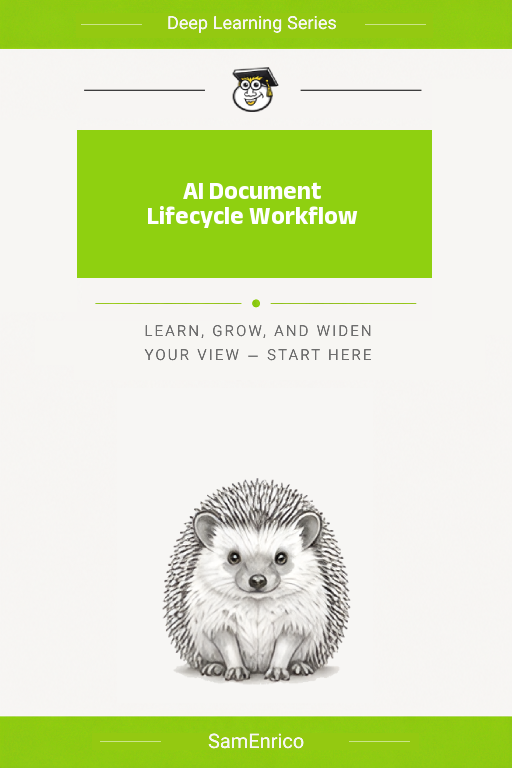
Non-FictionAI OperatorLifecycle Management
AI Document Lifecycle Workflow eBook
Create a closed-loop system from ingestion to disp
by Taggart Shon
Create a closed-loop system from ingestion to disposal. Covers version tracking, legal hold triggers, and collaborative human review for exception handling.
Formats
Free sample
Chapter 1: The Ingestion Gauntlet--–- The email arrived at 11:47 PM on a Friday. Maria Chen, general counsel of a mid-sized pharmaceutical company, was about to close her laptop when the notification popped up: "Legal hold notice received from opposing counsel re: patent infringement case." Her heart sank. Not because of the lawsuit—that was expected—but because she knew what happened next. For the next 72 hours, she and her team would manually search through 14 different systems: email archives, Share Point sites, Slack channels, Teams messages, personal network drives, and three legacy document repositories acquired over the last decade. They would find most of the relevant documents.
They would miss some. And they would almost certainly fail to preserve version histories, metadata, and the subtle but critical context of who approved what and when.–- Six months later, during discovery, the opposing side produced an email chain that Maria's team had deleted during the gap between the lawsuit filing and the manual hold being issued. The email contained a prior art reference that invalidated Maria's key patent claim. The judge issued spoliation sanctions: $2.3 million in fines and an adverse inference instruction that essentially handed the case to the other side. The company lost the patent, the lawsuit, and market share.
All because of a broken ingestion and hold process.–- This is not an edge case. It is the daily reality of organizations that treat document ingestion as an afterthought—a simple "save file" operation that happens at the start of a document's life and never matters again until disaster strikes. But ingestion is not storage preparation. It is the single most important decision point in the entire document lifecycle. Every subsequent action—every hold, every review, every disposal, every audit—depends on what happens in the first milliseconds after a document enters your system.The Cost of Getting Ingestion Wrong–- Before we dive into the mechanics of intelligent ingestion, let us quantify what is at stake.
A 2023 study by the Compliance, Governance, and Oversight Council found that 73% of organizations had been sanctioned or penalized in the previous five years due to document lifecycle failures. Of those, 68% traced the root cause to problems at ingestion: misclassified documents, missing metadata, undetected duplicates, or documents that never entered the workflow at all.–- The costs manifest in four specific ways.–- First, spoliation sanctions. When a legal hold is triggered, the system must know immediately which documents are potentially relevant. If your ingestion process did not classify documents by type, custodian, or subject matter, you cannot freeze the right documents quickly enough. Every hour of delay increases the probability that a relevant document will be deleted by routine retention policies or overwritten by careless users.
The average spoliation sanction in federal court is now $1.1 million, with egregious cases reaching into the tens of millions.–- Second, compliance fines. GDPR non-compliance fines average €15 million or 4% of global revenue, whichever is higher. HIPAA violations range from 100to100 to 100to50,000 per record. SEC Rule 17a-4 requires broker-dealers to preserve records for seven years in a non-rewritable, non-erasable format. Every one of these regulations depends on accurate classification and tracking from the moment of ingestion.
If you cannot prove when a document was created, who controlled it, and what retention schedule applies, you cannot defend against a regulatory fine.–- Third, litigation costs. Manual discovery costs average 18,000pergigabyteofdata.Foratypicalmid−sizedenterprisewithtwoterabytesofdocumentstorage,thatis18,000 per gigabyte of data. For a typical mid-sized enterprise with two terabytes of document storage, that is 18,000pergigabyteofdata.Foratypicalmid−sizedenterprisewithtwoterabytesofdocumentstorage,thatis36 million in potential discovery costs. The primary driver of these costs is over-retention: organizations keep everything because they are afraid to delete anything. But the root cause of over-retention is not fear—it is lack of confidence in the ingestion and classification process.
If you do not trust that your system correctly identified the retention schedule at ingestion, you cannot defensibly dispose of anything.–- Fourth, operational inefficiency. Knowledge workers waste an average of 2.5 hours per day searching for documents or recreating work that was lost in version confusion. The primary culprit is not search technology—it is that documents were never properly identified, tagged, or versioned at the point of entry. Your employees are not lazy. They are fighting a broken ingestion system.–- The good news is that these costs are avoidable.
Intelligent ingestion transforms the moment of entry from a passive save operation into an active decision engine. This chapter shows you exactly how to build it.The Three Pillars of Intelligent Ingestion–- Intelligent ingestion rests on three interconnected capabilities: multi-channel capture, AI-powered classification, and confidence-aware routing. Each pillar solves a specific failure mode of traditional document management systems. Together, they form the foundation of the closed-loop lifecycle.Pillar One: Multi-Channel Capture–- Documents do not arrive through a single door. They pour in through a dozen channels simultaneously: email attachments from external partners, PDFs from scanners, spreadsheets saved to Share Point, Power Point decks dropped into Teams channels, contracts uploaded to Box, HR records entered into Workday, Slack file shares, Whats App business messages, and the eternal trickle of documents saved to local desktop folders.–- Most organizations handle these channels with a patchwork of connectors, custom scripts, and manual uploads.
The result is predictable: documents fall through the cracks, metadata is inconsistent across channels, and version conflicts proliferate.–- Intelligent ingestion requires a unified connector architecture. Every channel must be instrumented with a lightweight agent that does three things: intercept the document at the moment of creation or receipt, extract its native metadata (creation date, author, source path, file hash), and forward it to a centralized ingestion queue. This is not a batch process that runs overnight. It is a real-time stream that processes documents within seconds of their creation.–- The technical implementation varies by channel, but the pattern is consistent. For email, you deploy a transport rule that copies every message with attachments to a monitoring mailbox.
For cloud drives, you use native webhooks (Share Point alerts, Box webhooks, Dropbox webhooks) that fire on create events. For local drives, you deploy a lightweight agent that monitors specified folders. For collaboration tools like Slack and Teams, you use their API endpoints to capture file uploads.–- The critical requirement is that the capture process must be non-disruptive. Users should never know it is happening. If your ingestion process requires users to change their behavior—to save files to a special folder or tag them manually—they will find workarounds.
The system must adapt to how users actually work, not the other way around.Pillar Two: AI-Powered Classification–- Once a document enters the ingestion queue, it must be classified before it is stored. Classification answers three questions: what type of document is this, what confidentiality level does it have, and what regulatory category applies?–- Document type classification identifies whether the document is a contract, invoice, HR record, email thread, technical specification, marketing collateral, source code, or one of dozens of other categories. This is not a simple taxonomy. Many documents span multiple categories. A single email might contain a contract negotiation, an HR complaint, and a technical discussion.
The classifier must handle multi-label assignment.–- Confidentiality classification assigns a sensitivity level: public, internal, confidential, restricted, or attorney-client privileged. This…
This is the end of the free sample. Get the eBook to keep going. Buy now
About this book
Details
- Author
- Taggart Shon
- Publisher
- SamEnrico
- Language
- English
- Genre
- Non-Fiction, AI Operator, Lifecycle Management
- Released
- 2026-06-01
- Pages (approx.)
- 160
- Available as
- eBook, Audiobook

Read better in the ZLOADR app
Your eBooks on your phone or tablet. Sign in with your SamEnrico account and start reading.
More by Taggart Shon
 Boundaries For Work AddictsTaggart Shon$11.99
 Failure Fear in NonprofitsTaggart Shon$11.99
 Miranda Lambert Gunpowder GuideTaggart Shon$11.99
 McClintock National Medal Of Science HandbookTaggart Shon$11.99
 Executive Function Decline PreventionTaggart Shon$11.99
 Soulful Shadows: The Untold Story of Motown’s Secret Studio SessionsTaggart Shon$11.99
 Anansi the Web-Weaver: Trickster of the Norse and AshantiTaggart Shon$11.99
 Yard JockeyTaggart Shon$11.99
 How to Become a JudgeTaggart Shon$11.99
 AI Data Enrichment GuideTaggart Shon$12.99
 Understanding Freire–maia–pinheiro–opitz SyndromeTaggart Shon$17.99
You may also like
 Hong Kong Handover 1997Dunn Johnnie$11.99
 Zumba For Postnatal Recovery CourseNeal Christian$11.99
 Zumba for BeginnersLadner Nikia$11.99
 YouTube Comment Mining GuideHumes Pandora$12.99
 Worry Box MeditationCarlin Rudy$11.99
 Workplace Stress MeditationNguyen Lynn$11.99
 Workplace Stress and Sleep RepairHawley Ivory$11.99
 Workplace Perfectionism CureDelaney Jeffry$11.99
 Workplace Injustice Anger GuideWallen Isabelle$11.99
 Work Addiction and Burnout LinkGreenwood Ester$11.99
 Women in Yoga and WellnessBeattie Galina$11.99
 Women in Stand Up ComedyChun Evangeline$11.99