
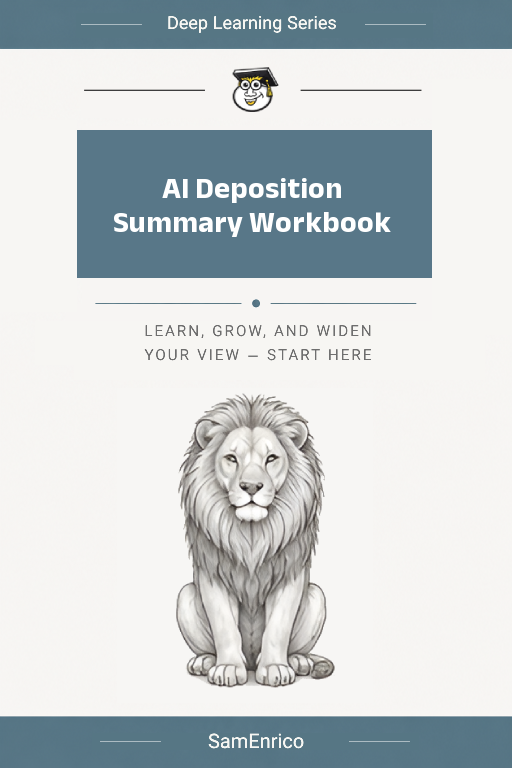
Non-FictionAI OperatorLitigation Support
AI Deposition Summary Workbook
Convert lengthy transcripts into chronologies, key
Convert lengthy transcripts into chronologies, key admission extracts, and exhibit lists using targeted prompts that preserve testimonial accuracy.
Formats
About this book
Free sample
Chapter 1: Beyond Yellow Highlighters--The yellow highlighter is a lie.It promises clarity. You glide its fluorescent tip across a page, and suddenly—magically—the important words glow. They separate themselves from the mundane. They announce: this matters. But here is what the yellow highlighter does not tell you.
After two hundred pages, everything glows. After four hundred pages, you cannot remember why you highlighted page 87. After six hundred pages, the yellow has lost all meaning. You are not analyzing testimony. You are painting.And the deposition keeps coming.Here is the problem that every litigator, paralegal, and legal assistant knows but rarely says aloud: the traditional method of reading and highlighting deposition transcripts does not scale to modern litigation.
It did not scale ten years ago, and it certainly does not scale now. In 2025, the average civil case generates over 4,200 pages of deposition transcript. A single expert witness can produce 800 pages. A corporate designee under Rule 30(b)(6) can produce 1,500 pages. Multiply that across five, ten, or twenty witnesses, and you are no longer a legal professional.
You are a page-processing machine whose only output is hand cramps and regret.This chapter is not a pep talk. It is an intervention. You will learn why your current workflow is failing, how AI changes the fundamental economics of deposition summarization, and why the shift from manual reading to AI-assisted analysis is not optional—it is a competence obligation under the ethical rules. By the end of this chapter, you will have a clear diagnostic of your current time-to-insight ratio and a roadmap for the eleven chapters that follow.The Seven Deadly Sins of Manual Summarization Let us name the enemy. Manual deposition summarization—the kind taught in law schools and practiced in firms across the country—suffers from seven structural flaws.
These are not matters of personal skill. They are matters of cognitive biology and workflow design. You cannot willpower your way out of them.Sin One: Cognitive Saturation. The human brain is not designed for sustained, high-density text analysis. After approximately ninety minutes of continuous transcript review, your error rate for contradiction…
This is the end of the free sample. Get the eBook to keep going. Buy now
Contents
- Chapter 1
- Chapter 2
- Chapter 3
- Chapter 4
- Chapter 5
- Chapter 6
- Chapter 7
- Chapter 8
- Chapter 9
- Chapter 10
- Chapter 11
- Chapter 12
Details
- Author
- Williford Tilda
- Publisher
- SamEnrico
- Language
- English
- Genre
- Non-Fiction, AI Operator, Litigation Support
- Released
- 2026-05-30
- Pages (approx.)
- 127
- Available as
- eBook, Audiobook

Read better in the ZLOADR app
Your eBooks on your phone or tablet. Sign in with your SamEnrico account and start reading.
More by Williford Tilda
 Imposter Syndrome for Social WorkersWilliford Tilda$11.99Imposter Syndrome for Social WorkersWilliford Tilda$11.99
 The Gacy Victim MemorialWilliford Tilda$11.99
 Occupational Therapy Poverty AdaptationWilliford Tilda$11.99
 Belgian Diamond Heist AftermathWilliford Tilda$11.99
 Pattern Recognition in EngineeringWilliford Tilda$11.99
 Nicotine Patch To FreedomWilliford Tilda$11.99
 Chronotype and Study TimingWilliford Tilda$11.99
 Mobutu Sese SekoWilliford Tilda$11.99
 RLS Trigger Avoidance GuideWilliford Tilda$11.99RLS Trigger Avoidance GuideWilliford Tilda$11.99
 The Secret Affair of the Royal Society: Love, Rivalry, and the Birth of Modern ScienceWilliford Tilda$11.99
You may also like
 Hong Kong Handover 1997Dunn Johnnie$11.99
 Zumba For Postnatal Recovery CourseNeal Christian$11.99
 Zumba for BeginnersLadner Nikia$11.99
 YouTube Comment Mining GuideHumes Pandora$12.99
 Worry Box MeditationCarlin Rudy$11.99
 Workplace Stress MeditationNguyen Lynn$11.99
 Workplace Stress and Sleep RepairHawley Ivory$11.99
 Workplace Perfectionism CureDelaney Jeffry$11.99
 Workplace Injustice Anger GuideWallen Isabelle$11.99
 Work Addiction and Burnout LinkGreenwood Ester$11.99
 Women in Yoga and WellnessBeattie Galina$11.99
 Women in Stand Up ComedyChun Evangeline$11.99