
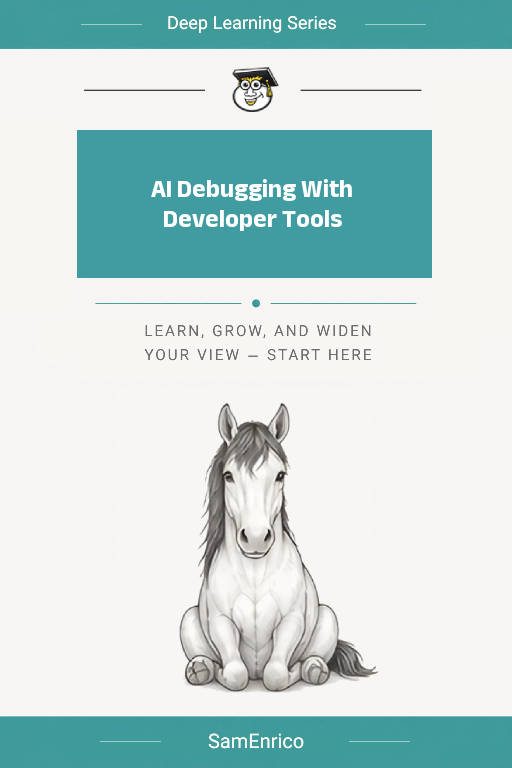
AI Debugging With Developer Tools eBook
Use AI to find and fix bugs faster than traditiona
by Geary Jeanie
Use AI to find and fix bugs faster than traditional debugging methods.
Formats
Free sample
Chapter 1: The Forensic Pivot--–- On a Tuesday morning at 2:47 AM, a senior Site Reliability Engineer named Maya stared at a dashboard that had turned the color of arterial blood. Forty-seven thousand customers in three regions could not log in. The error logs showed a Kafka Consumer Timeout Exception, but the real problem, she knew, was not in the logs. The real problem was that she had already spent ninety minutes stepping through code, adding print statements, and restarting services. The real problem was that she was still looking for a needle in a stack of haystacks while the haystacks themselves were on fire.Maya had learned to debug in the era of breakpoints. She was proud of her gdb proficiency. She could read a core dump like a neurologist reads an EEG. But on that Tuesday morning, none of those skills helped. The system was distributed across three cloud providers, fourteen microservices, and two versions of a Kafka client library that should have been identical but were not. She could not set a breakpoint on a production node without causing a cascading timeout. She could not reproduce the failure in staging because the staging environment did not have the same random traffic patterns. She was, in the most technical sense, flying blind.What Maya needed was not a better debugger. What Maya needed was a forensic partner—something that could read forty thousand lines of logs, correlate them with the last six commits, and return not a stack trace but a hypothesis. She needed, in other words, to pivot from manual debugging to AI-augmented forensics.This chapter is about that pivot. It is not about the death of traditional debugging, because traditional debugging is not dead. Gdb, Win Dbg, pdb, and all the other tools that have served engineers for decades are still valuable—not as the primary engine of debugging but as sensors. They are the microscopes. The AI is the pathologist who interprets what the microscope reveals. The shift is not from tools to AI. The shift is from reactive, manual, single-threaded reasoning to proactive, AI-assisted, parallel forensic analysis.We will begin by examining why traditional debugging methods—the methods that have been taught in computer science courses for thirty years—are failing in modern systems. Then we will introduce the concept of debugging latency, a metric that most engineers do not measure but should. After that, we will define the 80/20 rule of AI-assisted debugging, which is the single most important productivity heuristic you will learn in this book. Finally, we will walk through a concrete example of the same bug being debugged twice: once manually, once with AI. The difference will change how you think about your job.The Collapse of the Breakpoint Era Let us be precise about what we mean by "traditional debugging." Traditional debugging is any method that requires a human to manually trace execution state through a program, either by setting breakpoints and inspecting variables, by adding print statements and reading output, or by binary-search commenting to isolate a failing block of code. These methods share a common assumption: that the engineer can, with enough time and patience, reconstruct the program's behavior by simulating it in their own mind or by observing it in a controlled environment.That assumption held for forty years. It worked when programs ran on a single machine, when they were deterministic, when you could pause the world without consequence. It worked when a bug meant one function, one thread, one stack frame. It worked when the production environment was identical to the development environment because both were the same physical server.The modern world has shattered every pillar of that assumption.Consider distributed systems. When a request travels through twelve microservices, each with its own logs, its own clock skew, and its own failure modes, setting a breakpoint in one service is like trying to fix a traffic jam by looking at a single car. The bug is not in any one service. The bug is in the interaction between services—the timing, the retry logic, the idempotency keys that were not actually idempotent. You cannot set a breakpoint on an interaction.Consider serverless computing. Functions run for milliseconds, then disappear. There is no "attach debugger" button for a Lambda invocation that has already terminated. The only artifacts are logs and metrics. You cannot step through code that no longer exists.Consider edge computing. When a bug manifests only on a user's device in rural India on a low-end Android phone running a specific carrier's network configuration, you cannot reproduce that environment. You cannot even simulate it with high confidence. You can only observe its symptoms.And consider the sheer scale of modern logs. A single production error might generate five hundred lines of stack trace, environment variables, nested exceptions, and context. A human can scan those five hundred lines in about ten minutes and extract the three relevant lines. An LLM can do it in two seconds and return an explanation in plain English. This is not a marginal improvement. This is a change in kind, not degree.The breakpoint era is not dead. But it is no longer sufficient. The engineers who thrive in the next decade will not be those who can step through code fastest. They will be those who can formulate the right question for an AI to answer.Debugging Latency: The Hidden Tax Every engineering organization tracks deployment frequency, mean time to recovery, and change failure rate. Very few track debugging latency, even though debugging latency is the single largest component of mean time to recovery for non-catastrophic bugs. Let us define it precisely.Debugging latency is the time from the moment a bug is first observed in production to the moment the root cause is identified with high confidence. Note that this is not the same as time to fix. The fix might take thirty seconds—a one-line change. The debugging might take six hours. Debugging latency is the hidden tax on every incident.Here is what debugging latency looks like in practice. A bug is introduced on a Monday, when a developer refactors a utility function without realizing that three other services depend on its exact exception handling behavior. The bug sits dormant for two weeks because the conditions required to trigger it are rare: a specific sequence of network retries during a deployment window. On a Thursday at 3:00 PM, the bug manifests. The on-call engineer spends ninety minutes reproducing it locally, because reproduction is the first step in traditional debugging. They then spend two hours setting breakpoints and stepping through code. They spend another hour searching the codebase for all callers of the refactored function. They finally identify the root cause at 7:30 PM. Debugging latency: four hours and thirty minutes.Now consider the same bug in an AI-augmented workflow. The on-call engineer feeds the error message, the stack trace, and the last five commits to an LLM. The LLM returns, in forty-five seconds, a hypothesis: "The function normalize_user_id was changed on Monday to return None for invalid inputs instead of raising Invalid User Error. The calling service auth-service does not handle None. The attached stack trace shows auth-service line 117 attempting to call .lower() on None." The engineer verifies the hypothesis in five minutes. Debugging latency…
This is the end of the free sample. Get the eBook to keep going. Buy now
About this book
Details
- Author
- Geary Jeanie
- Publisher
- SamEnrico
- Language
- English
- Genre
- Non-Fiction, AI Operator
- Released
- 2026-05-29
- Pages (approx.)
- 131
- Available as
- eBook, Audiobook

Read better in the ZLOADR app
Your eBooks on your phone or tablet. Sign in with your SamEnrico account and start reading.
More by Geary Jeanie
 Indigenous Spiritual Counseling GuideGeary Jeanie$11.99
 Constipation HandbookGeary Jeanie$11.99
 The FCPA Penalty DatabaseGeary Jeanie$11.99
 Lawyer Imposter Syndrome GuideGeary Jeanie$11.99
 The Protestant Martyr AccountsGeary Jeanie$11.99
 Contract Abstraction for Law FirmsGeary Jeanie$11.99
 Screen Time ManagementGeary Jeanie$11.99
 On Call Work Stress ManagementGeary Jeanie$11.99
 Active Listening in GriefGeary Jeanie$11.99
 Voltaire's Torch: Enlightening the WorldGeary Jeanie$11.99
 The Silent Pioneers: Australia's Unsung Heroes of SpacewalkingGeary Jeanie$11.99
 The Van Gogh Heist: A Brush with DestinyGeary Jeanie$11.99
You may also like
 AI Presentation WorkbookSommers Tonda$11.99
 PowerPoint Copilot MasteryConway Lanita$11.99
 Branded AI DecksWindham Loni$11.99
 AI Presentation CourseGrooms Olin$11.99
 AI Presentation CertificationBlank Dolly$11.99
 AI Deck Version ControlMedley Lorina$11.99
 AI Deck Update AutomationFraser Tresa$11.99
 AI Deck Myths DebunkedCrittenden Romelia$11.99
 AI Deck Customization GuideDove Hannelore$11.99
 AI Bullet to Slide ConverterKohn Eloisa$11.99
 AI Deck Notes CreatorBarela Sunday$11.99
 AI Deck Outline GeneratorAshmore Morgan$11.99