
Non-FictionBusiness BriefGovernance AI
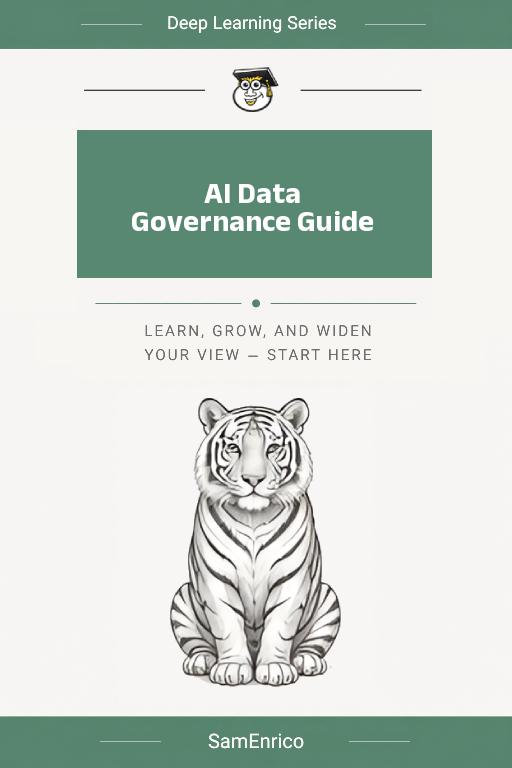
AI Data Governance Guide eBook
Implement data quality rules and access controls f
Implement data quality rules and access controls for AI-powered finance analytics.
Formats
Free sample
Chapter 1: The Million-Dollar Typo--It was 10:47 on a Tuesday morning when a mid-level data analyst named Priya pressed Enter. She had been working late the night before, cleaning a massive file of reference data that fed her bank’s automated trading system. One field had been misaligned—a decimal point in the wrong column. She fixed it, or so she thought. In reality, she had shifted the decimal point for a single ticker symbol by two places.
A stock that should have been priced at 104.57wasnowrecordedas104.57 was now recorded as 104.57wasnowrecordedas10,457.00 in the training dataset. The AI model that consumed this data did not question it. AI models do not question anything. They simply learn. And what this model learned was that a particular financial instrument was suddenly worth one hundred times its actual value.Within ninety minutes, the automated trading system had executed $462 million in erroneous trades.
By the time the bank’s risk team identified the source of the anomaly—Priya’s misplaced decimal—the losses were irreversible. The bank’s stock price fell 7 percent. Priya was terminated. The head of data governance resigned. And a class-action lawsuit from shareholders is still working its way through the courts six months later.This is not a cautionary tale.
It is a forensic accounting of what happens when data governance is treated as an afterthought rather than a strategic imperative. And it is far from unique.The Silent Sabotage of Automated Finance The financial services industry has spent the past decade racing to automate everything: trading, lending, fraud detection, risk management, customer service. The promise of artificial intelligence was never just about efficiency. It was about superiority. The bank with the smartest AI would win.
The lender with the fastest credit decision would capture market share. The trader with the most predictive model would generate alpha while everyone else chased beta.But there is a dirty secret that no vendor keynote speech will ever mention. AI models are not intelligent. They are statistical engines that find patterns in the data they are given. If the data is wrong, the patterns are wrong.
If the data is incomplete, the patterns are incomplete. If the data is biased, the patterns are biased. The AI does not know this. It cannot complain. It cannot raise its hand and say, “Excuse me, but this training example seems suspect.” It simply learns.
And then it acts.The financial services industry has lost an estimated $3.1 trillion over the past decade to poor data quality, according to a 2023 study by the Data Governance Institute. That is not a typo. Three point one trillion dollars. To put that number in perspective, it is roughly equivalent to the entire GDP of the United Kingdom. It is more than the market capitalization of JPMorgan Chase, Bank of America, and Wells Fargo combined.
And the vast majority of those losses are invisible because they are not recorded as “data quality loss” on any income statement. They appear as trading losses, loan defaults, regulatory fines, customer churn, and missed opportunities.The Anatomy of a Data Disaster Let us dissect what actually happened in Priya’s bank, because understanding the mechanics of failure is the first step toward building a system that prevents it.The bank in question operated a high-frequency trading desk that used a machine learning model to identify arbitrage opportunities across three different exchanges. The model was sophisticated. It had been trained on five years of historical trade data, incorporating price movements, volume patterns, and market microstructure features. The model had been validated, back-tested, and approved by the bank’s model risk management committee.
It had passed every regulatory review. It had generated consistent profits for eighteen months.The data that fed this model came from a pipeline that extracted reference data from a vendor feed, transformed it through a series of ETL jobs, and loaded it into a feature store that served the model in real time. The reference data included security identifiers, price multipliers, and corporate action adjustments. One field in this dataset was the “price denominator”—a multiplier that converted the vendor’s raw price into the actual trading price. For most securities, this denominator was 1.
For the security in question, it should have been 100. A legacy mapping table had the denominator incorrectly set to 10,000.Priya was not a data engineer. She was a business analyst assigned to clean up the mapping table as a side project. She had no formal training in data governance. She had no peer review requirement for her changes.
She had no automated validation that checked whether her modifications violated any business rules. She had a spreadsheet and a deadline.When she changed the denominator from 10,000 to 100, she was technically correcting an error. But the spreadsheet column alignment was off. She changed the wrong field. The denominator for a completely different security went from 1 to 100.
And because that security traded in high volume, the model’s feature store was updated within minutes. The model saw a price that was one hundred times higher than reality. It identified an arbitrage opportunity that did not exist. And it traded accordingly.The root cause analysis conducted after the incident identified seven separate control failures:No data quality rules were defined for the reference data pipeline.No validation checks existed to ensure price multipliers fell within reasonable ranges.No peer review requirement for changes to reference data.No automated lineage tracking to identify which models were affected by which data sources.No staging environment where changes could be tested before production deployment.No real-time monitoring of model inputs for anomalous values.No rollback procedure for quickly reverting erroneous data changes.The bank had invested 50millioninits AItradingplatform.Ithadinvestedapproximatelyzerodollarsindatagovernanceforthatplatform.Theresultwasa50 million in its AI trading platform. It had invested approximately zero dollars in data governance for that platform.
The result was a 50millioninits AItradingplatform.Ithadinvestedapproximatelyzerodollarsindatagovernanceforthatplatform.Theresultwasa462 million loss that could have been prevented by a single validation rule: “If price multiplier is not between 0.5 and 2.0, reject update.”Why Small Errors Become Catastrophic in AI Systems There is a fundamental property of artificial intelligence that every financial professional must internalize: AI models are amplifiers. They take the patterns in their training data and magnify them. This is their power. It is also their peril.In a traditional software system, an error typically affects a single transaction or a single calculation. A human reviews the output, notices the error, and corrects it.
The error is contained. In an AI system, an error in the training data becomes part of the model’s understanding of the world. It affects every subsequent prediction. The error is not contained. It is propagated.Consider the difference between a human loan officer and an AI credit scoring model.
A human loan officer who reviews one thousand applications might make ten errors. Those ten errors affect ten borrowers. An AI credit scoring model that learns from a biased dataset—perhaps historical lending decisions that discriminated against a particular zip code—will systematically undervalue or overvalue every applicant from that zip code. Thousands of borrowers are affected. The error is not ten mistakes.
It is a systemic bias embedded in every decision.This amplification effect is why the financial services industry is uniquely vulnerable…
This is the end of the free sample. Get the eBook to keep going. Buy now
About this book
Details
- Author
- Aranda Marvis
- Publisher
- SamEnrico
- Language
- English
- Genre
- Non-Fiction, Business Brief, Governance AI
- Released
- 2026-05-30
- Pages (approx.)
- 144
- Available as
- eBook, Audiobook

Read better in the ZLOADR app
Your eBooks on your phone or tablet. Sign in with your SamEnrico account and start reading.
More by Aranda Marvis
 Failure Fear in FreelancingAranda Marvis$11.99
 Music Performance Anxiety WorkbookAranda Marvis$11.99
 Dixie Chicks Wide Open SpacesAranda Marvis$11.99
 Work Addiction Assessment WorkbookAranda Marvis$11.99
 Mental Rotation Cognitive TrainingAranda Marvis$11.99
 The Trollwife’s Curse: A Nordic Tale of Revenge and RedemptionAranda Marvis$11.99
 The Fire Makers: How Prehistoric Chemists Unlocked the Secrets of LifeAranda Marvis$11.99
 Understanding Freiberg's DiseaseAranda Marvis$17.99
 How to Become a Name-plate StamperAranda Marvis$11.99
 Prompt Engineering for Records ManagersAranda Marvis$12.99
 X Twitter Growth and EngagementAranda Marvis$11.99
You may also like
 Hong Kong Handover 1997Dunn Johnnie$11.99
 Zumba For Postnatal Recovery CourseNeal Christian$11.99
 Zumba for BeginnersLadner Nikia$11.99
 YouTube Comment Mining GuideHumes Pandora$12.99
 Worry Box MeditationCarlin Rudy$11.99
 Workplace Stress MeditationNguyen Lynn$11.99
 Workplace Stress and Sleep RepairHawley Ivory$11.99
 Workplace Perfectionism CureDelaney Jeffry$11.99
 Workplace Injustice Anger GuideWallen Isabelle$11.99
 Work Addiction and Burnout LinkGreenwood Ester$11.99
 Women in Yoga and WellnessBeattie Galina$11.99
 Women in Stand Up ComedyChun Evangeline$11.99