
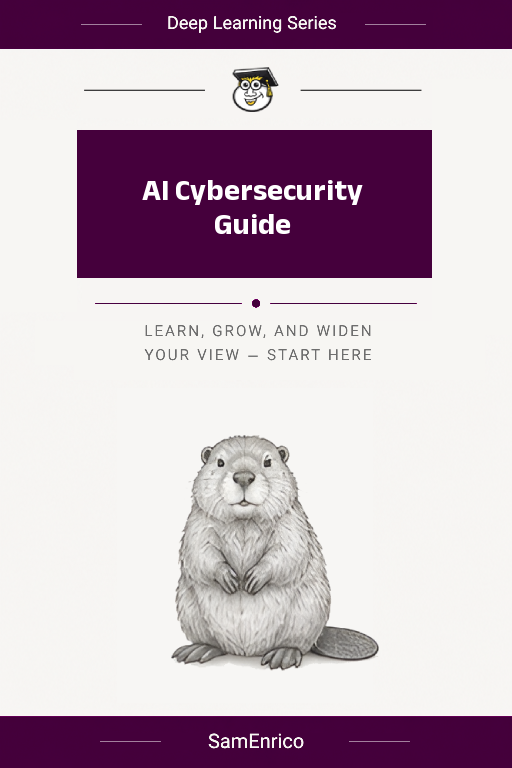
AI Cybersecurity Guide eBook
Use Darktrace, CrowdStrike, or SentinelOne to dete
by Gass Peter
Use Darktrace, CrowdStrike, or SentinelOne to detect threats for small business.
Formats
Free sample
Chapter 1: The Digital Blindfold--In the spring of 2023, a mid-sized accounting firm in Ohio with forty-seven employees and a smart coffee maker in the break room received an email that appeared to come from a longtime client. The email contained a single link labeled "Invoice_Q2_2023.pdf." One employee clicked it. Within ninety minutes, the firm's entire server cluster was encrypted. The attackers demanded 850,000in Bitcoin.Thefirmhadcyberinsurance,butthepolicyhada850,000 in Bitcoin. The firm had cyber insurance, but the policy had a 850,000in Bitcoin.Thefirmhadcyberinsurance,butthepolicyhada250,000 ransomware sublimit.
They paid the ransom. They restored from backups. They notified their clients. And eleven weeks later, they closed their doors for good.The coffee maker was not the cause of the breach. But the coffee maker—an internet-connected device that no one had thought to secure—was the beachhead the attackers used to move from the receptionist's computer to the accounting server.
The firm had antivirus software. It had a firewall. It had an IT consultant who came in once a month. What it did not have was any form of artificial intelligence watching its network for the subtle, unusual behaviors that signal an attack in progress.This book exists to ensure that your business does not become the next version of that story.The Myth That Keeps SMB Owners Awake at Night (For the Wrong Reasons)If you own or manage a small to medium-sized business, you have almost certainly told yourself some version of the following: "We're too small to be hacked. Why would anyone target us?
We don't have anything worth stealing."This is the most dangerous and expensive myth in modern business.The reality, confirmed by decades of breach data and incident response reports, is exactly the opposite. Small businesses are not too small to be hacked. They are the primary target. According to data from the National Cyber Security Alliance (2016, updated in subsequent Verizon Data Breach Investigations Reports), sixty percent of small businesses close within six months of a significant cyberattack. That number has been debated and refined over the years, but the underlying truth remains uncontested: a successful breach is often a terminal event for an SMB in a way that it is not for a Fortune 500 company.Consider the math.
A large enterprise might lose millions of dollars in a breach, but it has the capital reserves, legal team, public relations machinery, and cyber insurance limits to survive. A small business that loses $50,000 to ransomware might be looking at its entire annual profit margin evaporating. A law firm that has client data exfiltrated might face regulatory fines that exceed its operating budget. A medical practice hit with a HIPAA breach might lose its ability to accept insurance reimbursements.Large companies get breached and issue press releases. Small companies get breached and go out of business.Why Attackers Love Small Businesses To understand why SMBs are such attractive targets, you have to think like an attacker for a moment.
Cybercriminals are not masterminds in hoodies targeting the Pentagon. They are, for the most part, opportunistic entrepreneurs running a low-overhead, high-volume business. They use automated scanning tools that search the entire internet for vulnerabilities. These tools do not care if you are a multinational bank or a three-person dental practice. They only care if you have an open port, an unpatched server, or an employee who will click a link.The attacker's calculus is simple.
A large enterprise might have a security team of fifty people, a mature Security Operations Center, and a budget of millions. Breaching that target requires sophisticated, custom tools and a lot of luck. A small business might have no dedicated security staff, an IT budget that is a line item under "office supplies," and antivirus software that was installed five years ago and never updated. Breaching that target requires a phishing email and fifteen minutes of patience.From a pure return-on-effort perspective, small businesses are the ideal victims. They have just enough data to be valuable—client lists, banking credentials, employee Social Security numbers, intellectual property—and just few enough defenses to be vulnerable.The 2023 Verizon Data Breach Investigations Report found that seventy-four percent of all breaches involved the human element: phishing, credential theft, or simple error.
Small businesses are disproportionately vulnerable to these attacks because they lack the automated email filtering, behavioral analytics, and security awareness training that larger organizations take for granted.The Digital Transformation Gap Over the past decade, small businesses have undergone a remarkable digital transformation. The same accounting firm that used paper ledgers in 2005 now runs on Quick Books Online, Slack, Zoom, Microsoft 365, and a half-dozen other cloud applications. This transformation has been overwhelmingly positive for productivity and flexibility. But it has also created a problem that few SMB owners fully appreciate.The attack surface has expanded faster than the security budget.In the old world, your business had a clear perimeter. There was a physical office.
There were desktop computers connected to a local network. There was a firewall at the boundary. If you protected that firewall and kept your antivirus updated, you were reasonably secure. That world no longer exists.Today, your employees work from home, from coffee shops, from client sites, from airports. They access company data on personal laptops, on smartphones, on tablets.
They log into cloud applications from unsecured Wi-Fi networks. They share files through Dropbox and send sensitive information via Gmail. The traditional perimeter has evaporated, replaced by a chaotic collection of endpoints, identities, and cloud services.This is the Digital Transformation Gap: the widening chasm between how modern SMBs operate and how they protect themselves.The same cloud applications that make your business agile and competitive also create countless new entry points for attackers. Every Microsoft 365 login is an opportunity for credential theft. Every Slack message with an attached file is a potential malware vector.
Every Zoom meeting invitation in an email is a potential phishing lure.And here is the kicker: your employees are not stupid. They are not careless. They are simply human. Humans cannot detect a sophisticated phishing email by looking at it. Humans cannot spot a zero-day malware variant by watching their computer slow down.
Humans cannot notice that a compromised printer is sending data to a server in Belarus. These tasks require machine speed, machine scale, and machine pattern recognition.This is where artificial intelligence enters the story.The Old Way: Signature-Based Antivirus To understand why AI-driven security is not just an upgrade but a necessity, you first need to understand the limitations of the security tools that most SMBs currently use.Traditional antivirus software works on a simple principle: signatures. A signature is a unique digital fingerprint of a known piece of malware. When a file arrives on your computer, the antivirus scans it and compares its fingerprint against a database of known bad fingerprints. If there is a match, the file is blocked.
If there is no match, the file is allowed to run.This approach worked reasonably well for about two decades. Attackers wrote malware. Security researchers found it. Antivirus companies added signatures. Users updated their definitions.
The cycle repeated.But this approach has a fundamental flaw that has become fatal in the modern threat landscape. Signature-based detection…
This is the end of the free sample. Get the eBook to keep going. Buy now
About this book
Details
- Author
- Gass Peter
- Publisher
- SamEnrico
- Language
- English
- Genre
- Non-Fiction, Annual Checkup, Security AI
- Released
- 2026-05-30
- Pages (approx.)
- 143
- Available as
- eBook, Audiobook

Read better in the ZLOADR app
Your eBooks on your phone or tablet. Sign in with your SamEnrico account and start reading.
More by Gass Peter
 Teen Decision Making ConfidenceGass Peter$11.99
 Stracking Fitness Tracker Abuse CasesGass Peter$11.99
 Zumba Cooling Down Properly GuideGass Peter$11.99
 Loneliness In College GuideGass Peter$11.99
 TikTok Highlight Reel Reality CheckGass Peter$11.99
 The Watergate Whistleblower: Deep Throat's ShadowGass Peter$11.99
 The Dhows of the Indian Ocean: Zanzibar’s Forgotten Marine PioneersGass Peter$11.99
 Worker Committee FormationGass Peter$12.99
 CI SupervisorGass Peter$11.99
 Understanding Duker–Weiss–siber SyndromeGass Peter$17.99
 How to Become a Automotive-generator-and-starter RepairerGass Peter$11.99