
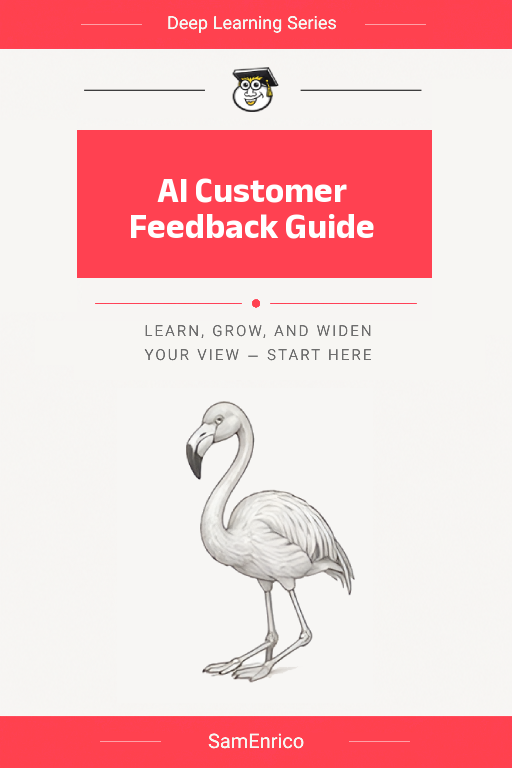
AI Customer Feedback Guide eBook
Use Qualtrics AI, SurveyMonkey AI, or Thematic to
by Lemke Tammie
Use Qualtrics AI, SurveyMonkey AI, or Thematic to analyze customer feedback automatically.
Formats
Free sample
Chapter 1: The Listening Crisis--–- The email arrived at 2:17 PM on a Tuesday. Jessica, the VP of Customer Experience at a mid-sized Saa S company with 45,000 active users, had just finished her third coffee of the morning when her CEO forwarded a message from a recently churned enterprise customer. The customer had written: "We left because no one listened. We told you about the reporting bug in November. We told you again in January.
Your support team was polite, but nothing changed. So we changed vendors."Jessica's stomach tightened. She pulled up her company's customer feedback spreadsheet — a 247-megabyte Excel file with 18,000 rows of open-ended comments from surveys, support tickets, and chat logs. She had two data analysts who spent 80% of their time manually coding these comments into themes. Their most recent report, delivered three weeks ago, identified "reporting issues" as the 11th most common complaint.
It never made it to the product roadmap because it was buried on page 42 of a 67-page slide deck.The customer who churned had been worth $240,000 annually. And their complaint had been sitting in a spreadsheet, invisible, for five months.This is not an isolated story. It happens thousands of times every day, across every industry, in companies of every size. The fundamental problem is not that companies don't collect customer feedback. They collect plenty.
The problem is that they are drowning in it — and they lack the tools to transform that raw, messy, human language into clear, actionable, real-time intelligence.This chapter is about that crisis and the solution that is finally, after decades of false starts, solving it. We will explore why traditional feedback analysis methods fail, how artificial intelligence fundamentally changes the game, and what is at stake for organizations that continue to rely on spreadsheets and manual coding. By the end of this chapter, you will understand why the era of the "spreadsheet coder" is over and how the modern customer experience professional becomes something far more valuable: an interpreter of AI-generated insights.The Iceberg of Ignorance Every company experiences what we will call the Iceberg of Ignorance. Above the waterline — visible to executives — are the complaints that rise to the top through sheer volume or the loudness of the complainer. A customer threatens to leave on social media.
A salesperson escalates a recurring issue. A support manager flags a spike in tickets about the same problem.But below the waterline — invisible, silent, deadly — is the vast majority of customer pain. It lives in survey comments that no one reads. In chat transcripts that are archived and forgotten. In support tickets that are closed without theme extraction.
In app store reviews that are responded to individually but never aggregated. In call center recordings that are sampled at a rate of 0.5% for quality assurance.Research consistently shows that less than 10% of customer feedback is ever systematically analyzed. The other 90% sinks below the surface, taking with it the early warnings of churn, the seeds of product innovation, and the raw material for customer loyalty.The Iceberg of Ignorance exists because of a simple, brutal math problem. A company with 100,000 customers might receive 50,000 open-ended survey responses per year. Add support tickets (perhaps 200,000 per year), chat logs (300,000 conversations), and social media mentions (50,000 per year), and you are looking at well over half a million unstructured text responses annually.
A human analyst, working at peak efficiency, can manually read and categorize about 50 comments per hour. To process 600,000 comments would require 12,000 hours of work — or six full-time analysts working nothing but coding, every day, with no interruptions, no meetings, no vacation.No company does this. Instead, most sample. They read the first 100 comments. Or they rely on keyword searches, looking for the words "bug" or "angry" or "cancel." Or they outsource to a market research firm that delivers a report three months later, by which time the data is stale and the customers have already left.This is not a failure of effort.
It is a failure of method. And it is precisely why AI is not a luxury or a buzzword but an operational necessity.The Two Data Worlds: O-Data and X-Data To understand why AI is the solution, we must first understand the fundamental divide in how companies measure performance. Every organization swims in two types of data, but most only know how to navigate one.Operational data, or O-data, is the world of structure. It includes sales figures, website traffic, inventory levels, support ticket volume, average handle time, and all the other numbers that fit neatly into spreadsheets and dashboards. O-data is easy to collect, easy to analyze, and easy to report.
It tells you what happened, when it happened, and often how much it cost.Experience data, or X-data, is the world of meaning. It includes open-ended survey responses, call transcripts, chat logs, social media comments, review text, and any other place where customers express themselves in their own words. X-data is messy, unstructured, and resistant to traditional analysis. It tells you why something happened, how it made the customer feel, and what might happen next.For decades, companies have excelled at collecting O-data and struggled with X-data. Your CRM knows exactly how many support tickets were opened last Tuesday.
Your analytics platform knows the exact second a user abandoned their cart. But why did they open the ticket? Why did they abandon the cart? That knowledge — the "why" — is locked in X-data, and it has remained largely inaccessible at scale.AI is the bridge between these two worlds. It transforms unstructured language into structured insights that can be counted, tracked, correlated with O-data, and acted upon.
When AI analyzes 50,000 survey comments and identifies that "login issues" are mentioned 3,000 times and correlate with a 40% higher churn rate, it has done something no human analyst could do at that scale and speed. It has connected the quantitative (churn rate) with the qualitative (the reason why) into a single, actionable intelligence.This connection is the entire point of the exercise. Without AI, you have numbers without context (O-data alone) or stories without scale (X-data alone). With AI, you have both.The Death of the Spreadsheet Coder Let us pause for a moment to mourn — and then bury — a role that has quietly consumed more hours of customer experience professionals' lives than almost any other: the spreadsheet coder.The spreadsheet coder is the person who opens a CSV export of survey comments, creates a column called "Theme," and manually types "billing issue" or "product feature request" into row after row. They might use Excel's filter function to group comments that contain the word "price" or "cost." They might create a pivot table to count frequencies.
They might spend an entire Friday afternoon coding 300 comments, feeling productive, only to realize that 2,000 more comments are waiting for them on Monday.The spreadsheet coder is not stupid. They are not lazy. They are working with the tools they have. But the tools are fundamentally inadequate for the scale of the problem. A human being cannot read 50,000 comments.
A human being cannot maintain consistent judgment across 50,000 comments. A human being cannot spot subtle patterns across 50,000 comments.Consider the challenge of consistency. A human coder might tag "delivery was…
This is the end of the free sample. Get the eBook to keep going. Buy now
About this book
Details
- Author
- Lemke Tammie
- Publisher
- SamEnrico
- Language
- English
- Genre
- Non-Fiction, Annual Checkup, Feedback AI
- Released
- 2026-05-29
- Pages (approx.)
- 148
- Available as
- eBook, Audiobook

Read better in the ZLOADR app
Your eBooks on your phone or tablet. Sign in with your SamEnrico account and start reading.
More by Lemke Tammie
 Deep Trance Self Hypnosis GuideLemke Tammie$11.99
 Twitch Gamer Status ComparisonLemke Tammie$11.99
 Spin Class Cross Training IntegrationLemke Tammie$11.99Spin Class Cross Training IntegrationLemke Tammie$11.99
 Teen Personal Brand GuideLemke Tammie$11.99
 Stalking Environmental Activist CasesLemke Tammie$11.99
 The Great Number Hunt: Cracking the Code of the Voynich ManuscriptLemke Tammie$11.99
 Frozen Secrets of the Andes: Unlocking South America's Ice Age MysteriesLemke Tammie$11.99
 Understanding Dupuytren Subungual ExostosisLemke Tammie$17.99
 Client Operations AssociateLemke Tammie$11.99
 Shutterstock Mobile ContributorLemke Tammie$12.99