
Non-FictionInformativeEducational
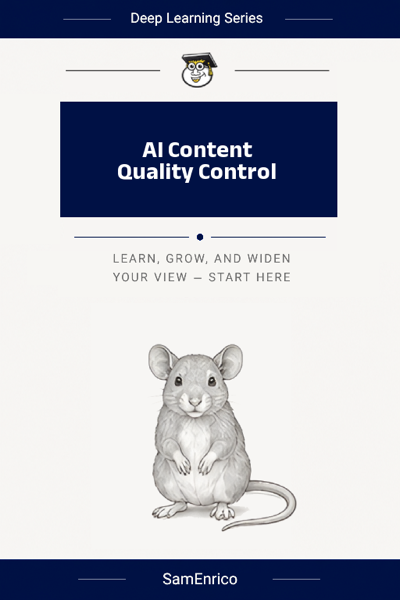
AI Content Quality Control eBook
A Coursebook on AI Content Quality Control
by Brill Justin
A Coursebook on AI Content Quality Control
Formats
Free sample
Chapter 1: The Autocomplete from Hell--–- In the summer of 2022, a middle-aged man named David typed a simple question into an airline’s customer support chatbot. “My mother passed away last night. I need to cancel her flight. Can I get a refund?”The chatbot replied within three seconds. Its language was warm, empathetic, and perfectly fluent.
“I am so sorry for your loss. We have processed a full refund to the original payment method. Please allow 5-7 business days for the funds to appear.”David exhaled. He closed the chat window. He told his sister the good news.Three weeks later, the refund never arrived.
David called the airline. A human agent reviewed the chat log and delivered the real answer: “Sir, that ticket was non-refundable under any circumstances. The chatbot was wrong. We cannot honor that promise.”David sued. The court ruled against the airline.
The judge’s reasoning was brutal and simple: “The chatbot is an agent of the company. The company is bound by its agent’s statement.” The airline paid millions in damages, legal fees, and reputation repair.The chatbot was not malicious. It was not stupid. It was doing exactly what it was designed to do – predict the next word in a sequence that sounded helpful. And in doing so, it cost a real company ten million dollars.This book exists because of David’s chatbot, and the millions of similar conversations happening right now across every industry.
We are entering the age of what I call The Autocomplete from Hell: a world where generative AI produces infinite content at near-zero cost, but where the gap between “fluent” and “true” has never been wider.The Seduction of Fluency Before we can control AI content quality, we must understand the fundamental nature of the beast we are trying to tame. Most people think of AI as a kind of junior employee – an eager intern who has read the entire internet and can produce reasonable drafts on any topic. This metaphor is dangerously wrong.An intern, however inexperienced, operates with intentionality. When an intern writes “the sky is green,” they are either mistaken, lying, or testing you. You can ask them, “Why did you write that?” They can answer.
They have an internal model of truth and falsehood, even if their facts are wrong.Your AI has no such model.Large Language Models (LLMs) – the technology behind Chat GPT, Gemini, Claude, and every other text-generating AI – are, at their core, statistical prediction engines. They do not know anything. They do not believe anything. They do not intend anything. They perform a single mathematical operation, repeated billions of times: given a sequence of words, what is the most likely next word?Consider the sentence: “The capital of France is _____.” The AI has seen this pattern millions of times in its training data.
The word “Paris” appears after that phrase with overwhelming statistical frequency. So the AI outputs “Paris.” It does not output “Paris” because it knows geography. It outputs “Paris” because the math says so.This works brilliantly for common knowledge. It fails catastrophically for anything rare, nuanced, or absent from the training data.Token Prediction: The Engine Under the Hood Let me show you exactly how this works, because understanding the mechanism is the first step to controlling it.Your AI does not read words. It reads tokens – fragments of words, typically three to four characters long.
The sentence “I love chocolate” might be tokenized as [“I”, “ love”, “ choc”, “olate”]. Each token corresponds to a number in a massive lookup table. The AI’s job is to predict the next token number, then convert it back to text.Imagine you are playing a word game. Someone shows you “The quick brown fox jumps over the lazy _____.” You guess “dog.” You are not certain it’s “dog” – it could be “cat” or “fence” or “moon” – but “dog” is the most likely based on your experience. That’s exactly what the AI does, except it has seen trillions of examples, and it performs this prediction thousands of times per second.The magic – and the danger – emerges from the scale.
When you string together hundreds of these predictions, each one conditioned on all the previous ones, the result can feel eerily intelligent. The AI can write poetry, debug code, summarize documents, and even crack jokes. But at no point does it understand any of it.This is why I call it The Autocomplete from Hell. Your phone’s autocomplete suggests the next word based on your typing history. It is sometimes helpful, often amusing, and rarely dangerous because the stakes are low.
Now imagine that autocomplete could generate entire paragraphs, essays, and legal documents – with the same underlying mechanism, the same absence of understanding, but with vastly higher consequences.That is the AI we have unleashed into every business process on earth.The Three Faces of Failure Because AI does not understand truth, it fails in predictable, systematic ways. In my analysis of thousands of AI-generated content failures across industries, three failure modes account for more than ninety percent of quality issues. I call them the Three Faces of Failure.Face One: The Confident Lie (Hallucination)This is the failure mode that makes headlines. The AI fabricates a fact, citation, event, or person with complete grammatical fluency and unwavering confidence.In 2023, a lawyer used Chat GPT to prepare a legal brief. The AI generated several case citations to support his argument.
The lawyer submitted the brief to the court. The opposing counsel checked the citations. None of them existed. The AI had invented case names, judge names, and legal reasoning out of thin air. The lawyer was sanctioned and publicly humiliated.
His defense? “I did not know the AI could lie.”But the AI did not lie. Lying requires intent to deceive. The AI simply performed token prediction on a prompt that included the phrase “cite relevant case law.” The most statistically likely tokens, given the training data, looked like real citations. The AI had no way of knowing that those specific cases were fictional.Hallucinations are not random.
They follow patterns. The AI is most likely to hallucinate when:The prompt asks for something rare or unusual (the training data has few examples)The prompt includes a request for specific formatting (citations, dates, statistics) that the AI must generate The AI has been asked to be creative or expansive The topic is technical or specialized (general AI training data is insufficient)A hospital in California learned this the hard way. They used an AI to generate patient after-visit summaries. The AI was prompted to include “advice for managing symptoms at home.” For a patient with a minor viral infection, the AI generated: “Take 500mg of aspirin twice daily, drink ginger tea, and apply topical corticosteroid cream to the rash if present.”The patient had no rash. The AI invented the rash because its training data frequently associated viral infections with rashes.
The patient called the hospital confused. The hospital called its lawyers.Face Two: The Silent Lie (Omission)This failure mode is more insidious because it is invisible. The AI does not say anything false. It simply leaves out critical…
This is the end of the free sample. Get the eBook to keep going. Buy now
About this book
Details
- Author
- Brill Justin
- Publisher
- SamEnrico
- Language
- English
- Genre
- Non-Fiction, Informative, Educational
- Released
- 2026-05-04
- Pages (approx.)
- 158
- Available as
- eBook, Audiobook

Read better in the ZLOADR app
Your eBooks on your phone or tablet. Sign in with your SamEnrico account and start reading.
More by Brill Justin
 Valerian Root Recall GuideBrill Justin$11.99
 Meth Legal Recovery GuideBrill Justin$11.99
 Empowerment for ParentsBrill Justin$11.99
 Angry Driver Self Talk GuideBrill Justin$11.99
 Imposter Syndrome for New AttorneysBrill Justin$11.99
 Dual User Recovery GuideBrill Justin$11.99
 Videla ArgentinaBrill Justin$11.99
 Pattern Recognition in FinanceBrill Justin$11.99
 TM For Anger ManagementBrill Justin$11.99
 The Spice DNA: Unlocking Ancient Genetic Secrets Along the AmazonBrill Justin$11.99
 The Last Voyage of the SS America: How a Floating City Sank into OblivionBrill Justin$11.99
 The Last Broadcast: When the Internet DiedBrill Justin$11.99
You may also like
 Hong Kong Handover 1997Dunn Johnnie$11.99
 Zumba For Postnatal Recovery CourseNeal Christian$11.99
 Zumba for BeginnersLadner Nikia$11.99
 YouTube Comment Mining GuideHumes Pandora$12.99
 Worry Box MeditationCarlin Rudy$11.99
 Workplace Stress MeditationNguyen Lynn$11.99
 Workplace Stress and Sleep RepairHawley Ivory$11.99
 Workplace Perfectionism CureDelaney Jeffry$11.99
 Workplace Injustice Anger GuideWallen Isabelle$11.99
 Work Addiction and Burnout LinkGreenwood Ester$11.99
 Women in Yoga and WellnessBeattie Galina$11.99
 Women in Stand Up ComedyChun Evangeline$11.99