
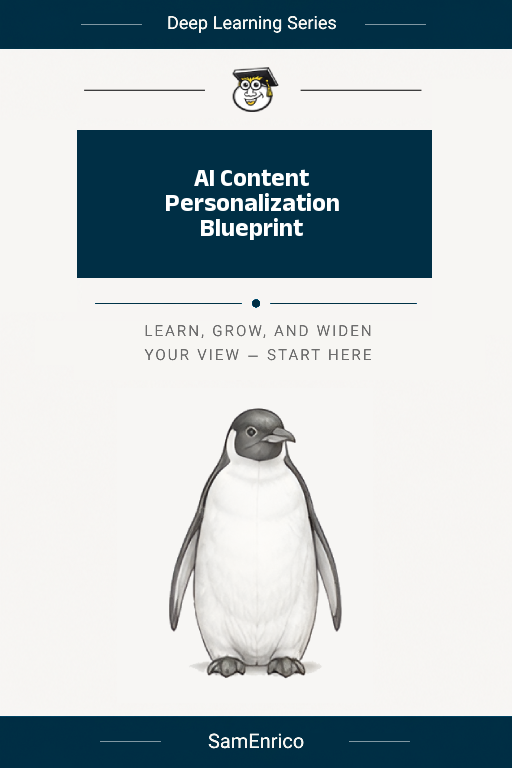
Non-FictionAI OperatorPersonalization
AI Content Personalization Blueprint eBook
Scale personalized content for email, web, and ads
Scale personalized content for email, web, and ads using generative AI.
Formats
Free sample
Chapter 1: The Personalization Paradox--The email landed in my inbox at 6:47 AM on a Tuesday. The subject line read, "Hi {First Name}, we thought you'd like this." Not only had the brand failed to populate the merge tag—leaving the ugly bracket placeholder exposed for the world to see—but they had also sent me a discount on baby products. I do not have children. I have never purchased baby products. My entire purchase history with this brand consisted of a single coffee mug purchased three years ago.This is not personalization.
This is performance art for lazy marketers.And yet, this is exactly what most brands still call "personalization" in 2026.The dirty secret of modern marketing is that the vast majority of personalized content is still just token replacement. Swap {First Name} into a template. Maybe swap {Company Name} if you are feeling advanced. Then hit send and congratulate yourself on your sophistication. Meanwhile, your customers are having natural language conversations with Chat GPT that remember context from three months ago.
They are watching Netflix recommend movies based on their viewing habits across five years. They are scrolling Tik Tok feeds that adapt in real-time to their scrolling velocity and pause duration.The gap between what consumers expect and what most brands deliver is no longer a crack. It is a canyon. And it is widening every single day.This book exists to help you cross that canyon.The Expectation Gap Let us start with a simple exercise. Think about the last time you interacted with a brand that truly understood you.
Perhaps it was Spotify surfacing a playlist that felt like it had been curated by your best friend. Perhaps it was Amazon showing you exactly the replacement part you needed without you having to search for it. Perhaps it was a small e-commerce store that sent you a handwritten note with your order.Now think about the last time a brand insulted your intelligence with a painfully generic email. The kind that clearly went to 500,000 other people. The kind that used your first name in the subject line and then never mentioned it again.
The kind that recommended products you had already purchased or would never need.That second experience is becoming the norm. And it is driving your customers away.Data from recent consumer behavior studies reveals a stunning contradiction. Personalized calls-to-action perform two hundred two percent better than default versions. Seventy percent of consumers say they are more likely to purchase from a brand that personalizes their experience. Yet seventy percent of brands admit they struggle to move beyond basic segmentation.
They know personalization works. They know customers demand it. They simply cannot deliver it at scale.The reason most brands fail is not a lack of effort. It is a lack of systems. They treat personalization as a one-off activity rather than an operational capability.
They assign a junior marketer to "write some personalized emails" without giving them the tools, data, or frameworks to do so effectively. They expect the AI to perform miracles while feeding it garbage.This is the Expectation Gap. On one side, what customers have seen AI do in their personal lives. On the other side, what brands are actually capable of delivering. The gap represents both an existential threat and an enormous opportunity.
Brands that close the gap will build unassailable loyalty. Brands that do not will become invisible.The Three Pillar Blueprint Throughout this book, I will teach you a system for closing that gap. It is called the Three Pillar Blueprint, and it forms the architecture for everything that follows.Pillar One is Foundation. You cannot scale personalization without a structured data layer that contains your brand voice, your audience personas, your terminology, and your modular content components. Without this foundation, your AI will produce generic garbage regardless of how well you prompt it.
The Foundation is the difference between AI that sounds like your brand and AI that sounds like everyone else.Pillar Two is Variation. Once you have a Foundation, you need prompt systems that generate channel-specific adaptations. Email requires a different voice than Linked In. A Google ad requires different constraints than a Facebook post. A welcome email requires different emotional resonance than an abandoned cart sequence.
Variation is the engine that turns one core message into hundreds of personalized outputs without manual effort.Pillar Three is Governance. Speed without control is just chaos. You need human-in-the-loop quality systems that ensure your AI content does not damage your brand, violate privacy regulations, or cross into the uncanny valley of creepy personalization. Governance is not about slowing down. It is about speeding up safely.Together, these three pillars transform AI from a writing tool into an operating system for personalized content at scale.The Four Levels of Personalization Maturity Before we go further, you need to know where you currently stand.
The book uses a consistent Four Level Maturity Model that applies to individuals, teams, and entire organizations.Level One is the Token Tosser. This is where most brands live today. You use merge tags like {First Name} and {Company}. You might have a few audience segments based on broad categories like industry or geography. Your personalization is superficial and easily ignored.
The telltale sign of a Token Tosser is the email that says "Hi {First Name}" in the subject line but then addresses you as "Valued Customer" in the body because someone forgot to populate the field correctly.Level Two is the Prompt Puncher. You have started using generative AI, but you treat it like a search engine. You type a few sentences into Chat GPT, copy the output, and spend more time editing than you would have spent writing from scratch. You are frustrated and starting to wonder if AI is overhyped. Your team is spending hours fixing robotic language and factual errors.
The telltale sign of a Prompt Puncher is the Slack message that says "Can someone fix this AI garbage before we send it?"Level Three is the Template Tinkerer. You have built some systems. You have a folder of prompt templates. You have documented your brand voice. But your systems are fragile.
When one person leaves the team, the knowledge walks out the door with them. Your personalization works inconsistently. Some campaigns soar while others flop without clear explanation. The telltale sign of a Template Tinkerer is the spreadsheet of prompts that no one outside the original author can understand.Level Four is the Engine Owner. You have a complete Gold Source repository containing your brand voice, personas, terminology, and modular content blocks.
Your prompt library is version-controlled and accessible to every team member. Your quality guardrails are automated. Your feedback loop continuously improves your system. New team members can produce brand-compliant, personalized content within their first week. The telltale sign of an Engine Owner is the ability to scale personalized content without scaling your headcount.Most readers of this book are at Level Two.
You know AI has potential. You have seen impressive outputs. But you cannot reliably produce them. You spend more time editing than creating. You are frustrated.The goal of this book is to move you from wherever…
This is the end of the free sample. Get the eBook to keep going. Buy now
About this book
Details
- Author
- Frank Belinda
- Publisher
- SamEnrico
- Language
- English
- Genre
- Non-Fiction, AI Operator, Personalization
- Released
- 2026-06-01
- Pages (approx.)
- 138
- Available as
- eBook, Audiobook

Read better in the ZLOADR app
Your eBooks on your phone or tablet. Sign in with your SamEnrico account and start reading.
More by Frank Belinda
 Sober Identity Transformation GuideFrank Belinda$11.99
 Comparison Affirmation GuideFrank Belinda$11.99
 Trello Calendar Power Up ScheduleFrank Belinda$11.99
 Negotiation For New ManagersFrank Belinda$11.99
 The Working Memory for ADHDFrank Belinda$11.99
 Purpose For Grief GuideFrank Belinda$11.99
 Islamic Mathematics Algebra GuideFrank Belinda$11.99
 Divorce and Retirement AccountsFrank Belinda$11.99
 The Golden Liberty: How Poland's Nobles Bankrolled a War Against RussiaFrank Belinda$11.99
 Rock in Rio: The Latin American Festival That Defied the OddsFrank Belinda$11.99
 How to Produce Motorcycle Hand GuardsFrank Belinda$11.99
 Co Founder AngelList GuideFrank Belinda$12.99
You may also like
 Hong Kong Handover 1997Dunn Johnnie$11.99
 Zumba For Postnatal Recovery CourseNeal Christian$11.99
 Zumba for BeginnersLadner Nikia$11.99
 YouTube Comment Mining GuideHumes Pandora$12.99
 Worry Box MeditationCarlin Rudy$11.99
 Workplace Stress MeditationNguyen Lynn$11.99
 Workplace Stress and Sleep RepairHawley Ivory$11.99
 Workplace Perfectionism CureDelaney Jeffry$11.99
 Workplace Injustice Anger GuideWallen Isabelle$11.99
 Work Addiction and Burnout LinkGreenwood Ester$11.99
 Women in Yoga and WellnessBeattie Galina$11.99
 Women in Stand Up ComedyChun Evangeline$11.99