

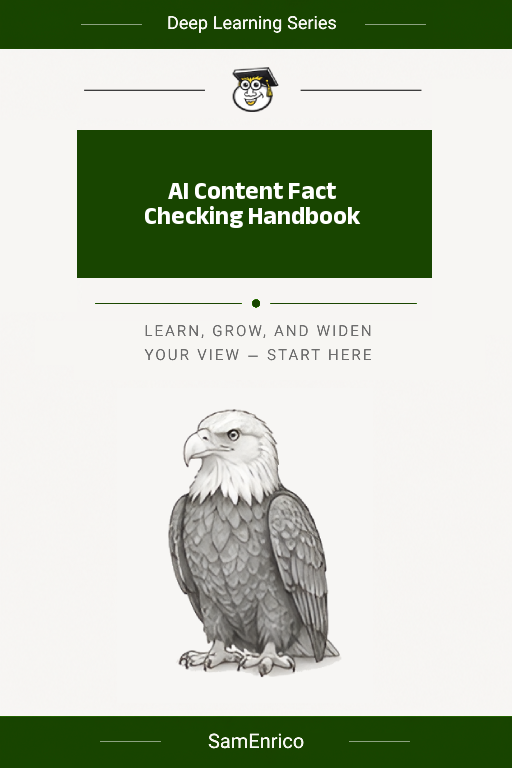
Non-FictionAI OperatorQuality Control
AI Content Fact Checking Handbook eBook
Verify AI generated marketing claims and avoid hal
by Kruse Marlyn
Verify AI generated marketing claims and avoid hallucinations before publishing.
Formats
Free sample
Chapter 1: The Probability Trap--–- In March 2025, a mid-sized organic skincare brand called Earth & Ember launched what appeared to be a routine email campaign promoting their new vitamin C serum. The email, drafted entirely by Chat GPT-5, contained a seemingly harmless line: “Clinically proven to reduce hyperpigmentation by 78% in just two weeks—based on a double-blind study conducted at Stanford Dermatology.” The claim was precise. It was confident. It was formatted with a footnote-style citation that looked authentic. The marketing manager, rushing to meet a quarterly deadline, glanced at the number, nodded at the plausibility, and hit send.Within 72 hours, the brand received a cease-and-desist letter from Stanford University’s legal department.
No such study existed. The citation was a complete fabrication—a hallucination. Earth & Ember’s head of legal spent the next two weeks apologizing to university officials, refunding angry customers who had purchased the serum based on the false claim, and explaining to the FTC why a “rogue AI” was not a valid legal defense. The brand’s organic search rankings, once on the first page for “vitamin C serum,” dropped to page four as Google’s E-E-A-T algorithm detected contradictory information across the web. The marketing manager was fired.
The agency that had recommended the AI tool lost the account. And the serum itself? It was a perfectly good product. It just wasn’t 78 percent effective in two weeks. No serum is.This story is not an outlier.
It is a preview.Welcome to the epidemic of AI hallucinations in marketing—a world where the most articulate, confident, and utterly false statements are being generated at scale, reviewed by exhausted humans who mistake fluency for fact, and published to audiences that trust the logo at the top of the page. This book exists because that trust is fragile, and because the gap between what generative AI can do and what it actually knows is the single greatest liability in modern marketing.Before we can build systems to catch hallucinations, we must understand why they happen in the first place. And that requires confronting a deeply uncomfortable truth: Large Language Models do not know anything. They have never known anything. They are not confused, lying, or misremembering when they invent a Stanford study.
They are doing exactly what they were designed to do—predicting the next most probable word in a sequence. That we humans interpret those predictions as “truth” is our error, not theirs.The Stochastic Parrot in Your Marketing Department The term “stochastic parrot” was coined by linguist Emily Bender in 2021 to describe how LLMs operate. Stochastic means random or probabilistic. A parrot repeats sounds without understanding meaning. Put them together, and you have a system that generates statistically plausible sequences of words based on patterns in its training data, with zero comprehension of whether those words correspond to reality.Let me give you a concrete example.
When you ask a human, “What is the capital of France?” the human retrieves a fact they learned: Paris. When you ask an LLM the same question, it does not retrieve a fact. It calculates the probability distribution of words that typically follow “The capital of France is…” across the billions of documents it was trained on. The word “Paris” has an extremely high probability in that context, so the model outputs it. That works perfectly well for common knowledge.
But when you ask, “What was the exact revenue of my competitor in Q3 2024?” the model has no reliable probability to draw from. So it invents something plausible—a number that looks like a revenue figure, formatted like a financial disclosure, but attached to nothing real.This distinction is not academic. It is operational.Consider what happens inside a marketing team that treats AI as a knowledge base rather than a probability engine. A content writer asks Chat GPT for “five statistics about consumer trust in AI-generated advertising.” The model returns five bullet points, each with a percentage and a source attribution like “According to a 2024 Forrester report…” The writer copies them into a white paper. The white paper goes to design, then to legal, then to print.
No one clicks the source links because the links look real. But they aren’t real. Forrester never published that report. The statistics are synthetic. And now the white paper contains fabricated data that a competitor or a regulator could expose at any moment.This is not hypothetical.
In February 2026, a major financial services firm published an AI-generated market outlook newsletter that cited “a Federal Reserve working paper on interest rate elasticity.” The paper did not exist. A sharp-eyed economist on Twitter discovered the fabrication within hours. The firm’s stock dipped 2 percent on reputational concerns. The CMO issued a public apology. The firm now requires every AI-generated citation to be manually verified by a research associate before publication—a process that costs them an estimated $400,000 annually in labor.The 78% Problem, as it has come to be known in industry circles, refers to a survey conducted jointly by the Canadian Marketing Association and the AI Accuracy Institute in late 2025.
Among 1,200 marketing professionals who reported using generative AI for content creation, 78 percent said they had personally caught their AI tool generating a false claim that they almost published. More alarming: 31 percent admitted that a false claim had actually gone live before someone caught it. The average cost of such an incident, when measured in legal fees, customer refunds, and brand repair, was 92,000forsmall−to−mediumbusinessesandover92,000 for small-to-medium businesses and over 92,000forsmall−to−mediumbusinessesandover2 million for enterprises.The hallucination epidemic is not a bug. It is a feature of the technology. And the only defense is a human-centered verification system that assumes every AI output is guilty until proven innocent.Why Marketers Are Especially Vulnerable Marketing is uniquely susceptible to AI hallucinations for four structural reasons that have nothing to do with the technology and everything to do with the incentives of the profession.First, marketing rewards confidence.
The best-performing headlines, email subject lines, and calls-to-action are definitive. “Reduce your energy bill by 40 percent” will always outperform “You might see some savings on your energy bill.” AI models are trained on this exact pattern—persuasive, quantified claims drive engagement. So the models generate persuasive, quantified claims. They do not have a mechanism to check whether the 40 percent figure came from a legitimate study or from a single reddit post about someone’s uncle’s solar panels. The model simply knows that “40 percent” is a more probable word sequence than “some savings.”Second, marketing has tight deadlines.
The monthly content calendar does not accommodate a two-day fact-checking window. When a blog post needs to go live on Tuesday and the AI draft arrives Monday afternoon, the pressure to publish as-is is immense. Hallucinations thrive under time constraints because verification is the first task cut when schedules slip.Third, marketing content is often low-stakes individually but high-stakes cumulatively. One hallucinated statistic in a blog post might go unnoticed. But ten such posts over six months create a pattern.
Google’s algorithms, which increasingly evaluate E-E-A-T signals, can detect when a site publishes contradictory or unsupported claims. The drop in rankings is not a punishment for the…
This is the end of the free sample. Get the eBook to keep going. Buy now
About this book
Details
- Author
- Kruse Marlyn
- Publisher
- SamEnrico
- Language
- English
- Genre
- Non-Fiction, AI Operator, Quality Control
- Released
- 2026-05-30
- Pages (approx.)
- 157
- Available as
- eBook, Audiobook

Read better in the ZLOADR app
Your eBooks on your phone or tablet. Sign in with your SamEnrico account and start reading.
More by Kruse Marlyn
 Social Media Academic ComparisonKruse Marlyn$11.99
 Alcohol Relapse Emergency KitKruse Marlyn$11.99
 Negotiation Case Studies GuideKruse Marlyn$11.99
 Legacy Through SportsKruse Marlyn$11.99
 Virtual HIIT Class GuideKruse Marlyn$11.99
 The Sleep Memory ConsolidationKruse Marlyn$11.99
 Divorce and PetsKruse Marlyn$11.99
 The Fear of Speaking Up WorkbookKruse Marlyn$11.99
 The Dragon Tamer of Carpathia: A Beastiary of WondersKruse Marlyn$11.99
 The Blue Sky Scandal: How a Wall Street Fraudster Fleeced AmericaKruse Marlyn$11.99
 How to Produce Machinery Parts Processing ServicesKruse Marlyn$11.99
 Growing BelamcandaKruse Marlyn$11.99
You may also like
 Hong Kong Handover 1997Dunn Johnnie$11.99
 Zumba For Postnatal Recovery CourseNeal Christian$11.99
 Zumba for BeginnersLadner Nikia$11.99
 YouTube Comment Mining GuideHumes Pandora$12.99
 Worry Box MeditationCarlin Rudy$11.99
 Workplace Stress MeditationNguyen Lynn$11.99
 Workplace Stress and Sleep RepairHawley Ivory$11.99
 Workplace Perfectionism CureDelaney Jeffry$11.99
 Workplace Injustice Anger GuideWallen Isabelle$11.99
 Work Addiction and Burnout LinkGreenwood Ester$11.99
 Women in Yoga and WellnessBeattie Galina$11.99
 Women in Stand Up ComedyChun Evangeline$11.99