
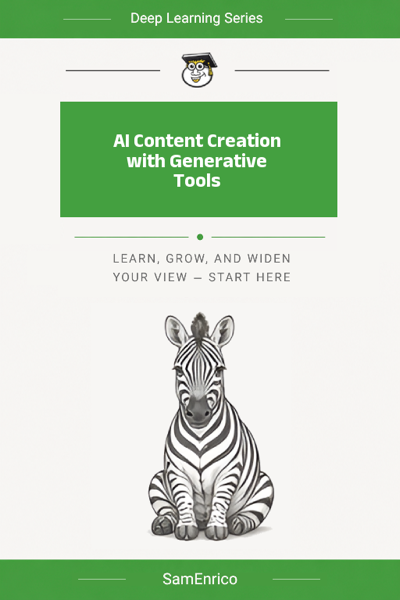
Non-FictionInformativeEducational
AI Content Creation with Generative Tools eBook
A Coursebook on AI Content Creation with Generativ
by Hinson Suzie
A Coursebook on AI Content Creation with Generative Tools
Formats
Free sample
Chapter 1: The Map Before the Mine--You are about to make a dangerous assumption. It is the same assumption that has already cost thousands of content creators their time, their money, and—in the most painful cases—their credibility. The assumption sounds reasonable. It sounds almost obvious. Here it is: Using AI to create content is just learning a few tricks with Chat GPT.If you believe that, this chapter exists to save you from a slow, frustrating death by a thousand mediocre outputs.
Generative AI is not one tool. It is an entirely new category of technology, as different from your word processor as a printing press is from a quill. Before you write a single prompt, before you sign up for any subscription, before you watch another You Tube tutorial promising "the one secret prompt," you need a map of the territory. This chapter is that map.You will learn what generative AI actually is under the hood—not the marketing hype, not the science fiction fears, but the practical reality of statistical pattern matching that sometimes looks like magic and sometimes looks like a toddler with a hallucination problem. You will understand why AI invents facts with the same confidence it uses to recite the capital of France.
You will see the landscape of tools laid out clearly: which ones excel at text, which at images, which at voice, and which at video. And most importantly, you will learn the three principles that separate professionals who use AI as a lever from amateurs who use AI as a crutch.By the end of this chapter, you will never look at a chatbot the same way again. You will see its strengths clearly, its weaknesses plainly, and—most critically—you will know exactly where your own human judgment must step in. Let us begin.The Great Misunderstanding: Why Most People Get AI Wrong From the Start Walk into any coffee shop where freelancers camp with their laptops. Eavesdrop on any online forum for "AI content hacks." Scroll through the comments on any viral Linked In post about Chat GPT.
You will hear the same conversation repeated thousands of times: "I asked it to write a blog post and it was okay but kind of boring." Or: "I tried to get it to research something for me and it made up a source that doesn't exist." Or the saddest variation: "I think I'm just bad at prompting."None of these people are bad at prompting. They are playing the wrong game entirely.The fundamental misunderstanding is treating generative AI like a smarter version of Google or a faster version of a human assistant. It is neither. Google retrieves existing information from the web. A human assistant has intentions, understands context, and knows when to ask clarifying questions.
Generative AI does none of these things. It predicts the next most likely word based on the words that came before it, repeated billions of times across a statistical model trained on roughly the entire public internet.That is not a limitation to be mourned. It is a feature to be understood.Think of it this way: a calculator does not "know" math. It executes operations according to rules. A GPS does not "know" geography.
It calculates routes based on map data. Generative AI does not "know" anything. It generates plausible sequences. The word "plausible" is doing all the work here. Sometimes plausible matches true.
Sometimes plausible matches convincing fiction. Sometimes plausible matches the most common opinion on the internet, regardless of whether that opinion is ethical, accurate, or even sane.This is why you cannot trust AI the way you trust a calculator. A calculator given the same inputs produces the same outputs every time. AI given the same prompt produces different outputs every time. That variability is either a superpower or a liability, depending entirely on whether you understand how to guide it.The Three Families of Generative AI: Text, Images, and Everything Else Before you can use these tools effectively, you need to know what kind of beast you are dealing with.
Generative AI comes in three broad families, each built on different architecture, each with different strengths, and each with different failure modes.Large Language Models (LLMs): The Text Predictors Large Language Models are what most people mean when they say "Chat GPT" or "AI writing." But that is like saying "vehicles" when you mean "Toyota Camry." LLMs include Chat GPT, Claude, Gemini, Llama, and dozens of others. They are trained on massive collections of text—books, articles, websites, code, forums, academic papers—and they learn to predict what word comes next given the words that came before.The astonishing thing is how well this simple mechanism works. By predicting the next word, again and again, LLMs learn grammar, style, reasoning patterns, factual knowledge (of a sort), and even the ability to follow instructions. But the mechanism never changes. It is always guessing.
When you ask an LLM "What is the capital of France?" it does not look up the answer. It generates the word "Paris" because in its training data, the pattern "the capital of France is" is almost always followed by "Paris."This works beautifully for common facts. It fails catastrophically for rare facts, recent events, or anything not well represented in its training data. And because the model cannot distinguish between a fact it has seen ten thousand times and a fact it has hallucinated from a single obscure reference, it delivers everything with the same calm confidence. That is the hallucination problem, and we will return to it.Diffusion Models: The Image Generators Midjourney, DALL-E, Stable Diffusion, and their rivals use a completely different architecture called diffusion models.
These are trained by taking millions of images, progressively adding noise until they become static, then learning how to reverse the process—turning static back into images.The practical implication is that diffusion models are extraordinary at creating visuals but have no understanding of the physical world. They do not know that hands have five fingers, that text should be legible, or that shadows should fall consistently. They have seen millions of pictures of hands, so they can generate something that looks like a hand, but they have no model of hand anatomy. Hence the famous "finger problem"—six fingers, fused fingers, fingers emerging from wrists—because the model is approximating a pattern it has seen, not rendering an anatomical structure.Understanding this changes how you prompt. You are not describing a scene to an artist who understands physics.
You are providing statistical guidance to a pattern-matching engine that has seen a lot of photographs taken in natural light. You succeed by giving it examples it has seen before, not by expecting it to reason from first principles.Multimodal Models: The New Frontier The third family is the newest and fastest evolving: multimodal models that can accept multiple types of input and generate multiple types of output. Gemini, GPT-4 with vision, and Claude 3 can all "see" images and respond to them. Newer models can generate images and text interleaved. Some can process audio directly.Multimodal models are not simply three separate models glued together.
They are trained from the ground up on mixed data—images paired with captions, video frames with transcripts, audio with text…
This is the end of the free sample. Get the eBook to keep going. Buy now
About this book
Details
- Author
- Hinson Suzie
- Publisher
- SamEnrico
- Language
- English
- Genre
- Non-Fiction, Informative, Educational
- Released
- 2026-05-11
- Pages (approx.)
- 143
- Available as
- eBook, Audiobook

Read better in the ZLOADR app
Your eBooks on your phone or tablet. Sign in with your SamEnrico account and start reading.
More by Hinson Suzie
 Bipolar Medication Adherence ManualHinson Suzie$11.99
 Medical Residency Imposter GuideHinson Suzie$11.99
 Delegation for WomenHinson Suzie$11.99
 PTSD Driving Hyperarousal GuideHinson Suzie$11.99
 Cocaine and ADHD ConnectionHinson Suzie$11.99
 Ashwagandha Sleep MemoryHinson Suzie$11.99
 Pinochet ChileHinson Suzie$11.99
 Chunking for Reading SpeedHinson Suzie$11.99
 TM For Grief ProcessingHinson Suzie$11.99
 Jerusalem's Shadow: The Siege of Antioch and the Birth of the First CrusadeHinson Suzie$11.99
 The Vanishing Diamonds: The Heist That Never HappenedHinson Suzie$11.99
 Neon Shadows: The Forgotten Rebellion of the 80s CyberpunksHinson Suzie$11.99
You may also like
 Hong Kong Handover 1997Dunn Johnnie$11.99
 Zumba For Postnatal Recovery CourseNeal Christian$11.99
 Zumba for BeginnersLadner Nikia$11.99
 YouTube Comment Mining GuideHumes Pandora$12.99
 Worry Box MeditationCarlin Rudy$11.99
 Workplace Stress MeditationNguyen Lynn$11.99
 Workplace Stress and Sleep RepairHawley Ivory$11.99
 Workplace Perfectionism CureDelaney Jeffry$11.99
 Workplace Injustice Anger GuideWallen Isabelle$11.99
 Work Addiction and Burnout LinkGreenwood Ester$11.99
 Women in Yoga and WellnessBeattie Galina$11.99
 Women in Stand Up ComedyChun Evangeline$11.99