
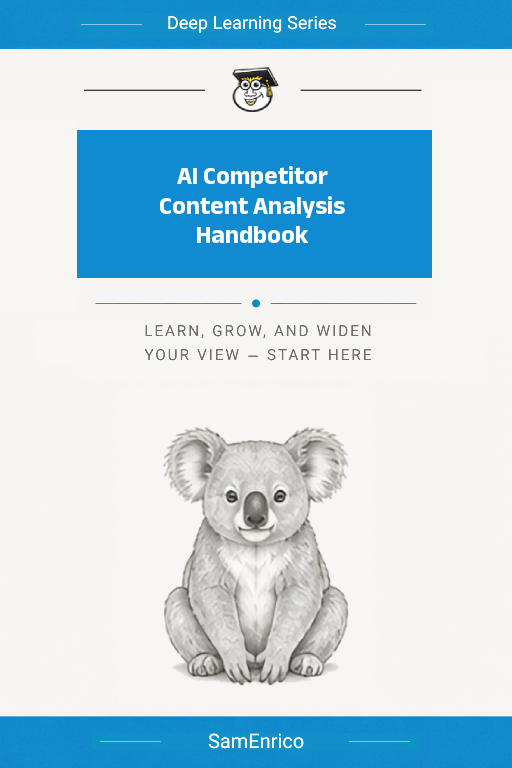
Non-FictionAI OperatorCompetitive Analysis
AI Competitor Content Analysis Handbook eBook
Analyze competitor content and generate better ver
Analyze competitor content and generate better versions using AI.
Formats
Free sample
Chapter 1: The Vanishing Brand–- On a Tuesday morning in March 2024, Sarah Chen, the Head of Marketing at a fifteen-million-dollar Saa S company, did something she had done thousands of times before. She opened Chat GPT and asked a simple question: “Who are the top three providers of project management software for distributed engineering teams?” Her company, Flow Track, had been in business for seven years. They had over four hundred paying customers, a ninety-two percent retention rate, and a team of thirty-seven employees. They had been featured in Tech Crunch, spoken at Saa Str Annual, and had a domain authority of fifty-four. By every traditional metric, they were a legitimate, successful, growing company.The AI answered in less than four seconds.It listed three names.
Flow Track was not among them.The first name was Asana, a legitimate category leader. The second was Monday.com, another valid competitor. But the third name stopped Sarah cold. It was a company she had never heard of called “Project Flow Hub.” She clicked through. The website was basic—a Word Press theme from 2021, twelve blog posts, no pricing page, no “About Us” section, no customer logos, no case studies, and no way to sign up for a free trial.
A reverse image search revealed that their “team photo” was a stock image. Their “customer testimonials” were lorem ipsum text that someone had forgotten to replace. The site had been live for only eight months. By every traditional metric, Project Flow Hub did not exist.And yet, Chat GPT had recommended them over Flow Track.Sarah spent the next hour digging. She asked the same question in different ways.
She tried Gemini. She tried Perplexity. She tried Claude. In eleven out of fifteen queries, Project Flow Hub appeared somewhere in the AI’s answer. Flow Track appeared exactly zero times.
She checked their traditional Google rankings. Flow Track ranked on page one for thirteen high-value keywords. Project Flow Hub did not rank on the first five pages for any of them.This was not an SEO problem. This was something else entirely. And it is the reason you are reading this book.The Day the Rules Changed Let us be clear about what just happened to Sarah.
She did not lose a deal to a competitor she knew. She lost visibility to a competitor she could not see. She did not fail at SEO. She failed at something that did not exist until recently. She failed at Answer Engine Optimization—the practice of optimizing content not for the ten blue links of Google, but for the single answer generated by an AI model.The difference between these two worlds is not incremental.
It is foundational.Traditional search engines like Google operate on a retrieval model. When you type a query, the engine scans its index of billions of pages, applies a ranking algorithm (Page Rank and its many descendants), and returns a list of links. Your job as a marketer is to get your link as high as possible on that list. The user’s job is to click, read, and decide for themselves.AI answer engines like Chat GPT, Gemini, Perplexity, and Claude operate on a generation model. When you type a query, the engine retrieves relevant information from its training data (or from real-time sources, depending on the model), synthesizes that information into a coherent answer, and presents it as a single paragraph or bulleted list.
Your job as a marketer is to be one of the sources the AI chooses to synthesize. The user’s job is to read the answer and move on. They may never click a link.This shift has profound implications for how you think about competition, content, and visibility.In the old world, your competitors were other companies selling similar products or services. In the new world, your competitors are any sources the AI deems authoritative enough to cite. That includes traditional rivals, yes.
But it also includes content aggregators, comparison websites, forums like Reddit, Q&A sites like Quora, educational institutions, government websites, and—as Sarah discovered—ghost companies with no product but excellent content structure.The battle for visibility has moved from the search engine results page to the inside of the AI’s black box. You cannot see the battlefield directly. You can only infer its shape from the answers the AI produces. This is what I call The Invisible Battlefield, and it is where your business will win or lose in the coming years.A Brief History of How We Got Here To understand where we are going, it helps to understand how we arrived. The shift from search engines to answer engines did not happen overnight.
It happened in three distinct phases, each one eroding the value of traditional SEO and creating the conditions for a new kind of competition.Phase One: The Feature Snippet Era (2014–2020)Google introduced “featured snippets” in 2014. These were the boxes that appeared at the top of search results, pulling a direct answer from one of the ranking pages. If you owned that snippet, you effectively owned “position zero”—the space above the first organic result. Marketers scrambled to optimize for snippets by writing clear definitions, using bullet points, and answering questions directly.The snippet era was a preview of what was to come, but it was still fundamentally a retrieval system. The snippet came from a single source.
Users could still see the other ten blue links. And Google’s algorithm still prioritized backlinks and domain authority above all else.Phase Two: The Large Language Model Breakthrough (2020–2022)The release of GPT-3 in 2020 and Chat GPT in 2022 changed everything. For the first time, a model could generate coherent, contextually relevant answers without simply regurgitating a single source. These models were trained on the entire public web—trillions of words, millions of documents. They did not “remember” individual pages the way Google indexes them.
Instead, they learned patterns, relationships, and associations. They learned entities.This is the key insight that most marketers still do not understand: AI models do not memorize content; they extract entities and their relationships. An entity is not a keyword. It is a thing—a person, place, concept, product, or idea with a distinct identity. When you ask an AI about “project management software for distributed engineering teams,” it is not searching for that exact phrase.
It is retrieving entities related to “project management,” “software,” “distributed teams,” and “engineering,” then generating an answer based on how those entities relate to each other in its training data.This is why Project Flow Hub beat Flow Track. Project Flow Hub had better entity coverage. Their twelve blog posts, despite being poorly designed and obviously fake, covered every single entity that the AI associated with the query. They had posts about “distributed team communication,” “engineering sprint planning,” “remote pair programming tools,” and “asynchronous workflow management.” Flow Track, by contrast, had excellent content about their specific product features but had never written a blog post about “distributed team communication” as a general topic. The AI did not have enough entity associations to connect Flow Track to the query.Phase Three: The Real-Time Answer Engine (2023–Present)The third phase began when…
This is the end of the free sample. Get the eBook to keep going. Buy now
About this book
Details
- Author
- Hawthorne Caterina
- Publisher
- SamEnrico
- Language
- English
- Genre
- Non-Fiction, AI Operator, Competitive Analysis
- Released
- 2026-06-01
- Pages (approx.)
- 154
- Available as
- eBook, Audiobook

Read better in the ZLOADR app
Your eBooks on your phone or tablet. Sign in with your SamEnrico account and start reading.
More by Hawthorne Caterina
 Who Killed Jimmy Hoffa Conspiracy HandbookHawthorne Caterina$11.99
 Omega 3 for Seasonal MoodHawthorne Caterina$11.99
 Cannabis Anxiety ReliefHawthorne Caterina$11.99
 Asana Approval Task WorkflowHawthorne Caterina$11.99
 Widow s Anniversary Grief GuideHawthorne Caterina$11.99
 Nuclear Freeze Movement MemoirHawthorne Caterina$11.99
 George Clooney LastHawthorne Caterina$11.99
 Job Loss for Software EngineersHawthorne Caterina$11.99
 Charlemagne's Golden Dawn: The Carolingian Renaissance RebornHawthorne Caterina$11.99
 Unbroken Will: The Miracle of Bethany Hamilton’s ReturnHawthorne Caterina$11.99
 A Collector's Handbook to the Rolls-royce Silver Cloud Ii SwbHawthorne Caterina$11.99
 Boss Peer Allies Network GuideHawthorne Caterina$12.99
You may also like
 Hong Kong Handover 1997Dunn Johnnie$11.99
 Zumba For Postnatal Recovery CourseNeal Christian$11.99
 Zumba for BeginnersLadner Nikia$11.99
 YouTube Comment Mining GuideHumes Pandora$12.99
 Worry Box MeditationCarlin Rudy$11.99
 Workplace Stress MeditationNguyen Lynn$11.99
 Workplace Stress and Sleep RepairHawley Ivory$11.99
 Workplace Perfectionism CureDelaney Jeffry$11.99
 Workplace Injustice Anger GuideWallen Isabelle$11.99
 Work Addiction and Burnout LinkGreenwood Ester$11.99
 Women in Yoga and WellnessBeattie Galina$11.99
 Women in Stand Up ComedyChun Evangeline$11.99