
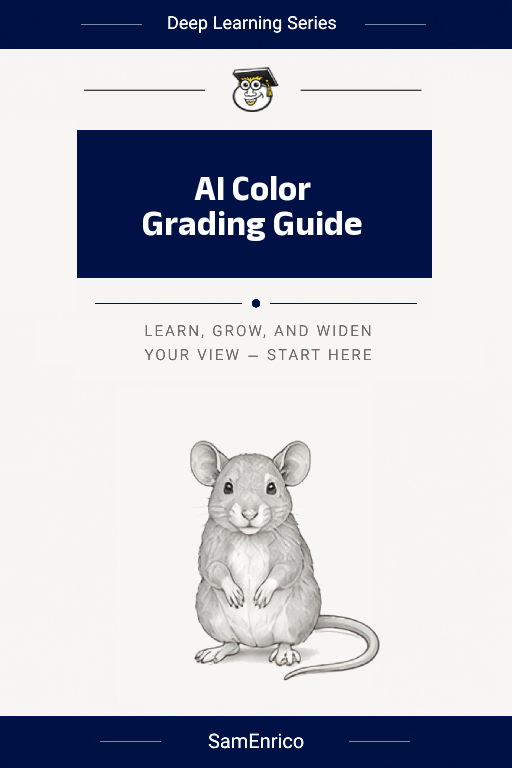
Non-FictionAI OperatorColor Grading
AI Color Grading Guide eBook
Use AI to automatically color grade video footage
Use AI to automatically color grade video footage for consistent visual style.
Formats
Free sample
Chapter 1: The Boring Middle...--–- Every colorist knows the feeling. You have just finished a rough cut. The director is happy with the pacing, the performances are locked, and the picture edit is finally approved. Then comes the moment you have been dreading: you open your color grading suite, look at the timeline, and realize you have two hundred and forty-seven clips to balance. Each clip was shot under different lighting conditions.
Some clips are from a Sony Venice on a sunny exterior. Others are from a Canon C70 inside a tungsten-lit kitchen. A handful of drone shots over a forest came in flat and green. Three interview angles from a DSLR look completely different from the main camera. And somewhere in the middle of the timeline, there is a single i Phone clip that the director fell in love with during production.You sigh.
You start the dance. Lift the shadows on clip one. Pull the gamma on clip two. Adjust the white balance on clip three. Match the exposure between clip four and clip five.
By the time you finish the first ten clips, two hours have passed. You have made exactly zero creative decisions. You have not touched a single artistic slider for mood, tone, or emotion. You have simply been fighting to make the footage look normal. This is the Boring Middle of color grading: the thousands of mechanical, repetitive, soul-crushing adjustments that consume eighty percent of a colorist's time but add absolutely nothing to the story.This book exists because the Boring Middle is finally dying.For decades, the film industry accepted mechanical color correction as an unavoidable rite of passage.
You had to balance the shots. You had to fix the white balance. You had to match the cameras. There was no shortcut because every clip was different, and only a trained human eye could decide how to make footage look consistent. Then artificial intelligence changed the rules.
Not gradually. Not politely. All at once.Today, AI systems can analyze a timeline of two hundred and forty-seven clips in seconds. They can detect every camera brand, every lens artifact, every lighting mismatch. They can balance exposure across a hundred different shots faster than you can brew a cup of coffee.
They can match the color response of a Sony Venice to an i Phone so perfectly that even a veteran colorist would struggle to tell the difference. And they can do all of this without touching a single creative slider that defines the emotional soul of your film.That last sentence is the most important one in this entire chapter.The AI Color Grading Guide is not a book about replacing artists with machines. It is a book about reclaiming your time, your energy, and your creative focus. The goal is not to push a button and walk away. The goal is to eliminate the drudgery so that you can spend your hours on what actually matters: crafting the emotional arc of a scene, building a visual language for a character, or evoking a specific memory through color.This chapter will establish the foundational problem that AI solves, define the critical distinction between correction and grading, survey the current landscape of AI color tools, and set the philosophical framework for the rest of the book.
By the time you finish reading, you will understand exactly why the Boring Middle is the enemy, and why AI is the weapon you need to defeat it.The True Cost of Manual Correction Let us put a number on the problem. A professional colorist working on a sixty-minute documentary might encounter between five hundred and fifteen hundred individual clips. For each clip, the colorist must perform at least five mechanical corrections: white balance, exposure normalization, contrast adjustment, saturation consistency, and black level setting. That is between twenty-five hundred and seventy-five hundred individual adjustments. Each adjustment requires looking at a waveform, moving a slider, checking the result against neighboring clips, and making a micro-decision.
Even at a blistering pace of ten seconds per adjustment, the math is brutal.A five hundred-clip project requires about fourteen hours of pure mechanical work before a single creative grade is applied. A fifteen hundred-clip project pushes past forty hours. That is an entire workweek spent on tasks that require no artistic judgment whatsoever. You do not need a trained colorist to tell you that a clip is too dark or too blue. You need a trained colorist to tell you whether the shadows should feel warm like a dying sunset or cold like a hospital hallway.
The first task is mechanical. The second is creative. And for decades, we have forced artists to do both.The Boring Middle has three hidden costs that most producers never calculate.First, there is the direct labor cost. A senior colorist earning seventy-five dollars per hour who spends forty hours on mechanical corrections costs the production three thousand dollars for zero creative value. That money could have paid for an additional day of shooting, a better lens rental, or a sound designer.Second, there is the opportunity cost.
While the colorist is balancing exposures, they are not developing the look book, not collaborating with the director on emotional arcs, and not experimenting with bold color choices. Every hour spent on the Boring Middle is an hour stolen from artistry.Third, and most damaging, there is the burnout cost. Mechanical work is monotonous. Monotony breeds fatigue. Fatigue breeds mistakes.
A colorist who has just spent ten hours balancing clips is far more likely to miss a subtle skin tone shift or a highlight clipping error than a fresh colorist who starts the day with creative work. The Boring Middle degrades the quality of the creative work that follows it.AI does not just speed up the Boring Middle. It eliminates it entirely.Correction vs. Grading: A Sacred Distinction Throughout this book, we will use two terms with surgical precision. Confusing them is the fastest way to misunderstand the role of AI in color work.Color correction is the set of purely technical adjustments required to make footage look normal, consistent, and physically plausible.
Correction answers questions like: Is the white balance accurate? Is the exposure within broadcast safe limits? Do the black levels match between two shots? Are skin tones free of unnatural color casts? Is the contrast appropriate for the delivery format?
Correction has a correct answer. Given the same source footage and the same technical specifications, two different colorists should arrive at nearly identical correction results. There is no artistic interpretation in correction. There is only math, physics, and engineering.Color grading is the set of subjective, narrative, and emotional adjustments that give a film its visual identity. Grading answers questions like: Should this scene feel warm or cold?
Should the shadows be crushed or lifted? Should the saturation be desaturated for a nostalgic effect or pushed for hyper-reality? Should the skin tones lean slightly golden or remain neutral? Should the highlights bloom or stay sharp? Grading has no single correct answer.
Two different colorists given the same source footage and the same script will produce two different grades, both of which could be brilliant.…
This is the end of the free sample. Get the eBook to keep going. Buy now
About this book
Details
- Author
- Vallejo Eugenia
- Publisher
- SamEnrico
- Language
- English
- Genre
- Non-Fiction, AI Operator, Color Grading
- Released
- 2026-05-29
- Pages (approx.)
- 146
- Available as
- eBook, Audiobook

Read better in the ZLOADR app
Your eBooks on your phone or tablet. Sign in with your SamEnrico account and start reading.
More by Vallejo Eugenia
 Zaire Mobutu Authenticity GuideVallejo Eugenia$11.99
 Disability Status Fitness AccessVallejo Eugenia$11.99
 Equifax Senate Hearings TranscriptVallejo Eugenia$11.99
 The Imposter Syndrome Anxiety LinkVallejo Eugenia$11.99
 Metta for MusiciansVallejo Eugenia$11.99
 The Age of Reason: Voltaire’s War of IdeasVallejo Eugenia$11.99
 A Beginners Guide to Dart Wars (Volume 1)Vallejo Eugenia$11.99
 Alibaba Logistics GuideVallejo Eugenia$12.99
 Understanding Mps Iii-dVallejo Eugenia$17.99
 Naturopathic DoctorVallejo Eugenia$11.99
You may also like
 Hong Kong Handover 1997Dunn Johnnie$11.99
 Zumba For Postnatal Recovery CourseNeal Christian$11.99
 Zumba for BeginnersLadner Nikia$11.99
 YouTube Comment Mining GuideHumes Pandora$12.99
 Worry Box MeditationCarlin Rudy$11.99
 Workplace Stress MeditationNguyen Lynn$11.99
 Workplace Stress and Sleep RepairHawley Ivory$11.99
 Workplace Perfectionism CureDelaney Jeffry$11.99
 Workplace Injustice Anger GuideWallen Isabelle$11.99
 Work Addiction and Burnout LinkGreenwood Ester$11.99
 Women in Yoga and WellnessBeattie Galina$11.99
 Women in Stand Up ComedyChun Evangeline$11.99