
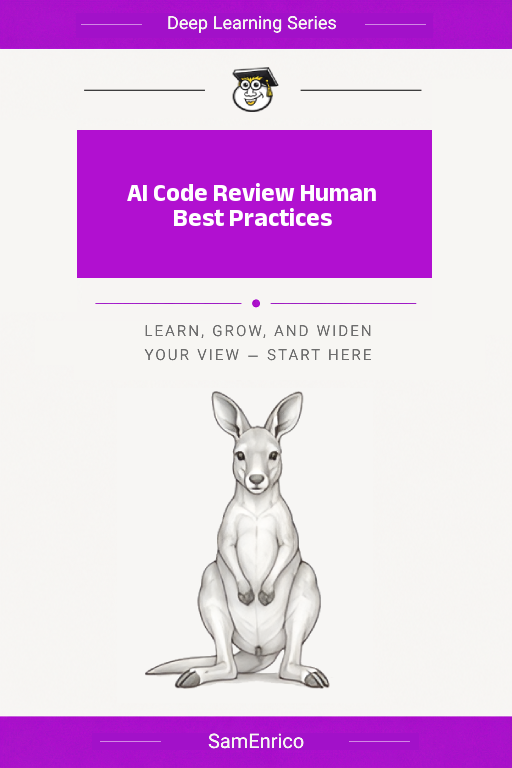
AI Code Review Human Best Practices eBook
Combine AI review with human judgment for maximum
Combine AI review with human judgment for maximum code quality.
Formats
Free sample
Chapter 1: The Silent Avalanche--Two hours into a quiet Tuesday afternoon, a senior engineer at a mid-sized fintech company named Sarah did something she had never done before in her decade of writing software: she approved a pull request without reading a single line of code.It wasn't laziness. It wasn't incompetence. It was exhaustion.The PR had been generated by an AI coding assistant on her team—a 847-line change that added a new payment validation feature. She had stared at the diff for thirty seconds, watched her eyes glaze over, and clicked "Approve." Then she closed her laptop, walked to the kitchen, and stood in silence for five minutes, wondering when her job had become this.Six hours later, that PR was merged. Three days after that, 47,000 transactions were double-processed.
The bug wasn't a complex race condition or a subtle concurrency issue. It was a single line: if (amount > 0) instead of if (amount > 0 && !already Processed). An AI reviewer—properly configured—would have caught it. A human reviewer who wasn't drowning in 847 lines of AI-generated code would have caught it.But Sarah had neither. She had an avalanche.The Mathematics of the Mess Here is the central problem this book exists to solve, stated as plainly as possible: AI coding assistants have increased the rate of code production by 200-300%, but the rate of code verification has remained almost completely flat.Let me put those numbers in human terms.Before AI coding assistants became mainstream, a productive developer might write 100-200 lines of production-ready code per day.
Code review—the process of having another human examine that code—took time, but it was roughly proportional to the code produced. A 200-line change might take 20 minutes to review. The ratio was manageable.Today, that same developer, using Git Hub Copilot, Cursor, or any of the other AI assistants now available, can generate 500-800 lines of code in a single morning. The AI handles boilerplate, writes tests, fills in repetitive patterns, and even suggests entire functions. The developer's role shifts from writing to directing—typing prompts, accepting suggestions, and making small adjustments.But here is the trap: the code review process has not accelerated at the same rate.A human reviewer still reads approximately the same number of lines per minute as they did five years ago.
A 500-line change still takes 50-60 minutes to review properly. The difference is that today, a single developer can generate three such PRs before lunch. A team of eight developers, each using AI assistants, can produce 24 substantial pull requests in a single day.The math is brutal. If each PR requires 60 minutes of human review time, that is 24 hours of review work for a team that has perhaps 8-10 collective review hours available per day. Something has to give.
And what gives, in most teams, is the quality of the review.This is the Silent Avalanche—the slow, accumulating crisis that no one notices until production breaks.The "Oh No Zone": Where Speed Outruns Safety There is a concept in aviation called the "coffin corner"—a narrow band of altitude and airspeed where a plane is simultaneously at risk of stalling and exceeding its structural limits. Move too far in either direction, and the plane falls out of the sky.Code review has its own coffin corner. I call it the Oh No Zone.The Oh No Zone is the region where the rate of code production exceeds the rate of code verification by a factor that makes thorough review impossible. Teams enter this zone gradually. First, PRs start sitting in the queue for a few extra hours.
Then a few extra days. Then developers start approving changes without reading them fully—just to keep the queue moving. Then small bugs start slipping through. Then larger ones.And then, one Tuesday afternoon, Sarah approves an 847-line PR without reading a single line.The Oh No Zone is not a binary state. It is a gradient, and most teams are already somewhere on its slope.
Here is how to tell if you are in the Oh No Zone:Early warning signs:You have more than five open PRs per reviewer on average The median PR size has increased by more than 50% in the last six months You find yourself approving PRs without expanding the files that changed Your team has started using "LGTM" (Looks Good To Me) as a formality rather than a genuine assessment Late warning signs:Post-merge hotfixes have increased by 100% or more The same simple bugs appear in production repeatedly Developers openly admit to "rubber stamping" reviews in retro meetings Your code review tool shows that the average time between PR open and first comment is less than 5 minutes (indicating no real reading occurred)Critical warning signs:A production incident was traced to a line of code that no human had ever read Reviewers have started approving PRs from authors they trust without looking at the changes Your team has normalized the phrase "just merge it, we can fix it later"If any of these sound familiar, you are in the Oh No Zone. The only question is how far down the slope you have already slid.The Burnout That No One Talks About The Silent Avalanche does not just break production—it breaks people.In 2024, a study of 10,000 software developers found that frequent users of AI coding assistants were 45% more likely to report symptoms of burnout than their colleagues who used AI sparingly or not at all. This finding surprised many. After all, AI assistants are supposed to reduce drudgery and increase satisfaction. Why would they be correlated with burnout?The answer lies in the nature of the work that remains.When AI handles the creative, generative parts of coding—the parts that feel like building, solving puzzles, making things work—the human is left with something else entirely: the drudgery of verification.
The human becomes a gatekeeper rather than a creator. And gatekeeping, done at scale, is exhausting.Consider the cognitive load. A developer writing code is in a state of flow—building mental models, testing hypotheses, experiencing the satisfaction of solving problems. A developer reviewing code is in a state of constant vigilance—scanning for errors, questioning assumptions, holding someone else's mental model in their head while also maintaining their own. Vigilance is metabolically expensive.
The brain consumes more glucose during sustained attention than during almost any other cognitive activity.Now multiply that by twenty PRs per day.The result is a specific flavor of burnout that I call Approval Fatigue. It is not the exhaustion of having worked too many hours. It is the exhaustion of having said "yes" too many times without the cognitive space to say "no" properly. It is the feeling of standing in front of an endless conveyor belt of code, knowing that each item needs your attention, knowing that you cannot possibly give each item the attention it deserves, and choosing to approve anyway because the alternative is a queue that never empties.Approval Fatigue has three distinct symptoms:The Shrinking Attention Span. Early in the day, a reviewer reads each PR carefully, expands every file, follows every thread.
By mid-afternoon, they scan the titles and approve based on author reputation. By late afternoon, they approve anything that passes…
This is the end of the free sample. Get the eBook to keep going. Buy now
About this book
Details
- Author
- Boyer Deandra
- Publisher
- SamEnrico
- Language
- English
- Genre
- Non-Fiction, AI Operator
- Released
- 2026-05-29
- Pages (approx.)
- 143
- Available as
- eBook, Audiobook

Read better in the ZLOADR app
Your eBooks on your phone or tablet. Sign in with your SamEnrico account and start reading.
More by Boyer Deandra
 LTC Insurance Claims ProcessBoyer Deandra$11.99
 Imposter Networking ConfidenceBoyer Deandra$11.99
 Breath Awareness While WalkingBoyer Deandra$11.99
 Benzodiazepine Taper HandbookBoyer Deandra$11.99
 Sleep Architecture for StudentsBoyer Deandra$11.99
 Indigenous Spiritual Lineage TracingBoyer Deandra$11.99
 Parent Time Success StoriesBoyer Deandra$11.99
 Lawyer Billable Hour AnxietyBoyer Deandra$11.99
 Armenian DeportationBoyer Deandra$11.99
 Blood and Roses: The Siege of La Rochelle - A Love Divided by FaithBoyer Deandra$11.99
 The Lost City of Troy: Schliemann's Dream and the Archaeology That Changed HistoryBoyer Deandra$11.99
 Operation Golden Fleece: The Inside Story of the FBI's Fake Art HeistBoyer Deandra$11.99
You may also like
 Hong Kong Handover 1997Dunn Johnnie$11.99
 Zumba For Postnatal Recovery CourseNeal Christian$11.99
 Zumba for BeginnersLadner Nikia$11.99
 YouTube Comment Mining GuideHumes Pandora$12.99
 Worry Box MeditationCarlin Rudy$11.99
 Workplace Stress MeditationNguyen Lynn$11.99
 Workplace Stress and Sleep RepairHawley Ivory$11.99
 Workplace Perfectionism CureDelaney Jeffry$11.99
 Workplace Injustice Anger GuideWallen Isabelle$11.99
 Work Addiction and Burnout LinkGreenwood Ester$11.99
 Women in Yoga and WellnessBeattie Galina$11.99
 Women in Stand Up ComedyChun Evangeline$11.99