
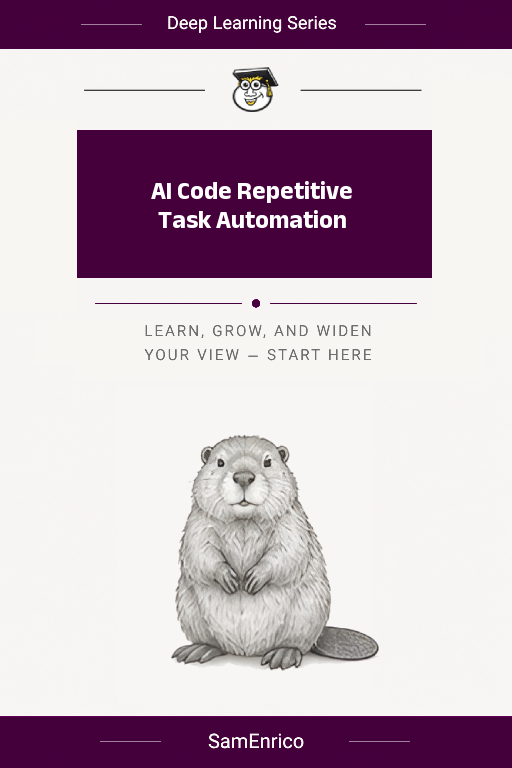
AI Code Repetitive Task Automation eBook
Use AI to generate boilerplate and repetitive code
Use AI to generate boilerplate and repetitive code patterns automatically.
Formats
Free sample
Chapter 1: The Typing Trap--I want you to imagine something.It’s 3:47 PM on a Tuesday. You’ve been coding since 9 AM. Your eyes are dry. Your coffee is cold. And you’re writing the same function you’ve written forty-seven times before.
It’s a simple CRUD endpoint—receive data, validate it, save it to a database, return a response. You could write it in your sleep. In fact, you have written it in your sleep, judging by the typos in your last commit.You finish the endpoint. You run the tests. Three fail because you forgot to handle a null case.
Again. You fix them. You push the code. And somewhere in the world, another developer is doing the exact same thing. And another.
And another. Millions of developers, typing millions of lines of repetitive code, every single day.Now I want you to imagine something else.It’s the same Tuesday, 3:47 PM. But this time, you type a single paragraph describing what you need. The AI writes the entire endpoint in three seconds—correct, tested, documented. You spend the next hour solving a real architectural problem that’s been bothering you for weeks.
You leave at 5 PM feeling energized. You play with your kids. You cook dinner. You don’t dream about semicolons.Which developer do you want to be?If you answered the second one, you’ve picked up the right book. But here’s the uncomfortable truth: most developers say they want to be the second one, yet they keep acting like the first one.
They keep typing. They keep grinding. They keep measuring their worth by lines of code written, as if we’re still living in 1995 and the compiler is powered by manual labor.The game has changed. The rules have been rewritten. And if you don’t update your operating system, you’re going to be left behind—not because AI will replace you, but because developers who use AI will outperform you so dramatically that your manual typing will look like using a rotary phone in an i Phone world.This chapter is about the fundamental shift that has to happen before you write a single prompt.
It’s about killing the part of your identity that confuses typing with productivity. It’s about becoming an architect of AI systems, not a typist of boilerplate code. And it’s about meeting Jordan—a developer who is about to go through the same transformation you are.Let’s begin.The 10x Myth That Won’t Die There’s a legend in software development. You’ve heard it. Maybe you’ve told it.
It goes like this: some developers are ten times more productive than others. They type faster. They know more shortcuts. They can hold more context in their heads. They are the mythical “10x developers.”Here’s the truth: that legend was always shaky.
Studies have tried to quantify the 10x phenomenon, and the results are all over the map. Some show a 10x difference. Others show 2x. Others show that the supposed “10x” developers just happened to work on smaller, simpler problems. The data is a mess.But even if the legend had some truth to it in the pre-AI era, it’s now officially dead.Let me explain why.Imagine two developers: Alex and Jordan.
Both are tasked with building a user authentication system—signup, login, password reset, session management.Alex is the “10x typist.” He knows every keyboard shortcut in VS Code. He can write a hundred lines of code per minute. He has memorized the entire Express.js documentation. He types the authentication system from scratch. It takes him four hours.
It’s solid. It works. He feels productive.Jordan is… slower. She’s a deliberate thinker. She types maybe thirty lines per minute.
But she’s read this book. She opens her AI tool. She writes a single prompt: “You are an expert backend developer. I need a user authentication system with signup, login, password reset, and session management. Use Node.js, Express, and JWT.
Include rate limiting, input validation, and error handling. Store passwords with bcrypt. Never hardcode secrets. Use parameterized queries.” Then she presses enter.Three seconds later, the AI returns five files: a user model, a password hashing utility, authentication routes, JWT middleware, and a test suite with twenty test cases. Jordan spends the next forty-five minutes reviewing the code, adjusting one edge case, and integrating it with her existing system.Alex took four hours.
Jordan took forty-eight minutes. Alex is supposed to be the 10x developer. But Jordan is 5x faster.Here’s the kicker: if Jordan had used a multi-agent workflow (which we’ll cover in Chapter 8), she could have cut that time even further. The 10x typist is dead. Long live the AI-augmented architect.So why do developers keep typing?Because typing feels like work.
It feels productive. It feels safe. When you type every character, you have complete control. You know exactly what’s in the file because you put it there. There’s no “magic.” No “black box.” No anxiety about what the AI might have hallucinated.I get it.
I really do. The resistance to AI is not laziness or Luddism. It’s a rational response to the fear of losing control. But here’s the thing: control is an illusion. You’ve never had complete control.
Every time you use a third-party library, you’re trusting someone else’s code. Every time you run a compiler, you’re trusting a transformation you don’t fully understand. Every time you deploy to the cloud, you’re trusting infrastructure you don’t manage.AI is just another layer of trust. But unlike a compiler, it’s a layer you can direct, constrain, and verify. And once you learn how to do that, the productivity gains are so enormous that the old way becomes indefensible.So let’s stop pretending that typing speed is a measure of skill.
Let’s stop romanticizing the grind. And let’s talk about what actually matters.What Really Makes a Great Developer in the AI Era If typing speed doesn’t matter, what does?I’ve spent the last two years studying hundreds of developers as they adopted AI tools. I’ve watched the ones who thrived and the ones who struggled. And I’ve identified three capabilities that separate the AI-augmented architects from the manual typists.Capability 1: Clarity of Intent The first capability is the ability to articulate what you want with precision. This sounds trivial, but it’s not.
Most developers, when asked what they want, say things like “write a function that processes user data.” That’s not clear. That’s a starting point for a conversation, not a specification.Clarity of intent means answering these questions before you ask the AI for anything:What is the input format? (Be specific: “a JSON object with fields: email (string, required), password (string, minimum 8 characters), name (string, optional)”)What is the output format? (Be specific: “a JSON object with fields: user Id (uuid), token (JWT), expires At (ISO timestamp)”)What are the edge cases? (Empty input?
Null? Malformed data? Duplicate emails?)What should happen on failure? (Throw an error? Return null?…
This is the end of the free sample. Get the eBook to keep going. Buy now
About this book
Details
- Author
- Dasilva Kasie
- Publisher
- SamEnrico
- Language
- English
- Genre
- Non-Fiction, AI Operator
- Released
- 2026-06-01
- Pages (approx.)
- 147
- Available as
- eBook, Audiobook

Read better in the ZLOADR app
Your eBooks on your phone or tablet. Sign in with your SamEnrico account and start reading.
More by Dasilva Kasie
 Nursing Home LTC Insurance GuideDasilva Kasie$11.99
 Peer Support Networks In Low Resource AreasDasilva Kasie$11.99
 Imposter Retirement IdentityDasilva Kasie$11.99
 Breath Awareness for Headache ReliefDasilva Kasie$11.99
 Indigenous Cosmology LeadershipDasilva Kasie$11.99
 Morning Recall Boost GuideDasilva Kasie$11.99
 Accountant Tax Season SurvivalDasilva Kasie$11.99
 Transcendental Meditation OriginsDasilva Kasie$11.99
 Parent Time Cheat SheetDasilva Kasie$11.99
 The Last Broadcast: How a 1938 Radio Play Fooled a NationDasilva Kasie$11.99
 The Invisible Line: How a 19th-Century Survey Mistake Reshaped Two NationsDasilva Kasie$11.99
 The Fire Makers of Karakoram: Ancient Explorers of Central Asia’s Volcanic WondersDasilva Kasie$11.99
You may also like
 Hong Kong Handover 1997Dunn Johnnie$11.99
 Zumba For Postnatal Recovery CourseNeal Christian$11.99
 Zumba for BeginnersLadner Nikia$11.99
 YouTube Comment Mining GuideHumes Pandora$12.99
 Worry Box MeditationCarlin Rudy$11.99
 Workplace Stress MeditationNguyen Lynn$11.99
 Workplace Stress and Sleep RepairHawley Ivory$11.99
 Workplace Perfectionism CureDelaney Jeffry$11.99
 Workplace Injustice Anger GuideWallen Isabelle$11.99
 Work Addiction and Burnout LinkGreenwood Ester$11.99
 Women in Yoga and WellnessBeattie Galina$11.99
 Women in Stand Up ComedyChun Evangeline$11.99