
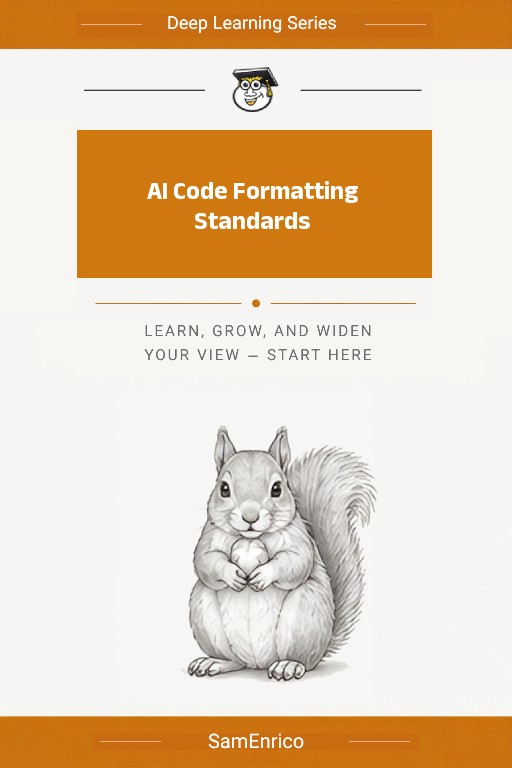
AI Code Formatting Standards eBook
Enforce consistent code style across teams using A
Enforce consistent code style across teams using AI-powered formatters.
Formats
Free sample
Chapter 1: The 15% Tax--–- Sarah had been a staff engineer for eleven years. She had architected systems that handled millions of requests per second, debugged race conditions that haunted her dreams, and once saved her company two million dollars by rewriting a single database query. But on this particular Tuesday afternoon, she found herself doing something that made her question her career choices: she was arguing about a trailing comma.The pull request had been open for four hours. It contained one hundred and forty-seven lines of genuinely good code – a clever optimization to the payment processing pipeline that would reduce latency by eighteen percent. Sarah had reviewed the logic, verified the edge cases, and approved the architecture.
But she had not approved the trailing comma.Or rather, she had not approved the absence of a trailing comma. The author, a talented junior developer named Marcus, had written:javascript Copy Downloadconst options = { retry: 3, timeout: 5000 }Sarah preferred:javascript Copy Downloadconst options = { retry: 3, timeout: 5000, }The debate consumed forty-five minutes. Marcus argued that trailing commas were unnecessary and added visual noise. Sarah argued that they improved git diffs and made additions cleaner. Two other senior engineers weighed in.
One cited the Java Script documentation. Another invoked the name of a prominent open-source maintainer as if it were scripture. The pull request sat idle. The payment processing pipeline remained unoptimized.That evening, Sarah calculated the cost. Her salary, annualized, came to approximately one hundred and twenty dollars per hour.
Marcus was at sixty-five. The two seniors were at one hundred and ten each. Forty-five minutes of collective engineering time cost roughly two hundred and thirty dollars. Multiplied across the company’s four hundred engineers, each formatting disagreement – each tabs-versus-spaces debate, each brace-placement skirmish, each line-wrapping battle – was not a technical discussion. It was a line item in the budget.She called it the 15% Tax.
And she had no idea yet that artificial intelligence would be the thing that finally let her stop paying it.The Forensic Accounting of Stupid Arguments Let us begin with a confession: nearly every software engineer reading this book has wasted at least one hour this month on formatting disputes. You know exactly which arguments I am talking about. They are the ones that appear in pull request comments with a distinctive tone – not the collaborative curiosity of genuine architectural debate, but the weary exasperation of someone who has explained the same style rule for the twelfth time.The top ten style wars, ranked by hours lost across the industry, form a kind of anti-canon of software engineering:Tabs versus spaces – The oldest and most emotionally charged. Tabs are semantically pure (one character, one level of indentation). Spaces are visually consistent (the same width everywhere).
Neither position has ever changed anyone's mind.Line length – Eighty characters? One hundred? One hundred twenty? The original eighty-character limit was born from the physical constraints of IBM punch cards. We kept it because of tradition, not teleology.Trailing commas – As seen in Sarah’s tragedy.
The pro-comma faction cites cleaner diffs. The anti-comma faction cites JSON incompatibility and visual clutter. Both are correct. Neither will surrender.Semicolons in Java Script – Automatic Semicolon Insertion (ASI) makes them optional. Optional things become battlegrounds.
The semicolon faithful argue for explicitness. The semicolon skeptics argue for minimalism. The language itself remains indifferent.Brace placement – K&R style (opening brace on the same line) versus Allman style (opening brace on its own line). This debate has ended friendships. I am not exaggerating.Spaces around operators – a+b versus a + b.
The difference is one keystroke. The emotional investment is infinite.Quotation marks – Single quotes versus double quotes in Java Script, Python, and others. The correct answer is “whatever the existing codebase uses.” The actual answer is a forty-comment thread citing three different style guides.Indentation width – Two spaces? Four spaces? Eight spaces?
The visual difference is millimeters. The cognitive load difference is measurable in hours per month.Newline at end of file – POSIX standards require it. Git complains without it. Developers forget it. Reviewers point it out.
The cycle repeats forever.Spaces inside brackets – [1, 2, 3] versus [1,2,3] versus [ 1, 2, 3 ]. I have seen people physically angry about this.Let us perform a simple calculation. The average software engineer produces approximately two thousand lines of code per month across ten to fifteen pull requests. Each pull request receives, on average, eight comments. Of those eight comments, the research is surprisingly consistent: between fifteen and twenty-two percent are exclusively about formatting.
That is one to two comments per pull request. Each comment takes, on average, three minutes to write and two minutes to read and respond to. Multiply by the number of engineers on your team. Multiply by the number of teams in your organization. Multiply by the number of months in a year.The 15% Tax is not a metaphor.
It is a line item.Cognitive Load Theft The cost of formatting disputes is not merely financial. It is neurological.Cognitive load refers to the total amount of mental effort being used in working memory. When a senior engineer reviews code, their brain is performing a complex dance of pattern recognition, logical verification, and architectural synthesis. They are asking questions like: Does this function handle the null case correctly? Is there a race condition in this async flow?
Does this abstraction leak implementation details? These are high-value, high-load cognitive tasks.Every time that same engineer writes a comment about a missing trailing comma, they are performing a low-load task. The problem is not the task itself. The problem is the task switch.Research from the University of California, Irvine, has shown that it takes an average of twenty-three minutes to return to a complex task after an interruption. A single formatting comment on a pull request does not just cost the three minutes to write it.
It costs twenty-three minutes of context recovery for the reviewer and twenty-three minutes for the author, who must stop their current work, read the comment, understand it, make the change, and re-engage with whatever they were doing before.Suddenly, that three-minute comment is a fifty-minute productivity sink.I call this cognitive load theft – the silent process by which trivial formatting disputes steal focused engineering time from the problems that actually matter. And unlike a conscious decision to spend time on architecture, cognitive load theft is invisible. It does not appear on any dashboard. It does not trigger any alert. It simply accumulates, hour by hour, week by week, until engineers burn out without understanding why they feel so perpetually interrupted.The Formatting Friction Log Before we can fix a problem, we must measure it.
This chapter introduces a simple tool that will appear throughout the book: the Formatting Friction Log.For the next two weeks, every time you or a teammate leaves a formatting comment on a pull request – every tabs-versus-spaces debate, every trailing comma discussion, every brace placement disagreement – record it. Use this template:text Copy Download Date: [YYYY-MM-DD] PR Link: [URL] Time Spent (mins): [X] Rule Disputed: [e.g., trailing commas] Outcome: [Changed / Rejected / Compromised] Estimated Cost: [Time spent × hourly rate]Do not cheat. Do not exclude the “quick” comments. The three-second comments are still interruption…
This is the end of the free sample. Get the eBook to keep going. Buy now
About this book
Details
- Author
- Thibodeaux Jenette
- Publisher
- SamEnrico
- Language
- English
- Genre
- Non-Fiction, AI Operator
- Released
- 2026-05-30
- Pages (approx.)
- 133
- Available as
- eBook, Audiobook

Read better in the ZLOADR app
Your eBooks on your phone or tablet. Sign in with your SamEnrico account and start reading.
More by Thibodeaux Jenette
 The Gacy Police FailuresThibodeaux Jenette$11.99
 Self Funding LTC Alternative GuideThibodeaux Jenette$11.99
 School Based Mental Health Access GuideThibodeaux Jenette$11.99
 Fourth Tetrad: Breathing with RealityThibodeaux Jenette$11.99
 The Sobriety Dating PlanThibodeaux Jenette$11.99
 Hidalgo DoloresThibodeaux Jenette$11.99
 FCPA Whistleblower CasesThibodeaux Jenette$11.99
 TM For InsomniaThibodeaux Jenette$11.99
 Depressed Parent ChildhoodThibodeaux Jenette$11.99
 The Last Empress: How a Queen Walked Away from PowerThibodeaux Jenette$11.99
 The Vanishing Diplomat: The Cold War's Most Dangerous Double AgentThibodeaux Jenette$11.99
 Lost in the Green Abyss: The Tragic Expedition of Paul Du Chaillu and the Pygmies of the CongoThibodeaux Jenette$11.99
You may also like
 AI Presentation WorkbookSommers Tonda$11.99
 PowerPoint Copilot MasteryConway Lanita$11.99
 Branded AI DecksWindham Loni$11.99
 AI Presentation CourseGrooms Olin$11.99
 AI Presentation CertificationBlank Dolly$11.99
 AI Deck Version ControlMedley Lorina$11.99
 AI Deck Update AutomationFraser Tresa$11.99
 AI Deck Myths DebunkedCrittenden Romelia$11.99
 AI Deck Customization GuideDove Hannelore$11.99
 AI Bullet to Slide ConverterKohn Eloisa$11.99
 AI Deck Notes CreatorBarela Sunday$11.99
 AI Deck Outline GeneratorAshmore Morgan$11.99