
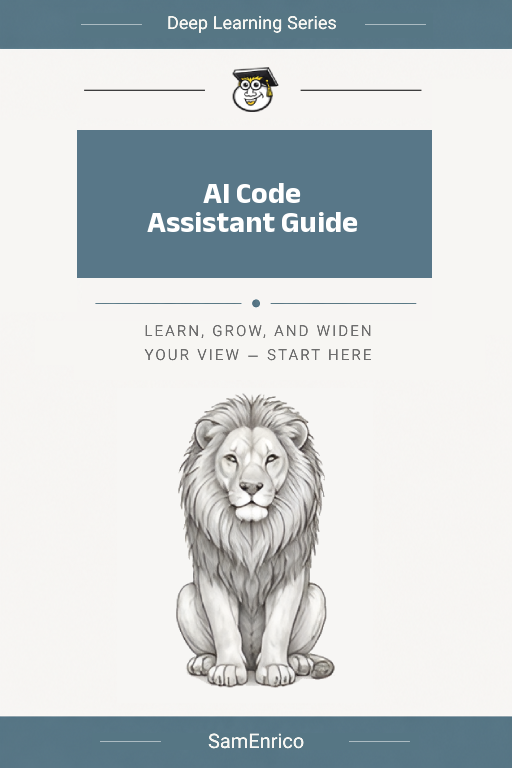
Non-FictionAnnual CheckupCoding AI
AI Code Assistant Guide eBook
Use GitHub Copilot, Tabnine, or Amazon CodeWhisper
by Abney Dede
Use GitHub Copilot, Tabnine, or Amazon CodeWhisperer to write code for business apps.
Formats
Free sample
Chapter 1: The Last Typist...--If you are reading this sentence, you have already written your last line of code that matters.Not your last line of code ever. You will write millions more lines. But the last line where the physical act of typing — the translation of thought into keystroke, the careful indentation, the semicolon that took three seconds to find — was the bottleneck. That era ended approximately eighteen months ago, though most developers haven't realized it yet. They are still measuring productivity in lines per minute, still celebrating the speed of their autocomplete, still treating the keyboard as if it were the primary tool of their trade.It is not.
The primary tool of the 2026 software engineer is no longer the keyboard. It is attention.This book will teach you to use Git Hub Copilot, Tabnine, and Amazon Code Whisperer to build business applications. But if you came here expecting a glorified user manual — a set of keystroke-by-keystroke instructions for getting slightly faster autocomplete — you have picked up the wrong book and should put it down now. What follows is not a reference guide. It is a transformation manual for engineers who want to survive the next five years and thrive in the next ten.The thesis of this book, stated plainly and without apology, is this: Typing code is now a commodity.
The engineer who refuses to use AI will be as productive as the engineer who refused to use Stack Overflow in 2010 — unemployable within three years. But the engineer who mindlessly accepts every AI suggestion will be worse than useless; they will actively destroy the codebase with plausible-sounding nonsense, security holes, and technical debt that accrues interest overnight.Somewhere between Luddite and Lemming lies the path of the Orchestrator — the developer who treats AI assistants as junior developers who work for free, never sleep, and occasionally hallucinate. Your job is no longer to write every function. Your job is to decide which functions need to be written, review what the AI produces, and verify that the business logic actually matches what the product manager asked for three weeks ago in a meeting you barely remember.This chapter establishes the historical and technical context for why 2026 is the "Golden Age" of AI pair programming, then delivers a rigorous comparative analysis of the three dominant enterprise-grade assistants. By the end, you will know exactly which tool to reach for based on your industry, your compliance requirements, and your cloud provider.
You will also understand why "vibe coding" — the increasingly popular philosophy of coding by feel and intent without rigorous verification — is a disaster waiting to happen for any business application that handles money, personal data, or compliance obligations.Let us begin with a story.The 90-Minute Morning That Changed Everything In January 2025, a senior engineer named Priya walked into her office at a mid-sized logistics company. She had been dreading the day's task: modernizing a 200-line COBOL routine that calculated shipping insurance premiums. The routine had been written in 1987, modified twelve times by eleven different engineers (none of whom worked at the company anymore), and contained business rules that existed nowhere in written documentation — only in the logic of the code itself.Priya estimated the work would take her team of three engineers approximately two weeks. They would need to reverse-engineer the business rules, rewrite the logic in Python, write unit tests, and validate the output against historical data. Two weeks of focused, tedious, high-stakes work.
Any mistake would miscalculate insurance premiums, leading to angry customers or lost revenue.She opened her IDE and, out of curiosity, pasted the COBOL routine into Amazon Code Whisperer with a simple prompt: "Rewrite this COBOL routine in Python. Preserve all business logic. Add unit tests for edge cases. Flag any ambiguous rules."Ninety seconds later, Code Whisperer returned 180 lines of Python, ten unit tests, and a flagged list of three ambiguous rules where the original COBOL logic contradicted itself depending on input order. Priya spent the next ninety minutes — not two weeks — reviewing the code, resolving the ambiguities with the business team, and running validation tests against historical data.By lunchtime, the task was done.
Her team of three engineers had just been freed from two weeks of work. They spent the afternoon refactoring other legacy modules, fixing bugs that had been ignored for years, and documenting the system.That is the power of AI code assistants when used correctly. But here is the crucial detail: Priya did not trust the AI. She verified every line. She used the AI to handle the translation — the mechanical work of converting COBOL syntax to Python syntax — but she applied her human judgment to the business logic, the edge cases, and the validation strategy.Contrast Priya's approach with a junior developer on her team who, around the same time, used Git Hub Copilot to generate a React component for a customer dashboard.
He accepted every suggestion Copilot offered, never questioned the logic, and committed the code without writing a single test. The component worked — until a customer with a null shipping address triggered an unhandled exception that crashed the entire dashboard for all users. The bug cost the company four hours of incident response, a post-mortem, and a customer apology email.The difference between Priya and her junior colleague was not intelligence or experience. It was workflow. Priya had a disciplined process for AI collaboration; the junior developer did not.
This book will give you that process.The Evolution from Autocomplete to Architect To understand where we are, you must understand how we got here. The journey from Intelli Sense to Git Hub Copilot is not a straight line of incremental improvement — it is a series of discontinuous leaps that have fundamentally changed the nature of software development.Phase 1: Syntax Highlighting and Basic Autocomplete (1980s–2000s). Your editor knew the keywords of the language. It could suggest if when you typed i. This was not intelligence; it was a lookup table.
The developer was still the sole generator of logic.Phase 2: Intelli Sense and Static Analysis (2000s–2015). Your IDE understood types. It could suggest methods available on an object, catch typos in variable names, and refactor across files. This was intelligence of a sort — but it was deterministic intelligence. The same input always produced the same output.
The developer was still the author; the IDE was a sophisticated assistant.Phase 3: Code Completion with Machine Learning (2015–2020). Tools like Tab Nine (the precursor to Tabnine) introduced neural networks that learned from your codebase. They could predict the next few tokens based on patterns they had seen elsewhere. This was probabilistic intelligence. The same input could produce different outputs depending on training data.
The developer began sharing authorship with a statistical model.Phase 4: Generative AI Pair Programming (2021–present). Git Hub Copilot (launched 2021), Tabnine (rebranded and expanded), and Amazon Code Whisperer (launched 2022) introduced models that understand not just the next token but the intent of a function based on its name, comments, and surrounding context. These models can generate entire functions, test suites, and documentation from natural language prompts. The developer is no longer the sole author — they are an editor and verifier of AI-generated code.Phase…
This is the end of the free sample. Get the eBook to keep going. Buy now
About this book
Details
- Author
- Abney Dede
- Publisher
- SamEnrico
- Language
- English
- Genre
- Non-Fiction, Annual Checkup, Coding AI
- Released
- 2026-06-01
- Pages (approx.)
- 142
- Available as
- eBook, Audiobook

Read better in the ZLOADR app
Your eBooks on your phone or tablet. Sign in with your SamEnrico account and start reading.
More by Abney Dede
 Post Hypnotic Suggestion CourseAbney Dede$11.99
 Breath Awareness for PanicAbney Dede$11.99
 Stress First Aid WorkbookAbney Dede$11.99
 Acupuncture for Anxiety ReliefAbney Dede$11.99
 TikTok Aesthetic Perfection GuideAbney Dede$11.99
 The Icebound Tycoon: James Ross and the Lost Expedition of the ErebusAbney Dede$11.99
 Pets.com: The $300 Million Puppet That Ruined EverythingAbney Dede$11.99
 How to Become a Contract SpecialistAbney Dede$11.99
 Collateral SpecialistAbney Dede$11.99
 Freepik Mobile GuideAbney Dede$12.99
 Understanding Dwarfism Stiff Joint Ocular AbnormalitiesAbney Dede$17.99
You may also like
 Hong Kong Handover 1997Dunn Johnnie$11.99
 Zumba For Postnatal Recovery CourseNeal Christian$11.99
 Zumba for BeginnersLadner Nikia$11.99
 YouTube Comment Mining GuideHumes Pandora$12.99
 Worry Box MeditationCarlin Rudy$11.99
 Workplace Stress MeditationNguyen Lynn$11.99
 Workplace Stress and Sleep RepairHawley Ivory$11.99
 Workplace Perfectionism CureDelaney Jeffry$11.99
 Workplace Injustice Anger GuideWallen Isabelle$11.99
 Work Addiction and Burnout LinkGreenwood Ester$11.99
 Women in Yoga and WellnessBeattie Galina$11.99
 Women in Stand Up ComedyChun Evangeline$11.99