
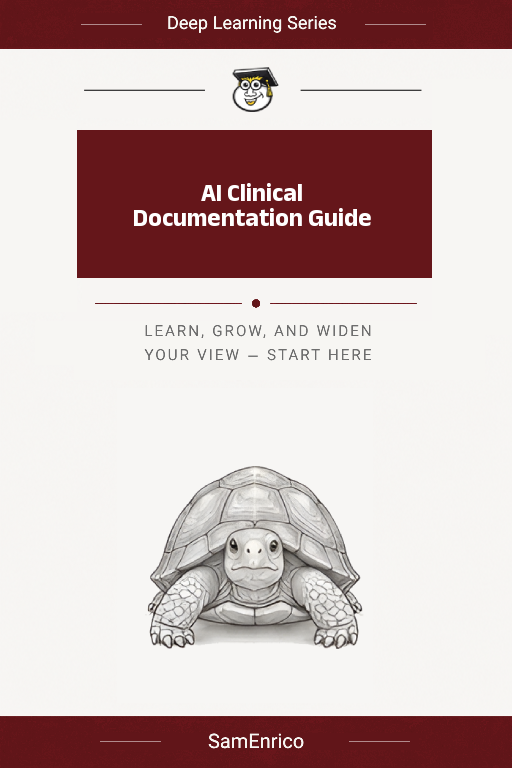
Non-FictionForecast & OutlookClinical AI
AI Clinical Documentation Guide eBook
Learn how ambient voice scribes automatically gene
by Weber Debbie
Learn how ambient voice scribes automatically generate SOAP notes and billing codes during patient consultations.
Formats
Free sample
Chapter 1: The Last Fifteen...-- The Tuesday that changed everything began like any other. Dr. Maya Chen walked into Maplewood Family Practice at 7:15 AM, coffee in hand, ready to face the 22 patients on her schedule. She had been a family physician for eleven years—long enough to know the rhythms of the practice, the names of the receptionist's children, and the exact number of minutes she could spend with each patient before the documentation avalanche buried her.By 7:30 AM, she had pre-charted three patients. By 8:00 AM, she had reviewed fifteen lab results, responded to eight portal messages, and signed off on four refill requests.
Her first patient was already waiting. The day had not yet begun, and she was already behind.This is not a story about a bad doctor. This is a story about a broken system—and the technology that finally offers a way out.The Arithmetic of Exhaustion The numbers are almost too stark to believe, yet every practicing clinician lives them. For every hour of direct patient care, clinicians spend approximately two hours on electronic health record (EHR) documentation. A 2019 study in the Annals of Internal Medicine analyzed over 100 million EHR interactions and found that for every eight-hour clinical day, physicians averaged five to six hours of after-hours documentation.
Another hour was spent documenting during patient visits, typing while the patient spoke, eyes fixed on a screen instead of a suffering human being.Let us do the math together. A primary care physician seeing 20 patients per day spends roughly 15 minutes in the room with each patient. That is 300 minutes—five hours—of face-to-face care. But the documentation for those 20 visits requires an additional 10 hours. Where do those hours come from?
They come from lunch breaks (eaten over a keyboard). They come from evenings (dinner at 9 PM, if at all). They come from weekends (charting alongside soccer practice highlights on a second screen). They come, most devastatingly, from the margins of family life—the bedtime stories missed, the spouse's hand left unheld, the child's recitation of the day's events heard only in fragments between keystrokes.The math is unsustainable. And the human cost is catastrophic.More than 50 percent of physicians now report experiencing at least one symptom of burnout: emotional exhaustion, depersonalization (viewing patients as objects rather than people), and a diminished sense of personal accomplishment.
Among emergency physicians and intensivists, the rate exceeds 60 percent. Among residents in their first year of training, it approaches 70 percent. These are not weak or lazy professionals. These are the best and brightest of their generation, selected through brutal competition, trained for a decade, and then thrown into a documentation system that treats them as data-entry clerks with medical degrees.The Binary Choice That Defines Modern Medicine Here is the truth that no medical school teaches, no residency prepares for, and no administrator fully acknowledges: every patient encounter forces the clinician into an impossible binary choice.Choice A: Maintain eye contact, listen actively, and be fully present. This is the medicine you dreamed of practicing.
This is why you went into healthcare—to sit with suffering, to hear the subtext beneath the words, to notice the tremor in the hand that the patient is too embarrassed to mention. But if you choose presence, your note will be incomplete. You will forget to document that the patient denied chest pain. You will miss the Review of Systems question about night sweats. You will fail to justify the billing level, and the claim will be denied.
The next morning, you will receive an angry email from billing. The patient will receive an unexpected bill. And somewhere in the dark arithmetic of healthcare finance, you will be penalized for being human.Choice B: Document continuously throughout the visit. Type while the patient speaks. Keep your eyes on the screen.
Let the EHR be your primary conversation partner. If you choose efficiency, your notes will be complete. Your billing will be accurate. Your RVUs (relative value units) will shine. But the patient will feel unheard.
The therapeutic alliance—the single most powerful predictor of positive health outcomes—will erode with every keystroke. Studies show that when physicians type during visits, patients perceive lower empathy, lower satisfaction, and lower trust. They are less likely to adhere to treatment recommendations. They are more likely to seek care elsewhere. And somewhere in the quiet geography of the human heart, a connection fails to form.This is the binary.
It is false. It is cruel. And for the past two decades, it has been inescapable.Dr. Chen knows this binary intimately. On Tuesday morning, her third patient was a 68-year-old man with uncontrolled diabetes and a new limp.
He had been avoiding the clinic for months because his wife died of pancreatic cancer the previous year, and the building itself felt like a mausoleum of memory. He needed more than medication adjustments. He needed someone to see his grief. But Dr. Chen had 12 minutes left in the appointment slot, a full inbox of unreviewed labs, and a note from the previous patient that was already two hours old.She chose the screen.
She typed while he spoke. She captured every relevant detail—the A1c of 8.9, the new swelling in the left ankle, the medication list that included metformin and glipizide but not the SGLT2 inhibitor he actually needed. The note was perfect. The connection was not.That evening, driving home at 7:45 PM, Dr. Chen cried in her car.
Not from sadness, exactly. From something worse: the quiet recognition that she had become the doctor she never wanted to be.The Promise of Something Invisible But what if the binary was never necessary? What if there was a third option—a technology so seamless, so unobtrusive, that it simply disappeared into the background of care?Enter ambient intelligence. The term sounds futuristic, perhaps even threatening. But in the context of clinical documentation, it describes something surprisingly simple: artificial intelligence that passively listens to the patient-clinician conversation, processes the audio into structured data, and generates a complete clinical note—without any active effort from the clinician.Let us be precise about what ambient intelligence is not.
It is not voice dictation, which requires the clinician to press a button, speak in complete sentences, and actively narrate the encounter. Dictation is faster than typing, but it still demands cognitive effort. It interrupts the flow of conversation. It turns the clinician into a narrator rather than a listener.Ambient intelligence is also not a human scribe. Human scribes are wonderful—they allow clinicians to focus on patients while another person handles the documentation.
But scribes are expensive (often $20-30 per hour), require training and supervision, introduce another person into the exam room (which some patients find intrusive), and are unavailable for after-hours calls or home visits.Ambient intelligence is something else entirely. It is a microphone—often a smartphone placed discreetly on the desk or a dedicated device clipped to a lanyard—that captures the natural dialogue between clinician and patient. The AI does not need to be triggered. It does not require special phrases or structured commands. It simply listens, distinguishes between voices, extracts the clinically relevant information, and generates a SOAP note (Subjective…
This is the end of the free sample. Get the eBook to keep going. Buy now
About this book
Details
- Author
- Weber Debbie
- Publisher
- SamEnrico
- Language
- English
- Genre
- Non-Fiction, Forecast & Outlook, Clinical AI
- Released
- 2026-05-30
- Pages (approx.)
- 134
- Available as
- eBook, Audiobook

Read better in the ZLOADR app
Your eBooks on your phone or tablet. Sign in with your SamEnrico account and start reading.
More by Weber Debbie
 Breath Awareness For Weight LossWeber Debbie$11.99
 Yoga Based Stretching RoutineWeber Debbie$11.99
 Franchise Builder's Teen Hiring SuccessWeber Debbie$11.99
 Weekly Wins ReviewWeber Debbie$11.99
 The Great American Heist: How the U.S. Government Stole $400 Million in Gold from the PhilippinesWeber Debbie$11.99
 The Djinn’s Bargain: A Thousand and One Nights’ Unseen TaleWeber Debbie$11.99
 Information Security AdministratorWeber Debbie$11.99
 Understanding Hypertrophic HemangiectasiaWeber Debbie$17.99
 Medical Billing And Coding PrimerWeber Debbie$12.99
 How to Start a Patchwork BusinessWeber Debbie$11.99
You may also like
 Hong Kong Handover 1997Dunn Johnnie$11.99
 Zumba For Postnatal Recovery CourseNeal Christian$11.99
 Zumba for BeginnersLadner Nikia$11.99
 YouTube Comment Mining GuideHumes Pandora$12.99
 Worry Box MeditationCarlin Rudy$11.99
 Workplace Stress MeditationNguyen Lynn$11.99
 Workplace Stress and Sleep RepairHawley Ivory$11.99
 Workplace Perfectionism CureDelaney Jeffry$11.99
 Workplace Injustice Anger GuideWallen Isabelle$11.99
 Work Addiction and Burnout LinkGreenwood Ester$11.99
 Women in Yoga and WellnessBeattie Galina$11.99
 Women in Stand Up ComedyChun Evangeline$11.99