
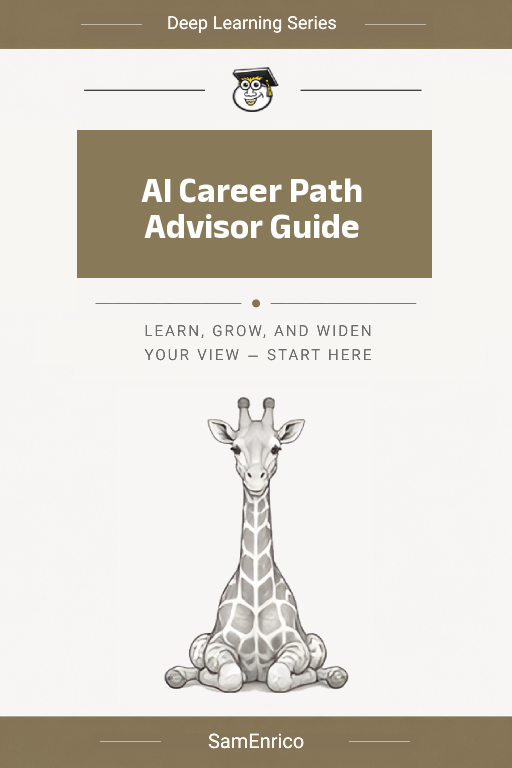
Non-FictionForecast & OutlookCareer Tech
AI Career Path Advisor Guide eBook
Explore algorithms matching student skills, intere
by Gough Kyoko
Explore algorithms matching student skills, interests, and labor market data to career recommendations.
Formats
Free sample
Chapter 1: The Psychology Trap--–- Every career decision begins with a lie we tell ourselves. Not a malicious lie, but a comforting one: the belief that we know ourselves well enough to plan our future. We take personality quizzes that ask whether we prefer parties or books, then stare at four-letter codes as if they were prophecies carved in stone. We list our skills as "Microsoft Office" and "team player," ignoring the fact that these phrases mean nothing to an algorithm—or to an employer desperate for someone who can actually do the job. We answer questions about whether we like helping people or working with data, as if those were mutually exclusive tribes.
And then we wonder why career guidance has never worked.The truth is that the traditional tools of career counseling—Myers-Briggs, Holland Codes, Strong Interest Inventory—were designed for a world that no longer exists. They were created in an era when a career meant a single company, a single function, and a forty-year march to a gold watch. They assumed stability. They assumed that the jobs of tomorrow would resemble the jobs of yesterday. And they assumed that a human being could be reduced to a handful of categories without losing something essential.They were wrong.This chapter dismantles those assumptions.
Before we can build an AI system that matches people to careers, we must first build a model of the person that is worthy of the name. That means moving beyond personality quizzes and into a dynamic, multi-dimensional understanding of human potential. It means distinguishing between what you have done and what you are willing to learn. It means measuring your belief in your own growth. And it means understanding whether you want machines to do your work for you or to help you do it better.This is not psychology for its own sake.
Every variable we introduce in this chapter will become a mathematical input to the matching engine in Chapter 5. Every score we calculate will influence which jobs the system recommends and which it hides. If we get the psychology wrong, the algorithm will be wrong—no matter how sophisticated its math.So let us begin by admitting that we do not know ourselves as well as we think. And let us build a better way.The Failure of the Four-Letter Box The most popular personality assessment in corporate history, the Myers-Briggs Type Indicator, was created by a mother and daughter with no formal training in psychology. Katherine Briggs and Isabel Briggs Myers were fascinated by Carl Jung's theories, so they turned his abstract archetypes into a questionnaire.
The result is a test that sorts people into sixteen boxes based on four binaries: Extraversion vs. Introversion, Sensing vs. Intuition, Thinking vs. Feeling, Judging vs. Perceiving.Here is what the research says about that test: it is essentially useless for predicting job performance, career satisfaction, or retention.
A comprehensive review by the National Academy of Sciences found no compelling evidence that Myers-Briggs types correlate with occupational outcomes. The test fails the most basic criterion of psychological measurement—test-retest reliability. Take it twice, and you have a fifty-fifty chance of getting a different type. Half the people who are classified as INTJ (the "Architect") on Monday will be something else by Friday.The Holland Codes (RIASEC: Realistic, Investigative, Artistic, Social, Enterprising, Conventional) are slightly better, but only because they measure interests rather than personality. Research shows that interests are moderately stable over time and have some predictive power for career choice.
A person who loves tinkering with engines is more likely to become a mechanic than a poet. That is not nothing. But it is also not enough.The problem with these legacy tools is not that they are wrong about everything. It is that they are static, self-reported, and coarse-grained. They ask you to describe yourself in the abstract, without any behavioral data to ground your answers.
They collapse the complexity of human motivation into a handful of categories. And they assume that who you are today is who you will be tomorrow—an assumption that flies in the face of decades of research on adult development.A career guidance system built for the age of AI cannot rely on these tools. It needs a model of the person that is dynamic (changing as the user learns and grows), behavioral (based on what users actually do, not just what they say), and granular (capturing dozens or hundreds of dimensions, not four or six).This chapter introduces three such dimensions. They are not the only possible dimensions, but they are the most important ones that existing systems miss. Each one is measurable, algorithmically useful, and directly relevant to career outcomes.Dimension One: Skill Versus Will The first question any career advisor should ask is not "What are you good at?" but rather "What are you willing to work hard at?" The distinction between skill and will is the difference between demonstrated ability and performed motivation.
You may have a natural talent for mathematics, but if you find solving equations tedious, you will burn out as an actuary. Conversely, you may struggle with public speaking, but if you are deeply motivated to communicate ideas, you will improve faster than anyone expects.Research by psychologist Angela Duckworth popularized the concept of "grit"—passion and perseverance for long-term goals. Her studies at West Point, the National Spelling Bee, and the Chicago public schools found that grit was a better predictor of retention and success than IQ, SAT scores, or physical fitness. Cadets with higher grit scores were more likely to survive the brutal first summer of Beast Barracks. Spelling bee finalists with higher grit spent more hours practicing.
Teachers with higher grit were more likely to stay in the profession.What makes grit so powerful as a predictor is that it captures something that skill tests miss: the willingness to persist through failure. A high-skill, low-grit person will excel in controlled environments where the path is clear and the rewards are immediate. They will struggle in careers that require resilience, adaptability, and the ability to learn from setbacks. A low-skill, high-grit person may start slowly, but they will outrun their peers over long distances.For our AI career advisor, grit is not a fixed trait. It is measured through a combination of self-report (short questions about how often you give up on difficult tasks) and behavioral data (how long you persist on challenging exercises in the system).
A user who abandons a logic puzzle after thirty seconds is different from a user who tries for ten minutes before requesting a hint. Those behaviors are data.The algorithmic implication is straightforward: users with high grit scores should be shown "stretch" recommendations—careers that require significant upskilling but offer high long-term rewards. Users with low grit scores should be shown "fit" recommendations—careers that align closely with their existing skills and interests, minimizing the need for sustained effort. This is not a judgment. It is an efficiency principle.
A low-grit user can still succeed in a stretch role, but the probability of attrition is higher, and the advisor should flag that risk.Dimension Two: The Neuroplasticity Quotient If grit…
This is the end of the free sample. Get the eBook to keep going. Buy now
About this book
Details
- Author
- Gough Kyoko
- Publisher
- SamEnrico
- Language
- English
- Genre
- Non-Fiction, Forecast & Outlook, Career Tech
- Released
- 2026-05-29
- Pages (approx.)
- 148
- Available as
- eBook, Audiobook

Read better in the ZLOADR app
Your eBooks on your phone or tablet. Sign in with your SamEnrico account and start reading.
More by Gough Kyoko
 New Zealand Home Energy GrantsGough Kyoko$11.99
 YouTube Comments Comparison GuideGough Kyoko$11.99
 Key Results That Actually WorkGough Kyoko$11.99
 Opioid Use Disorder Pregnancy GuideGough Kyoko$11.99
 The Great Post Office Strike: When Britain’s Mail StoppedGough Kyoko$11.99
 Understanding Ichthyosis Linearis CircumflexaGough Kyoko$17.99
 How to Start a British Computer Society Business (Beginners Guide)Gough Kyoko$11.99
 H-1B Visa Annual Guide 2025Gough Kyoko$12.99
 Medical CoderGough Kyoko$11.99
You may also like
 Hong Kong Handover 1997Dunn Johnnie$11.99
 Zumba For Postnatal Recovery CourseNeal Christian$11.99
 Zumba for BeginnersLadner Nikia$11.99
 YouTube Comment Mining GuideHumes Pandora$12.99
 Worry Box MeditationCarlin Rudy$11.99
 Workplace Stress MeditationNguyen Lynn$11.99
 Workplace Stress and Sleep RepairHawley Ivory$11.99
 Workplace Perfectionism CureDelaney Jeffry$11.99
 Workplace Injustice Anger GuideWallen Isabelle$11.99
 Work Addiction and Burnout LinkGreenwood Ester$11.99
 Women in Yoga and WellnessBeattie Galina$11.99
 Women in Stand Up ComedyChun Evangeline$11.99