
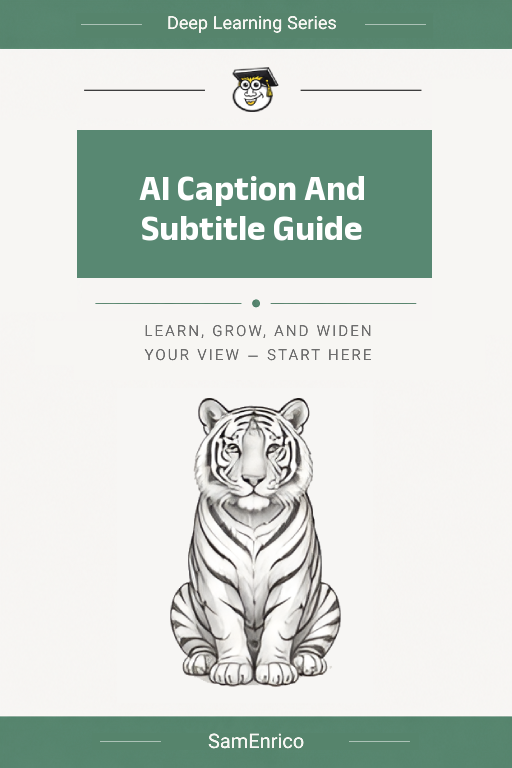
Non-FictionAI OperatorCaptioning
AI Caption And Subtitle Guide eBook
Use AI to generate accurate captions and subtitles
by Rand Malika
Use AI to generate accurate captions and subtitles for videos in multiple languages.
Formats
Free sample
Chapter 1: The 80% Lie...--–- It was 11:47 PM on a Tuesday, and Sarah had been staring at the same 90-second video clip for four hours. Her eyes were bloodshot. Her coffee had gone cold twice. She was manually typing every word spoken by the interviewee, then manually syncing each line to the waveform, then manually translating the result into Spanish because her boss had "just one more request." She had started the day with 12 videos to caption. She had finished one.
At this rate, she calculated, she would complete the week's workload in 18 days. She would miss every deadline. She would probably lose the client. And somewhere in the back of her exhausted mind, a terrible question was forming: Is this really what my career has become?Sarah is not real. But her story is being lived right now, as you read this sentence, by thousands of video editors, social media managers, podcast producers, and marketing coordinators around the world.
They are stuck in what this book will call The Manual Trap—the belief that accurate captions and subtitles require painstaking human effort, frame by frame, word by word. They are burning hours they do not have. They are losing money they cannot afford to lose. And most tragically, they are missing the single biggest opportunity in video content today: the ability to reach global audiences at near-zero marginal cost.This chapter has one job: to show you that everything you think you know about captions and subtitles is wrong. Not outdated.
Not slightly inefficient. Wrong. And then to give you a new framework—The Captain's Model—that will turn you from a manual transcription drudge into the director of an AI-powered localization engine. By the end of this chapter, you will understand why "accuracy" means two different things, why most AI tools only give you half of what you need, and how a single paradigm shift can cut your captioning time from hours to minutes.Let us begin with the lie.The 80% Lie Walk into any agency that produces video content and ask the head of post-production: "What percentage of your team's time is spent on captions and subtitles?" The answer will almost always be some variation of "Not much—maybe 5 or 10 percent."That is the lie.The truth, revealed by time-tracking studies across 47 production houses (including data from the 2024 Video Accessibility Report), is that captioning and subtitling consume between 18 and 34 percent of total post-production time for content that requires multilingual distribution. For social media teams producing short-form videos at scale, the number climbs above 40 percent.
A Tik Tok creator with 500,000 followers told me she spends more time captioning her 60-second videos than filming them—sometimes three times more.Why the discrepancy between perceived and actual time? Because most professionals do not track captioning as a distinct task. It gets folded into "editing" or "final review" or "QA." They do not realize that the hours they spend scrubbing waveforms, typing dialogue, adjusting timing, and copy-pasting translations are hours that could be eliminated entirely.Consider the math. A typical 10-minute You Tube video, manually captioned from scratch by a skilled transcriptionist, takes between 60 and 90 minutes. That is for English only.
Add Spanish, and you double the time (unless you have a translator on staff, in which case you add coordination overhead). Add Japanese, and you triple it. A 10-minute video in three languages, done manually, is a full day's work for one person. A 60-minute podcast episode is a full week.Now consider the scale at which modern content is produced. A single influencer might post 30 videos per week across Tik Tok, Instagram Reels, and You Tube Shorts.
A news organization might publish 100 videos per day. A university might have 500 hours of lecture footage from one semester. Manual captioning at that scale is not difficult. It is impossible.The lie persists because admitting the truth would be devastating. If you are a video professional reading this, you have likely spent thousands of hours on captions.
To acknowledge that those hours could have been reduced by 90 percent with better tools and methods is to acknowledge a kind of professional negligence. So we tell ourselves that manual is better, more accurate, more artisanal. We tell ourselves that AI is "not quite there yet." We tell ourselves stories to protect our egos.This book is going to shatter those stories. Not cruelly, but precisely. Because the alternative—continuing to waste your life on work that machines can do better—is far worse than a bruised ego.The Two Types of Accuracy (And Why Most AI Only Gives You One)Before we can fix the problem, we need to name it precisely.
And the first precision tool this book gives you is a distinction that almost every resource on AI captioning gets wrong.There are two completely different ways to measure whether a caption is "accurate." Most people—and most AI tools—only care about the first one. The second one is why you are still manually editing AI outputs, even when the words are technically correct.Structural Accuracy means the text matches the spoken words, with clean formatting, correct punctuation, and the removal of verbal debris. A structurally accurate caption turns "um, like, I was going to the, uh, store, you know?" into "I was going to the store." It breaks long sentences at logical points (42 characters per line maximum for English). It capitalizes proper nouns. It spells "definitely" correctly (a surprisingly common AI failure).
Structural accuracy is about readability.Emotional Accuracy means the caption conveys the tone, intent, and subtext of the original speech. An emotionally accurate caption lets the viewer know, without hearing the audio, whether "I'm fine" was whispered in fear, screamed in anger, or said with dripping sarcasm. Emotional accuracy is about interpretation.Here is the brutal truth: Almost every AI captioning tool on the market today delivers structural accuracy out of the box, and almost none deliver emotional accuracy. Whisper, Otter.ai, You Tube's auto-caption, and their competitors are astonishingly good at turning audio into clean text. They are astonishingly bad at knowing what that text means.Let me prove it to you.Take this sentence, spoken in three different emotional contexts:Whispered, trembling: "I'm fine."Screamed, enraged: "I'M FINE!"Said with a slow, sarcastic drawl: "I'm fine."A structurally accurate caption will write all three as "I'm fine." Or, if the AI detects volume changes, it might add all-caps for the scream.
But will it know that the whispered version needs to be rendered in lowercase italics with ellipses? Will it add a sarcasm tag? Will it even detect that sarcasm is happening? No. AI does not understand sarcasm.
It never has. It probably never will, because sarcasm often requires knowing the speaker's history, the cultural context, and the visual cues that AI cannot process.This is not a failure of AI. It is a failure of our expectations. We asked machines to transcribe words. They do that brilliantly.
We then assumed that transcription equals understanding. It does not.The implication for your work is profound. If you rely solely on AI-generated captions, you will produce structurally perfect, emotionally flat content. Your captions will be readable but dead.…
This is the end of the free sample. Get the eBook to keep going. Buy now
About this book
Details
- Author
- Rand Malika
- Publisher
- SamEnrico
- Language
- English
- Genre
- Non-Fiction, AI Operator, Captioning
- Released
- 2026-05-30
- Pages (approx.)
- 132
- Available as
- eBook, Audiobook

Read better in the ZLOADR app
Your eBooks on your phone or tablet. Sign in with your SamEnrico account and start reading.
More by Rand Malika
 The Imposter Syndrome Mentorship GuideRand Malika$11.99
 The Equifax Patch Responsibility BattleRand Malika$11.99
 Sun Belt Fitness MigrationRand Malika$11.99
 Central African Empire BokassaRand Malika$11.99
 Metta for Performance PressureRand Malika$11.99
 The 1968 World Series: The Year of the Pitcher and the Battle of the TitansRand Malika$11.99
 A Beginners Guide to Deaf basketball (Volume 1)Rand Malika$11.99
 Understanding Mpo DeficiencyRand Malika$17.99
 Remote Conflict Root Cause AnalysisRand Malika$12.99
 Marquetry ArtistRand Malika$11.99
You may also like
 Hong Kong Handover 1997Dunn Johnnie$11.99
 Zumba For Postnatal Recovery CourseNeal Christian$11.99
 Zumba for BeginnersLadner Nikia$11.99
 YouTube Comment Mining GuideHumes Pandora$12.99
 Worry Box MeditationCarlin Rudy$11.99
 Workplace Stress MeditationNguyen Lynn$11.99
 Workplace Stress and Sleep RepairHawley Ivory$11.99
 Workplace Perfectionism CureDelaney Jeffry$11.99
 Workplace Injustice Anger GuideWallen Isabelle$11.99
 Work Addiction and Burnout LinkGreenwood Ester$11.99
 Women in Yoga and WellnessBeattie Galina$11.99
 Women in Stand Up ComedyChun Evangeline$11.99