
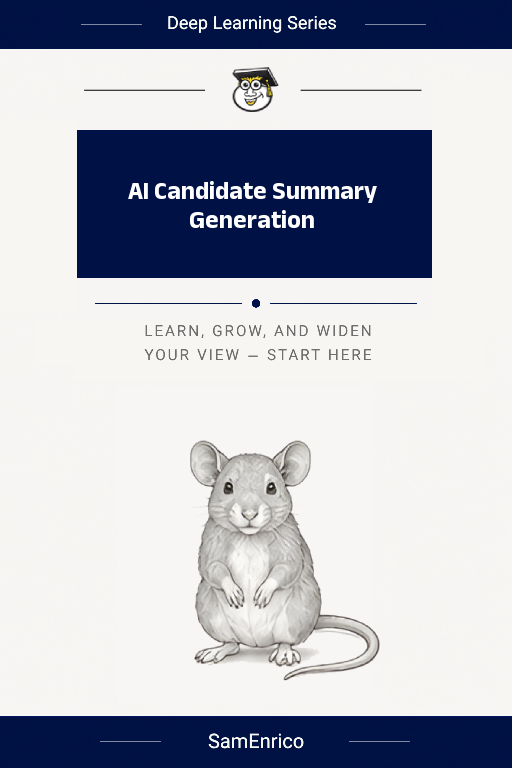
Non-FictionAI OperatorTalent Acquisition Tech
AI Candidate Summary Generation eBook
Generate candidate summaries from parsed resume da
by Zarate Dara
Generate candidate summaries from parsed resume data. Speed up recruiter review.
Formats
Free sample
Chapter 1: The Parsing Graveyard--–- Maria stared at her screen. It was 2:47 AM. She had 143 resumes left to review, and her third coffee had gone cold an hour ago. Somewhere in this pile of PDFs, DOCXs, and badly scanned images was the perfect candidate for the Senior Dev Ops role at her fintech company. She had already rejected 87 people.
The guilt was starting to settle in.She clicked on the next file. The ATS had already done its job—or so the vendor promised. The resume was parsed into neat little tags: "5 years Python," "AWS certified," "Kubernetes," "CI/CD pipelines." The system gave it an 86% match score. Maria almost moved it to the "screen" pile. But something made her click the original PDF.The resume was a work of art—not in design, but in substance.
The candidate hadn't just "used Python." They had rebuilt a legacy trading platform, reduced latency by 40%, and mentored six junior engineers. The parsed data had captured the nouns but murdered the story. The ATS saw keywords. Maria saw a person. She had almost rejected a gem because the parsing engine couldn't tell the difference between a list of tools and a narrative of impact.This is not a story about bad technology.
It is a story about the gap between what machines extract and what humans need. That gap is the subject of this book. And until we close it, recruiters like Maria will keep working at 2:47 AM, haunted by the candidates they almost missed.The Candidate Summary Crisis Every year, recruiters spend an estimated 13 million hours manually reviewing resumes that could be summarized by AI. That is not a typo. Thirteen million hours.
To put that number in perspective, it is equivalent to a single person working 24 hours a day, 365 days a year, for 1,484 years. And most of that time is not spent making nuanced judgments. It is spent scanning, skimming, and searching for signal in a sea of noise.The problem is not that recruiters are slow. The problem is that they are being asked to do something that no human should do at scale: extract structured meaning from unstructured, inconsistent, and often misleading documents. Resumes are not databases.
They are marketing collateral. They are narratives designed to persuade. And when we ask a recruiter to read 200 of them in a single day, we are not asking them to evaluate talent. We are asking them to survive.This is where AI candidate summary generation enters the picture. The premise is simple: instead of asking a recruiter to read an entire resume, we ask an AI to read it first, extract the most relevant information, and present it in a consistent, decision-ready format.
The recruiter then reads the summary, not the resume—or at least, not the resume first. The summary becomes the primary screening artifact. The original resume becomes a source of verification for the top candidates.In theory, this is elegant. In practice, it is a minefield.The Three Failures of Current Parsing Before we can build reliable summaries, we must understand what parsing actually does—and where it collapses. Parsing is the process of converting a raw resume file (PDF, DOCX, image) into structured data fields: name, email, work history, skills, education, certifications.
It sounds straightforward. It is not.Failure #1: The Layout Trap Resume design is an arms race. Candidates use two-column layouts, tables, icons, graphics, and custom fonts to stand out. Every one of these design choices breaks standard parsers. Two-column layouts cause parsers to read across columns horizontally, mixing job titles from the left column with dates from the right column.
Tables are often read row by row, turning a skills matrix into a meaningless string of words. Icons for phone numbers, email addresses, and Linked In profiles are frequently ignored entirely, causing critical contact information to vanish.Consider a real example from a 2023 audit of three major ATS platforms. A candidate used a two-column resume with skills on the left and experience on the right. The parser read the left column first, then the right, producing a work history that listed "Python, AWS, Docker" as job titles and actual job titles like "Senior Software Engineer" as skills. The candidate was automatically rejected by the scoring algorithm.
A human later reviewed the original PDF and discovered the error. The candidate was hired. They are now a team lead.Failure #2: The Context Blindness Parsers do not read. They match patterns. This is a critical distinction.
When a parser sees the word "Python," it cannot tell if you are a programmer who writes Python code or a herpetologist who studies pythons. Both are technically correct. Both are useless without context. Similarly, "lead" could mean you led a team, or it could mean you were a lead generator in sales, or it could be a typo for "led." Parsers do not disambiguate. They collect and count.This context blindness produces what researchers call "false positive skills"—tags that are technically present in the text but semantically irrelevant to the role.
A candidate who writes "I have used Python for data analysis" and a candidate who writes "I am not a Python user" will both trigger the "Python" skill tag because the word appears. The parser does not understand negation, sarcasm, or irrelevance. It is a word counter with delusions of intelligence.Failure #3: The PDF Black Hole PDFs are not designed for data extraction. They are designed for print. A PDF contains no concept of a "paragraph," "bullet point," or "table." It contains instructions for drawing lines and shapes on a page.
Parsers must reverse-engineer the visual layout from these drawing instructions—a task that fails unpredictably. A resume that looks perfect to the human eye can be a jumbled mess to a parser because a single misplaced text box or overlapping shape changes how the drawing instructions are interpreted.The worst offenders are scanned resumes—images of printed pages run through OCR (Optical Character Recognition). OCR introduces errors: "rn" becomes "m," "cl" becomes "d," "li" becomes "h." A candidate who worked at "Accenture" might appear as "Accenmre." A degree in "Biology" might become "Biology." These errors are not random noise. They systematically degrade the quality of parsed data, particularly for candidates with non-standard fonts, low-quality scans, or complex layouts—demographics that correlate with socioeconomic background.The Distinction That Changes Everything: Parsed Data vs. Resume Summary Here is the single most important concept in this book, and it is the one that most AI recruiting tools get wrong.
There is a fundamental difference between a summary of the parsed data and a summary of the resume. Understanding this distinction is the difference between an AI tool that saves time and an AI tool that loses candidates.A summary of the parsed data looks like this: "5 years Java. AWS certified. BS Computer Science. Job hopper (4 jobs in 5 years)." This is what most commercial ATS products generate.
It is fast, cheap, and almost useless. It tells you what tags were extracted. It does not tell you what the candidate actually did. It cannot distinguish between a candidate who "has Java" because they took a bootcamp and a candidate who "has Java" because they architected…
This is the end of the free sample. Get the eBook to keep going. Buy now
About this book
Details
- Author
- Zarate Dara
- Publisher
- SamEnrico
- Language
- English
- Genre
- Non-Fiction, AI Operator, Talent Acquisition Tech
- Released
- 2026-05-26
- Pages (approx.)
- 132
- Available as
- eBook, Audiobook

Read better in the ZLOADR app
Your eBooks on your phone or tablet. Sign in with your SamEnrico account and start reading.
More by Zarate Dara
 Chin Gestures GuideZarate Dara$11.99
 Shop Window Sticker AdsZarate Dara$11.99
 Nicotine Pouches Cessation GuideZarate Dara$11.99
 Canva Brand Identity for ArtistsZarate Dara$11.99
 The Last Masterpiece: The Unseen Works of Jean-Michel BasquiatZarate Dara$11.99
 Learn to Play the TarogatoZarate Dara$11.99
 Fichtelite MiningZarate Dara$11.99
 How to Start a Banquet Catering Business (Beginners Guide)Zarate Dara$11.99
You may also like
 Hong Kong Handover 1997Dunn Johnnie$11.99
 Zumba For Postnatal Recovery CourseNeal Christian$11.99
 Zumba for BeginnersLadner Nikia$11.99
 YouTube Comment Mining GuideHumes Pandora$12.99
 Worry Box MeditationCarlin Rudy$11.99
 Workplace Stress MeditationNguyen Lynn$11.99
 Workplace Stress and Sleep RepairHawley Ivory$11.99
 Workplace Perfectionism CureDelaney Jeffry$11.99
 Workplace Injustice Anger GuideWallen Isabelle$11.99
 Work Addiction and Burnout LinkGreenwood Ester$11.99
 Women in Yoga and WellnessBeattie Galina$11.99
 Women in Stand Up ComedyChun Evangeline$11.99