
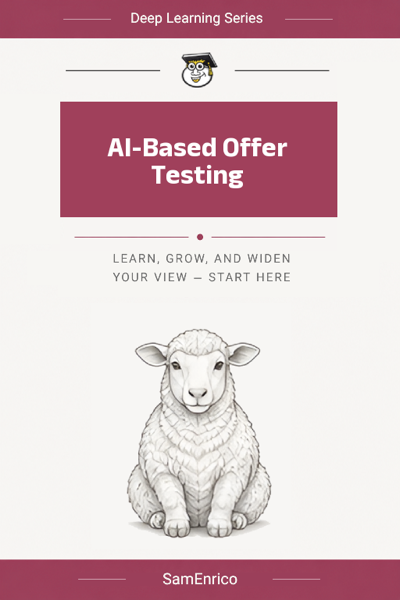
AI-Based Offer Testing eBook
A Coursebook on AI-Based Offer Testing
A Coursebook on AI-Based Offer Testing
Formats
Free sample
Chapter 1: The Certainty Trap--–- Dave had just spent eighteen months and forty-seven A/B tests trying to optimize his Saa S company’s pricing page. He had tested button colors (green won, then blue, then green again), headline variants (nine of them, no clear winner), testimonial placements (above the fold, below the fold, everywhere and nowhere), and three different guarantee structures. His team had celebrated small victories—a 3% lift here, a 7% lift there—but revenue had barely moved. The CEO was losing patience. Dave was losing sleep.Then, on a Tuesday afternoon in March, he fed his last twelve months of session data into a large language model he had barely heard of a week earlier.
The model processed 47,000 user sessions, 12,000 support tickets, and 8,000 hotjar recordings in under four hours. What it found made Dave’s stomach drop. The friction point wasn’t the button color, the headline, or the testimonial placement. It was a single word in his guarantee: “reasonable.”The guarantee read: “We will issue a full refund for any reasonable request within 30 days.” To Dave, that word seemed harmless—professional, even cautious. But the model identified that users who hovered over the word “reasonable” spent an average of eleven more seconds on the page, then left without converting.
They were trying to figure out what “reasonable” meant. Was their reason reasonable enough? Would they have to argue with support? The ambiguity created cognitive friction, and friction killed conversions.When Dave changed the guarantee to “We will refund every penny, no questions asked, for 30 days,” conversions on that page increased 31% within two weeks. No multivariate test, no statistical significance waiting period, no expensive consultant.
Just a single word, identified by an AI that saw what humans could not.This book exists because Dave’s story is not an exception. It is the rule. Every day, businesses leave millions of dollars on the table because they are testing the wrong things, testing them poorly, or not testing them at all. And the problem is getting worse, not better, because the complexity of modern offers has outpaced the human brain’s ability to predict what will work.The Psychological Pillars of Every Offer Before we can understand how AI changes offer testing, we must understand what an offer actually is. An offer is not a price tag.
It is not a product. It is a psychological contract between seller and buyer, written in the language of perceived value, risk, urgency, and action. Every high-converting offer—from a 3coffeesubscriptiontoa3 coffee subscription to a 3coffeesubscriptiontoa50,000 enterprise software deal—rests on four non-negotiable pillars. These pillars have held for a century of direct response marketing, and they will hold for a century more, regardless of how AI changes the testing process.Pillar One: Perceived Value Differential The first pillar is the gap between what the customer gives up (usually money, but also time, effort, or attention) and what they believe they will receive in return. Notice the word “perceived.” Value is never objective.
A bottle of water has a perceived value near zero in a grocery store and perceived value near one hundred dollars in a desert. Your job as an offer architect is not to calculate the “true” value of your product. Your job is to understand and shape what your specific customer believes they are getting.AI’s role here is radically new. Historically, marketers inferred perceived value through surveys (unreliable), focus groups (expensive and slow), or their own intuition (often wrong). AI can now process thousands of customer reviews, support transcripts, and social media conversations to identify exactly which features, outcomes, or emotional benefits drive perceived value for your audience.
It can tell you, with statistical confidence, that your customers value “time saved” over “money saved,” or that they mention “peace of mind” three times more often than “performance.” This is not guesswork. This is pattern recognition at scale.Pillar Two: Risk Reversal The second pillar addresses the customer’s greatest fear: what happens if they are wrong? Every purchase carries risk. The product might not work. The service might underdeliver.
The customer might look foolish in front of their boss or spouse. Risk reversal is the set of mechanisms—guarantees, warranties, free trials, sample periods, money-back promises—that shift that risk from the buyer back to the seller.The most effective risk reversals are not cautious or qualified. They are unconditional. “We will refund every penny” beats “We will refund reasonable requests” every time, as Dave discovered. “You will see results in 30 days or we will work for free” beats “We strive for customer satisfaction.” The human brain is wired to overweigh potential losses relative to potential gains.
A strong guarantee neutralizes that bias by removing the loss entirely.AI transforms risk reversal testing in two ways. First, it can identify which specific fears are most active in your audience by analyzing the language they use before purchase. If customers ask “what if I change my mind?” more often than “what if it breaks?”, your guarantee needs to address flexibility, not durability. Second, AI can generate dozens of guarantee variations and score them for clarity and confidence before you ever show them to a customer. The word “unconditional” scores higher than “satisfaction-based.” “No questions asked” scores higher than “reasonable.” These are not subjective opinions.
They are measurable linguistic patterns.Pillar Three: Scarcity The third pillar exploits a quirk of human psychology: we want what we cannot have, and we want it more when time is running out. Scarcity takes two forms. Quantity scarcity (“only 47 left in stock”) triggers competition anxiety—the fear that others will take what we want. Time scarcity (“offer ends at midnight”) triggers regret aversion—the fear that we will miss a limited opportunity.Scarcity is powerful, but it is also dangerous. Fake scarcity destroys trust.
Permanent scarcity (a “limited time offer” that renews every week) trains customers to ignore your urgency signals. The most effective scarcity is real, verifiable, and tied to a genuine constraint: inventory, production capacity, or a fixed promotional window.AI helps test scarcity by predicting which type of scarcity resonates with which segment of your audience. New visitors, for example, often respond better to quantity scarcity (“10 people are looking at this right now”) because they lack context about your brand. Returning visitors may respond better to time scarcity (“your 15% discount expires in 3 hours”) because they have already signaled interest. AI can dynamically allocate scarcity frames to different user segments based on their behavior, testing thousands of combinations without burning through your audience’s patience.Pillar Four: Call-to-Action Clarity The fourth pillar is the most frequently violated, because it seems too simple to matter.
The call-to-action is not a button. It is the moment where psychological commitment becomes physical action. If the CTA is unclear, ambiguous, or misaligned with what the customer believes they are getting, the entire offer collapses.Clear CTAs do three things. They state exactly what will happen next (“Start my free trial” vs. “Submit”).
They reinforce the value proposition (“Get my 50% discount” vs. “Click here”). And they lower the perceived effort of action (“Instant access” vs. “Complete registration”).AI can now score CTAs for clarity and actionability…
This is the end of the free sample. Get the eBook to keep going. Buy now
About this book
Details
- Author
- Greathouse Mark
- Publisher
- SamEnrico
- Language
- English
- Genre
- Non-Fiction, Informative, Educational
- Released
- 2026-05-04
- Pages (approx.)
- 159
- Available as
- eBook, Audiobook

Read better in the ZLOADR app
Your eBooks on your phone or tablet. Sign in with your SamEnrico account and start reading.
More by Greathouse Mark
 Road Rage and Pregnancy DrivingGreathouse Mark$11.99
 Opioid Recovery Sleep GuideGreathouse Mark$11.99
 Immigrant Nonprofit Founder GuideGreathouse Mark$11.99
 Nap Myths DebunkedGreathouse Mark$11.99
 The Stress Hand PainGreathouse Mark$11.99
 Metta for an Unborn BabyGreathouse Mark$11.99
 Elaboration TechniquesGreathouse Mark$11.99
 Time Audit Block RefinementGreathouse Mark$11.99
 NVC For Friendship ConflictGreathouse Mark$11.99
 White Gold & Blood Diamonds: The Untold Cocaine Cartels of Sierra LeoneGreathouse Mark$11.99
 The Battle of Lake Poyang: The Last Stand of the Ming Loyalists (1363)Greathouse Mark$11.99
 Bootleggers & Blue Notes: The Jazz That Defied the LawGreathouse Mark$11.99