
Non-FictionAI OperatorMedia Operations
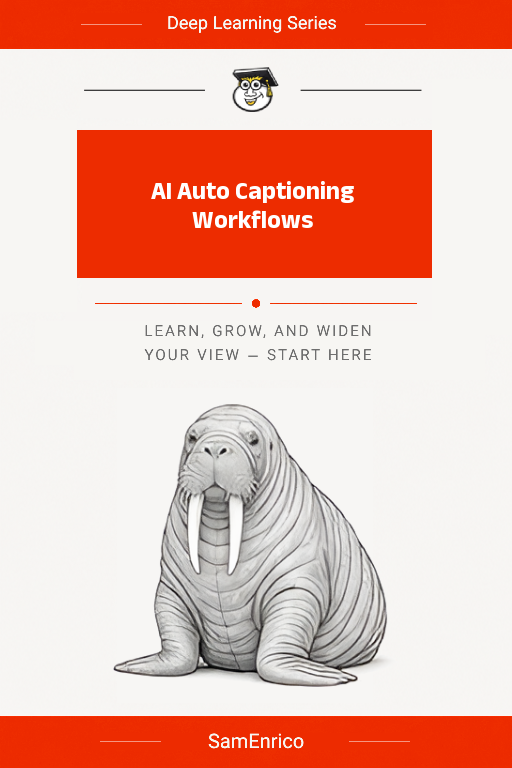
AI Auto Captioning Workflows eBook
Generate accurate transcripts, captions, and subti
Generate accurate transcripts, captions, and subtitles for videos using AI. Improve accessibility and engagement.
Formats
Free sample
Chapter 1: The Silent Majority--–- On a Tuesday morning in March 2023, a marketing director named Priya watched her company’s most expensive video production—a sixty-second advertisement featuring a celebrity spokesperson—generate half the engagement of a low-budget Tik Tok filmed on an i Phone in a parking lot. The difference was not production value, casting, or even the script. The difference was captions. The parking lot video had them, burned directly into the frame with bright yellow keywords popping up in rhythm with the speaker’s voice. Her sixty-thousand-dollar spot had none.
Viewers scrolling past on their morning commutes simply kept scrolling. They could not hear the celebrity’s voice over the subway noise, and the video offered them nothing to read.This is not an edge case. It is the new normal.Every minute of every day, more than five hundred hours of video are uploaded to You Tube alone. On Tik Tok, users watch a cumulative billion hours of content daily. Instagram Reels, Facebook Watch, Linked In video, Twitter—the platforms have merged into a single, scrolling river of moving images and sound.
But here is the detail that most video creators still fail to grasp: the majority of that river is watched in silence.Facebook reports that eighty-five percent of its video views occur without sound. Instagram’s internal data puts the number at seventy percent for feed videos. On Linked In, where professionals scroll during meetings and commutes, the silent viewing rate approaches ninety percent. These statistics are not outliers or temporary trends. They represent a fundamental shift in how human beings consume media in the twenty-first century.
The sound is no longer the primary channel. The text on the screen has become the narrative backbone.And yet, most video producers still treat captions as an afterthought—a legal checkbox, an accessibility accommodation, a last-minute export setting before hitting publish. This chapter exists to shatter that assumption completely and permanently. Captions are not a courtesy. They are the user interface of modern video.
They determine whether someone watches for two seconds or two minutes. They decide whether a viewer retains information or forgets it immediately. And when powered by artificial intelligence, they transform from a cost center into one of the highest-ROI investments a content creator can make.The Four Audiences You Are Ignoring Before we discuss workflows and tools, we must understand the scope of the audience that captions serve. Most creators think of captions as being solely for the Deaf and Hard of Hearing community. That is one critical audience, but it is only the first of four.
Each group represents millions of potential viewers who are currently abandoning your content because you have not given them a reason to stay.The first audience is the one we just described: the Deaf and Hard of Hearing community. Globally, an estimated four hundred sixty-six million people live with disabling hearing loss, according to the World Health Organization. That number is projected to grow to over nine hundred million by 2050 as populations age and noise-induced hearing loss increases. For these viewers, captions are not a convenience. They are the only access point to your audio content.
Without them, you are not just losing viewers—you are excluding an entire population from your message. The Americans with Disabilities Act and similar legislation in dozens of countries have made captions a legal requirement for many types of content, but compliance is the floor, not the ceiling.The second audience is neurodivergent viewers. Attention deficit hyperactivity disorder affects approximately four to five percent of adults worldwide, with many more undiagnosed. Autism spectrum disorders affect another two percent. For these viewers, processing spoken language in real time can be cognitively exhausting.
The brain must decode sounds, parse meaning, filter background noise, and hold information in working memory simultaneously. Text changes the equation. Written language is permanent. It does not vanish the moment a sound wave ends. It can be reviewed, re-read, and processed at the viewer’s own pace.
For a person with ADHD, captions can mean the difference between following a four-minute tutorial and giving up after forty-five seconds of mental fog.The third audience is non-native speakers. There are approximately one and a half billion English learners worldwide, with more than three hundred seventy million native English speakers. That means the majority of English-language video content is consumed by people for whom English is a second, third, or fourth language. Even fluent non-native speakers struggle with rapid speech, regional accents, and unfamiliar vocabulary. Captions provide scaffolding.
They connect the sounds of unfamiliar words to their written forms. They allow viewers to pause, look up definitions, and re-read complex sentences. A video without captions is a video that tells over a billion potential viewers, "You are not welcome here."The fourth audience is the one that creators forget most often: environmentally constrained viewers. These are people watching in a quiet office while their boss sits ten feet away. They are commuters on a train with no headphones.
They are parents nursing a sleeping baby at two in the morning. They are gym-goers on a treadmill who forgot their earbuds. They are not Deaf. They are not neurodivergent. They are not language learners.
They are simply people in circumstances where turning on sound is impossible, rude, or dangerous. And they are the majority of viewers on every major platform.When you add these four groups together—the Deaf and Hard of Hearing, neurodivergent viewers, non-native speakers, and environmentally constrained viewers—you are not talking about a niche audience. You are talking about the majority of your potential viewership on most platforms. Publishing a video without captions is not like publishing a book with small print. It is like publishing a book with invisible ink.Captions as User Interface The phrase "captions as accessibility" implies that captions are an add-on—a feature for a subset of users.
The phrase "captions as user interface" implies something fundamentally different. It suggests that captions are not optional ornamentation but a core structural element of the viewing experience, as essential to comprehension as lighting or camera framing.Consider how people actually watch videos on their phones. The phone is held at waist height while standing in a crowded elevator. The screen is small. The ambient noise is loud.
The viewer has approximately two seconds to decide whether to keep scrolling or stop and watch. In that moment, what information is available? The thumbnail image provides a vague hint. The title text provides context. But the first frames of the video itself—the opening words of the narrator, the establishing shot, the visual hook—are inaccessible without sound unless captions are present.A well-captioned video uses text not merely to transcribe dialogue but to guide attention.
When a new speaker begins talking, their name appears in the caption. When a key term is introduced, it is highlighted. When a sound effect matters—a door slamming, a phone buzzing, a dog barking—it is described in brackets. The captions become a second narrative track, running parallel to the visuals, reinforcing what the eye sees and the ear cannot hear.This is not speculation. Research on dual coding theory, developed…
This is the end of the free sample. Get the eBook to keep going. Buy now
About this book
Details
- Author
- Pfeifer Evelin
- Publisher
- SamEnrico
- Language
- English
- Genre
- Non-Fiction, AI Operator, Media Operations
- Released
- 2026-05-29
- Pages (approx.)
- 123
- Available as
- eBook, Audiobook

Read better in the ZLOADR app
Your eBooks on your phone or tablet. Sign in with your SamEnrico account and start reading.
More by Pfeifer Evelin
 Cough Headache GuidePfeifer Evelin$11.99
 Office Politics Stress SurvivalPfeifer Evelin$11.99
 LibraryThing Early ReviewersPfeifer Evelin$11.99
 Benzo Taper Emergency PlanPfeifer Evelin$11.99
 Laughter in the Dark: The Balloon Man of BlackpoolPfeifer Evelin$11.99
 Credit Risk SpecialistPfeifer Evelin$11.99
 How to Start a Dental Filling Business (Beginners Guide)Pfeifer Evelin$11.99
 Learn to Play the Piccolo TrumpetPfeifer Evelin$11.99
You may also like
 Hong Kong Handover 1997Dunn Johnnie$11.99
 Zumba For Postnatal Recovery CourseNeal Christian$11.99
 Zumba for BeginnersLadner Nikia$11.99
 YouTube Comment Mining GuideHumes Pandora$12.99
 Worry Box MeditationCarlin Rudy$11.99
 Workplace Stress MeditationNguyen Lynn$11.99
 Workplace Stress and Sleep RepairHawley Ivory$11.99
 Workplace Perfectionism CureDelaney Jeffry$11.99
 Workplace Injustice Anger GuideWallen Isabelle$11.99
 Work Addiction and Burnout LinkGreenwood Ester$11.99
 Women in Yoga and WellnessBeattie Galina$11.99
 Women in Stand Up ComedyChun Evangeline$11.99