
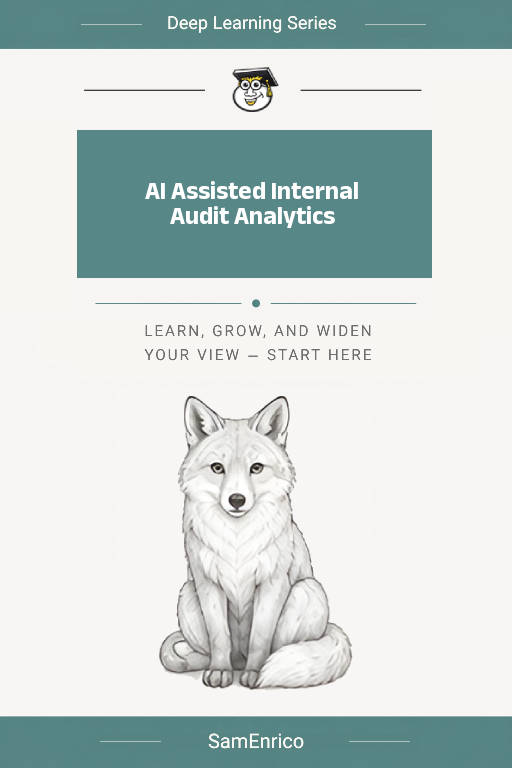
AI Assisted Internal Audit Analytics eBook
Identify control exceptions and test full populati
Identify control exceptions and test full populations using AI that flags journal entries, approval violations, and segregation of duties breaches.
Formats
Free sample
Chapter 1: The Sampling Lie...--–- Every internal audit report you have ever signed that relied on sampling was wrong. Not maybe wrong. Not probably wrong. Mathematically, statistically, and inevitably wrong in ways that you could not see, your managers could not detect, and your external auditors could not challenge. The lie is not malicious.
It is not a conspiracy. It is worse than that. It is a quietly accepted mathematical fiction that has been embedded in audit standards for decades, protected by the comforting language of "reasonable assurance" and "tolerable error rates" and "confidence levels." But comfort is not truth. And sampling, as a method for detecting control exceptions in modern ERP environments, is a mathematical guarantee of false negatives.The problem is simple to state but devastating in its implications: sampling works when populations are homogeneous, when errors are randomly distributed, and when fraudsters do not know they are being sampled. None of these conditions exist in any modern organization running SAP, Oracle, Net Suite, or Dynamics 365.
Fraud concentrates. Exceptions cluster. And the one transaction that would blow open a scheme sits quietly in the 99.5% of transactions your sampling plan told you it was safe to ignore.This chapter dismantles the traditional reliance on statistical sampling in internal audit, but with a crucial distinction that most books ignore. We will separate two entirely different uses of sampling that practitioners constantly confuse: audit testing sampling (selecting a subset of transactions to test for control exceptions) versus data science sampling (using holdout samples and back-testing for model validation). The argument against audit testing sampling is unequivocal and absolute.
But the argument for statistical sampling as a validation technique remains essential. These are different tools for different jobs. Confusing them has caused more audit failures than almost any other single misunderstanding.By the end of this chapter, you will understand why sampling for control testing is now audit malpractice when AI-enabled 100% population testing is available, why the Wirecard auditors missed $2 billion hiding in plain sight, and how closing the "Audit Data Gap" transforms internal audit from a compliance cost center to a strategic intelligence function.The Mathematics of Missing Fraud Let us begin with a simple thought experiment that reveals the core mathematical flaw in audit sampling. Imagine a company with 100,000 journal entries in a given quarter. One hundred of those entries are fraudulent—not a high number, just 0.1% of the population.
A standard audit sampling plan with 95% confidence and 5% tolerable error might select 300 to 400 entries for testing. What is the probability that your sample includes even one of the fraudulent entries?The answer is approximately 30% to 35%. That means there is a 65% to 70% chance that your sample will contain zero fraudulent entries. You will test 300 transactions, find no exceptions, and sign an opinion stating that controls are operating effectively. But you have not tested controls.
You have tested randomness and lost.The mathematics gets worse when fraud is not random, and it never is. Fraudulent transactions exhibit clustering, unusual timing, specific dollar amounts, and particular user behaviors. Sampling assumes that every transaction has an equal probability of being selected—a condition that fraudsters exploit ruthlessly. They know sampling exists. They know most organizations sample on random intervals or predictable cycles.
They structure their activity to fall outside the sampling window, just below approval thresholds, and during periods when auditors are least likely to be looking.Consider the case of a large European bank that discovered a $2 billion misstatement hidden in journal entries—a fraud that had persisted for nearly three years. The internal audit team had conducted quarterly sampling reviews throughout that period. Every sample passed. Every report said controls were effective. The fraud was not discovered by sampling.
It was discovered by accident during a systems migration. When investigators later ran a simple anomaly detection algorithm on the full population of journal entries, the fraudulent pattern was flagged in under four seconds. It had been there the entire time, invisible to sampling, screaming at the data.This is not a failure of auditor competence. It is a failure of methodology. Sampling, as a tool for detecting control exceptions, has a mathematical blind spot that no amount of auditor training can fix.
The blind spot is this: sampling can only detect errors that are randomly distributed. Fraud is never randomly distributed. Therefore, sampling is systematically incapable of detecting the very thing it is most urgently needed to find.The Wirecard Warning: A Case Study in Sampling Failure No case demonstrates the catastrophic consequences of sampling reliance better than Wirecard. The German payment processing company collapsed in 2020 after admitting that €1.9 billion in cash did not exist. External auditors had signed off on Wirecard's financial statements for years.
Internal audit had conducted regular testing. Regulators had reviewed the company. And yet, the fraud was so large that it consumed the entire company.How did sampling fail at Wirecard? The answer is instructive for every internal auditor reading this book. Wirecard's fraud involved fake transactions with partner companies in Asia.
These transactions were not randomly distributed. They were carefully structured to fall within certain thresholds, involve specific counterparties, and follow patterns that would not trigger traditional sampling alerts. The sampling plans used by Wirecard's auditors selected transactions based on monetary thresholds and random intervals. The fake transactions were designed to fall just below those thresholds and to cluster in periods between sampling windows.When investigators finally gained access to Wirecard's full transaction data—every single record, not just the sampled subset—the pattern was obvious. Transactions with Asian partners spiked in the last week of each quarter and the first week of each quarter, creating a pattern that looked like a heartbeat on a graph.
Transactions just below approval thresholds were 400% more common than transactions just above those thresholds. Users with privileged access were posting entries at 2:00 AM on Sundays. All of this was invisible to sampling. All of it was obvious when the full population was analyzed.The tragedy of Wirecard is not that auditors were lazy or corrupt. The tragedy is that most auditors, even today, would follow the same sampling methodology that failed at Wirecard because it remains embedded in professional standards.
Those standards were written for a different era—an era of paper ledgers, manual entries, and transaction volumes measured in thousands rather than millions. They have not caught up to the reality of modern ERP systems.The Audit Data Gap Defined We need a term for the dangerous disconnect between what operations teams see and what auditors examine. Let us call it the Audit Data Gap. Operations teams see 100% of their transactions—every invoice, every payment, every journal entry, every user access change. They monitor dashboards, track exceptions, and respond to anomalies in real time.
Auditors, by contrast, typically see less than 1% of transactions. They rely on samples, extrapolate findings, and issue opinions based on statistical inference rather than direct observation.The Audit Data Gap exists for three reasons, each of which AI eliminates.Reason One: Volume. Organizations generate more transactions than human auditors can reasonably review. A mid-sized manufacturing company might process 500,000 invoices annually. A regional bank might post 2 million journal entries per quarter.
A global retailer might handle 10 million point-of-sale transactions monthly. No human team can review all of these individually. Sampling…
This is the end of the free sample. Get the eBook to keep going. Buy now
About this book
Details
- Author
- Scoggins Emile
- Publisher
- SamEnrico
- Language
- English
- Genre
- Non-Fiction, AI Operator
- Released
- 2026-06-01
- Pages (approx.)
- 158
- Available as
- eBook, Audiobook

Read better in the ZLOADR app
Your eBooks on your phone or tablet. Sign in with your SamEnrico account and start reading.
More by Scoggins Emile
 Self Esteem for Return to Work MomsScoggins Emile$11.99
 Morning Anxiety MeditationScoggins Emile$11.99
 Frank Sheeran I Heard You Paint Houses AnalysisScoggins Emile$11.99
 SAD Treatment Plan TemplateScoggins Emile$11.99
 Nuclear Test Ban Treaty FighterScoggins Emile$11.99
 Job Loss for ConstructionScoggins Emile$11.99
 Medical Bill Stress ReliefScoggins Emile$11.99
 The Phantom of the Opera Down Under: A Decades-Long Quest for Broadway GloryScoggins Emile$11.99
 Sand and Shadow: The Forgotten Consort of HatshepsutScoggins Emile$11.99
 How to Produce MP3 PlayersScoggins Emile$11.99
 Growing BongardiaScoggins Emile$11.99
 Boss Promotion Conversation GuideScoggins Emile$12.99
You may also like
 Hong Kong Handover 1997Dunn Johnnie$11.99
 Zumba For Postnatal Recovery CourseNeal Christian$11.99
 Zumba for BeginnersLadner Nikia$11.99
 YouTube Comment Mining GuideHumes Pandora$12.99
 Worry Box MeditationCarlin Rudy$11.99
 Workplace Stress MeditationNguyen Lynn$11.99
 Workplace Stress and Sleep RepairHawley Ivory$11.99
 Workplace Perfectionism CureDelaney Jeffry$11.99
 Workplace Injustice Anger GuideWallen Isabelle$11.99
 Work Addiction and Burnout LinkGreenwood Ester$11.99
 Women in Yoga and WellnessBeattie Galina$11.99
 Women in Stand Up ComedyChun Evangeline$11.99