
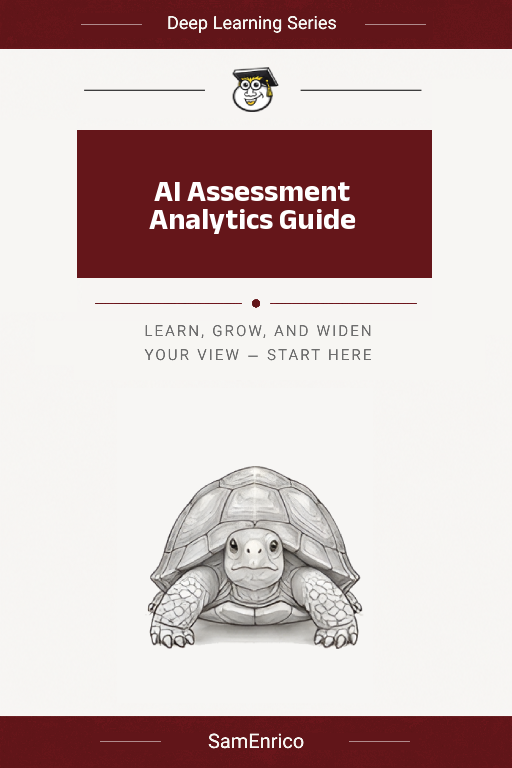
Non-FictionAI OperatorEducational Technology
AI Assessment Analytics Guide Audiobook
Analyze student assessment data to identify learni
by Blue Santo
Analyze student assessment data to identify learning gaps and inform instruction using AI.
Formats
Free sample
Chapter 1: The Co-Intelligence Pact--–- Your gradebook is a liar. Not because you entered the numbers wrong, and not because your students didn’t try. It lies because averages are a statistical convenience that have nothing to do with how human beings actually learn. A student with a 75% average could have mastered 75% of the material completely while understanding nothing of the remaining 25%. Another student with the same 75% could understand every concept half as well as they should.
Both get the same number. Both receive the same feedback. Both move on to the next unit, carrying different chasms of misunderstanding that will crack open when the curriculum builds on foundations they never laid.This is not a failure of teaching. It is a failure of the technology we have accepted as normal for over a century. The percentage grade was designed for factories, not for brains.
It was designed to rank, not to diagnose. And today, as artificial intelligence floods into classrooms, we face a choice: use AI to double down on the same broken metrics, or use it to see what we have never been able to see before—the actual shape of each student’s understanding, crack by crack, gap by gap.But there is a trap waiting for the well-intentioned educator. The same AI that can illuminate learning gaps can also amplify bias, automate bad teaching, and convince you to hand over your professional judgment to a statistical model that has never met your students. The difference between AI as a miracle and AI as a disaster comes down to one thing: the agreement you make with the machine before you ever type your first prompt.This chapter is that agreement. Call it the Co-Intelligence Pact.
It is not a legal document. It is a mindset, a set of four principles that will govern every use of AI in your assessment practice. Without these principles, AI is just a faster way to make the same old mistakes. With them, AI becomes something education has never had: a partner that thinks differently, sees patterns you cannot see, and never sleeps—but also never decides.The Four Principles of Working with AI in Schools Before we write a single prompt, before we upload a single CSV of quiz results, we must agree on how we will relate to this new intelligence. These four principles are drawn from the work of Ethan Mollick…
This is the end of the free sample. Get the Audiobook to keep going. Buy now
About this book
Details
- Author
- Blue Santo
- Publisher
- SamEnrico
- Language
- English
- Genre
- Non-Fiction, AI Operator, Educational Technology
- Released
- 2026-05-30
- Pages (approx.)
- 147
- Available as
- eBook, Audiobook

Listen in the VoxFlicks app
Audiobooks and audio dramas wherever you go. Sign in with your SamEnrico account and press play.
More by Blue Santo
 Poker Tells and NonverbalsBlue Santo$11.99
 Gacy Neighbor AccountsBlue Santo$11.99
 Village Crier Audio AdsBlue Santo$11.99
 Cigar and Pipe Tobacco Quit PlanBlue Santo$11.99
 The Architects of the Nile: Builders of Eternal GloryBlue Santo$11.99
 Learn to Play the Slide WhistleBlue Santo$11.99
 How to Start a Carpet Pile Yarn Spun on The Cotton System Business (Beginners Guide)Blue Santo$11.99
 Ettringite MiningBlue Santo$11.99
You may also like
 Hong Kong Handover 1997Dunn Johnnie$11.99
 Zumba For Postnatal Recovery CourseNeal Christian$11.99
 Zumba for BeginnersLadner Nikia$11.99
 YouTube Comment Mining GuideHumes Pandora$12.99
 Worry Box MeditationCarlin Rudy$11.99
 Workplace Stress MeditationNguyen Lynn$11.99
 Workplace Stress and Sleep RepairHawley Ivory$11.99
 Workplace Perfectionism CureDelaney Jeffry$11.99
 Workplace Injustice Anger GuideWallen Isabelle$11.99
 Work Addiction and Burnout LinkGreenwood Ester$11.99
 Women in Yoga and WellnessBeattie Galina$11.99
 Women in Stand Up ComedyChun Evangeline$11.99