
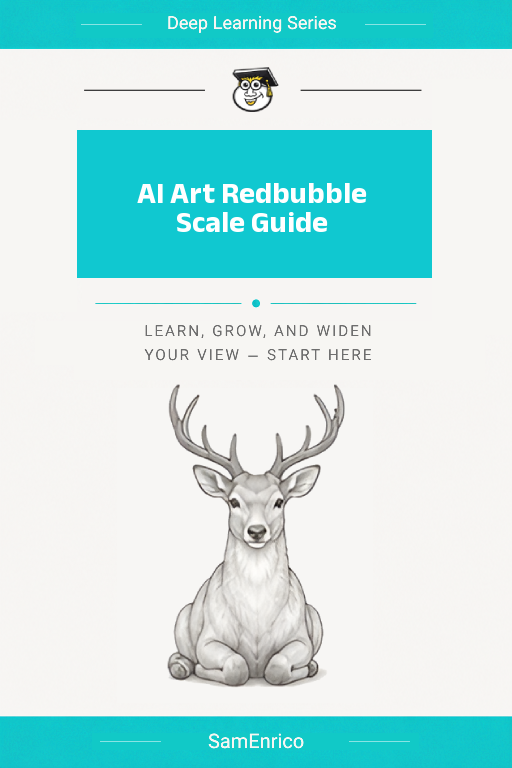
Non-FictionSide Hustle ArchitectScalingGrowth
AI Art Redbubble Scale Guide eBook
Scale Redbubble AI art side hustle to full time in
by Oneill Alita
Scale Redbubble AI art side hustle to full time income using batch creation and outsourcing.
Formats
Free sample
Chapter 1: The 10,000-Hour Shortcut--–- Malcolm Gladwell popularized the idea that mastery requires 10,000 hours of deliberate practice. For print-on-demand success, the old path demanded exactly that—thousands of hours learning design software, building illustration skills, and mastering typography before you could even begin selling. AI has demolished that timeline.Today, someone with zero design background can produce commercially viable artwork in their first week. Not because they are naturally talented, but because they have learned to collaborate with artificial intelligence. The 10,000-hour rule still applies to mastery.
But you do not need mastery to start selling. You need competence, systems, and volume.This chapter is not a pep talk. It is a reality check followed by a roadmap. You will learn why AI has fundamentally changed the print-on-demand landscape, how the math of volume works on Redbubble, what realistic timelines look like for building a full-time income, and the four phases of scaling that form the backbone of this entire book. By the end of this chapter, you will understand exactly where you are going and why the path is more achievable than you think.Why This Moment Is Different Print-on-demand has existed for years.
Redbubble launched in 2006. For most of its history, the bottleneck was design skills. You either had them or you hired someone who did. Both options were expensive and slow.Learning design software took months or years. Hiring a freelance illustrator cost $50–200 per design.
Building a catalog of 1,000 designs—the minimum for significant passive income—required either massive upfront investment or years of personal labor. Most people gave up before they started.AI image generators changed everything starting in 2022. By 2026, tools like Midjourney v7, DALL-E 3, and Adobe Firefly have matured to the point where they can produce professional-grade illustrations, patterns, and typographic designs indistinguishable from human-created work. The technology is not perfect, but it is commercially viable. And it is getting better every month.Here is what that means for you:Speed.
A design that used to take three hours in Illustrator now takes three minutes of prompt engineering. You can produce 10–20 unique, high-quality designs in a single focused hour. In the time it takes a traditional artist to complete one illustration, you can complete an entire collection.Cost. AI tools cost 20–50permonthtotal.Midjourneyruns20–50 per month total. Midjourney runs 20–50permonthtotal.Midjourneyruns10–30 depending on your usage tier.
Chat GPT Plus with DALL-E 3 is 20.Adobe Fireflyisincludedwith Creative Cloudplansstartingat20. Adobe Firefly is included with Creative Cloud plans starting at 20.Adobe Fireflyisincludedwith Creative Cloudplansstartingat20 or available standalone for $10. For that fixed monthly price, you can generate unlimited designs. No per-image fees. No hiring artists.
No expensive software subscriptions. Your marginal cost per design approaches zero.Volume. More designs equal more chances to be discovered. Top Redbubble sellers have thousands of designs. Before AI, building a catalog of 5,000 designs was a multi-year endeavor requiring a full-time team.
AI makes that catalog achievable for a solo creator in months, not years. Volume is not the only factor, but it is the foundation that makes everything else work.Quality. Skeptics will tell you AI art looks generic. Those skeptics have not used 2026 tools. With proper prompting and post-processing—which you will learn in Chapter 3—AI-generated designs now stand alongside traditional work in terms of aesthetic appeal and print readiness.
The key phrase is "with proper prompting." Generic prompts produce generic results. Specific, well-structured prompts produce work that sells.The Volume Math That Changes Everything Let me show you why volume matters so much on Redbubble. This is not speculation. This is how the platform works.Redbubble is a discovery platform. Customers search for keywords, browse categories, and scroll through results.
The algorithm rewards shops that consistently upload new, relevant designs. It penalizes shops that go dormant. Unlike Etsy, where you can pay for advertising to jump the line, Redbubble traffic is almost entirely organic. You earn visibility through volume and optimization.Here is the simple math of discovery:A shop with 100 designs might get 10 views per day.A shop with 1,000 designs might get 100 views per day.A shop with 5,000 designs might get 500 views per day.These numbers are averages. Some shops outperform; some underperform.
But the relationship holds: more designs equal more views, roughly proportionally.Now let us talk about money. Conversion rates on Redbubble typically range from 1–3% for established shops. At 500 daily views, that is 5–15 sales per day. But what does each sale pay?Here is how Redbubble royalties work. You set a markup percentage on each product.
Redbubble charges the customer the base price plus your markup. Then Redbubble takes its fees (production, platform, payment processing) and pays you the remainder. Effective royalty rates typically land between 10–20% of the customer's total paid price.For example: a t-shirt has a base price of 18.Youseta3018. You set a 30% markup, making the customer price 18.Youseta3023.40. After Redbubble takes its fees, you might receive $3–5 per sale.
This is the average royalty figure you will see throughout this book.So at 500 daily views with a 2% conversion rate, that is 10 sales per day. At an average royalty of 4persale,thatis4 per sale, that is 4persale,thatis40 daily, 280weekly,280 weekly, 280weekly,1,200 monthly. At 1,000 daily views, double those numbers. At 1,500 daily views, triple them.The math works. You just need the volume.The Four Phases of Scaling This book is organized around four distinct phases of building your AI art business.
Do not skip phases. Each one builds on the last. Trying to run before you can walk is the fastest path to burnout and failure.Phase 1: Foundation (Chapters 2–4)In this phase, you will learn how to find profitable niches that are not oversaturated. You will master the AI tools that produce commercial-ready designs. You will develop batch creation workflows that allow you to generate 50+ designs in a single session.
By the end of Phase 1, you will have a working system for producing designs efficiently and a clear understanding of who you are selling to.This phase takes most people 1–3 months. Do not rush it. The habits you build here determine your success in every subsequent phase.Phase 2: Systems (Chapters 5–7)Once your foundation is solid, you will identify which parts of your workflow can be outsourced to virtual assistants. You will optimize your Redbubble store for maximum visibility. You will implement automation tools that handle uploading, tagging, and metadata generation.
Phase 2 is about moving from doing everything yourself to managing a system that produces results.This phase typically takes another 2–3 months. By the end, you should be able to step back from daily design work while maintaining or increasing your output.Phase 3: Expansion (Chapters 8–10)With systems running smoothly, you will build quality control processes that maintain standards as volume increases. You will expand beyond Redbubble to Etsy, Society6, and other platforms. You will learn to read your analytics and double down on what actually sells. Phase 3 is about taking a working system and scaling it across multiple revenue streams.This phase overlaps with months 6–12 of your journey.
By the end, you should have consistent monthly income and clear data on what works.Phase 4: Full-Time Operation (Chapters 11–12)The final phase is about sustainability at scale. You will implement daily, weekly, and monthly rhythms that support a $10,000+ monthly business. You…
This is the end of the free sample. Get the eBook to keep going. Buy now
About this book
Details
- Author
- Oneill Alita
- Publisher
- SamEnrico
- Language
- English
- Genre
- Non-Fiction, Side Hustle Architect, Scaling, Growth
- Released
- 2026-05-29
- Pages (approx.)
- 125
- Available as
- eBook, Audiobook

Read better in the ZLOADR app
Your eBooks on your phone or tablet. Sign in with your SamEnrico account and start reading.
More by Oneill Alita
 Insulin Resistance Cholesterol GuideOneill Alita$11.99
 Leading Global Virtual TeamsOneill Alita$11.99
 Financial Shame Recovery CourseOneill Alita$11.99
 Teresa of Ávila Spiritual Direction PrimerOneill Alita$11.99
 Romantic Relationship AssertivenessOneill Alita$11.99
 Into the Abyss: The First Descent into the Mariana TrenchOneill Alita$11.99
 Boardroom Bloodlines: The Cutthroat Dynasty of the Opium WarsOneill Alita$11.99
 High Key PhotographyOneill Alita$11.99
 Scrum for Epic GamesOneill Alita$12.99
 How to Start a Dam Construction Business (Beginners Guide)Oneill Alita$11.99
 Understanding EpendymomaOneill Alita$17.99
You may also like
 Hong Kong Handover 1997Dunn Johnnie$11.99
 Zumba For Postnatal Recovery CourseNeal Christian$11.99
 Zumba for BeginnersLadner Nikia$11.99
 YouTube Comment Mining GuideHumes Pandora$12.99
 Worry Box MeditationCarlin Rudy$11.99
 Workplace Stress MeditationNguyen Lynn$11.99
 Workplace Stress and Sleep RepairHawley Ivory$11.99
 Workplace Perfectionism CureDelaney Jeffry$11.99
 Workplace Injustice Anger GuideWallen Isabelle$11.99
 Work Addiction and Burnout LinkGreenwood Ester$11.99
 Women in Yoga and WellnessBeattie Galina$11.99
 Women in Stand Up ComedyChun Evangeline$11.99