
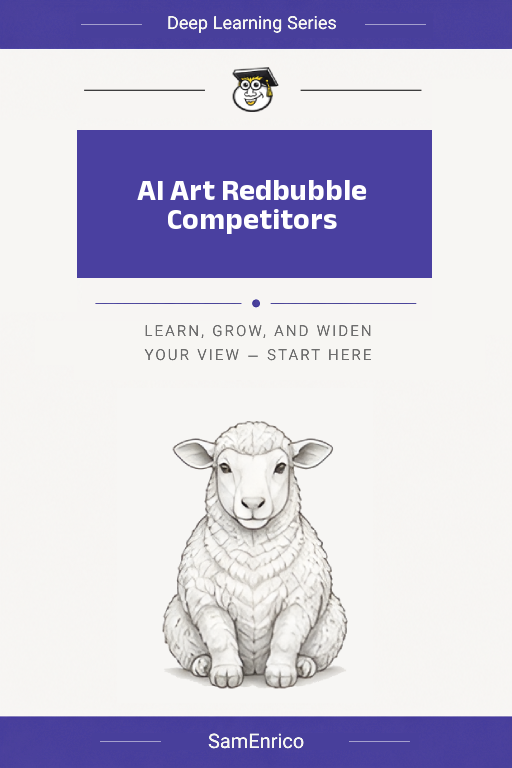
Non-FictionSide Hustle ArchitectCompetitorsResearch
AI Art Redbubble Competitors eBook
Research successful Redbubble AI art competitors f
Research successful Redbubble AI art competitors for design and niche inspiration.
Formats
Free sample
Chapter 1: The 67-Cent Epiphany...--I made my first dollar on Redbubble in 2023. Actually, that's a lie. I made sixty-seven cents. After Redbubble took their cut, after the manufacturing costs, after everything, I had sixty-seven cents sitting in my dashboard. I stared at that number for ten minutes.
Sixty-seven cents. I had spent eighteen hours designing that t-shirt. Eighteen hours for less than the price of a gumball.But here's what I didn't know then: that sixty-seven cents was a miracle. In 2025, most new sellers will wait six months to see their first sixty-seven cents. Some will never see it at all.The landscape has changed.
Not gradually, not predictably, but like a flash flood. In 2022, a new Redbubble store with one hundred original designs could expect a sale within two weeks. The platform was hungry for content. Buyers were hungry for novelty. And most importantly, the barrier to entry was still high enough to keep out the casual experimenters.Then came the democratization of creativity.AI art tools put the ability to generate professional-looking designs into the hands of anyone with an internet connection and fifteen minutes of patience.
Midjourney launched. DALL-E went viral. Stable Diffusion put open-source model weights on every developer's laptop. Suddenly, the barrier to entry wasn't a skill wall anymore. It was a suggestion.
A polite request. A velvet rope that everyone could step over.By 2025, Redbubble was receiving millions of new designs every month. Most of them were generated by people who had never held a drawing tablet, never studied color theory, never learned why a t-shirt design needs breathing room around the collar. They had a prompt, a dream of passive income, and absolutely no differentiation strategy.This book is for everyone else.The Great Filter If you search You Tube for "Redbubble AI art passive income," you will find thousands of videos promising the same thing: generate one hundred designs, upload them, and watch the money roll in while you sleep. The math sounds reasonable.
If each design makes just one dollar per month, one hundred designs make one hundred dollars per month. Scale to one thousand designs, and you have a thousand dollars. Passive. Effortless. Inevitable.This is the "Spray and Pray" strategy.
And it is a lie.Let me tell you about a store I analyzed while researching this book. Let's call it "Galaxy Cats Unlimited." The owner had uploaded 5,237 designs. Every single one was a variation of a glowing cat floating through a starfield. Some cats were sitting. Some were standing.
Some had wizard hats. Some had crowns. But fundamentally, every design was the same: low-effort, high-gloss AI-generated cat in space.How much did Galaxy Cats Unlimited make in six months?Fourteen dollars.Not fourteen thousand. Not fourteen hundred. Fourteen dollars.
And most of that came from one confused buyer who bought a sticker by accident and didn't bother returning it.Why did this store fail? The owner did everything the You Tube videos said. They uploaded consistently. They used all fifteen tags. They priced competitively.
By every metric of the "Spray and Pray" playbook, they should have succeeded. But they didn't. Because the playbook was written for a different era.Redbubble's algorithm has evolved. It no longer rewards pure volume. In fact, it actively penalizes it.How the Algorithm Actually Thinks Imagine you are Redbubble's search algorithm.
You have millions of designs to sort through for every user query. Your job is to show the user the designs they are most likely to buy, because every sale makes Redbubble money. You have learned, through billions of data points, that users behave in predictable ways.When a user clicks on a design and immediately clicks back, you learn that the design was disappointing. When a user clicks on a design and spends thirty seconds zooming in, reading the description, and checking the size chart, you learn that the design was engaging. When a user favorites a design, you learn that they are likely to return and buy it later.
When a user buys a design, you learn that the design successfully converted.Now imagine you see a store uploading fifty new designs every day. The algorithm notices. It gives each new design its "freshness boost" – a seventy-two hour window where the design is shown to more users than usual. This is Redbubble's way of testing new content.But if those fifty designs are all low-quality variations of glowing cats in space, the algorithm will learn something devastating: this store is a time-waster. Users click, see another glowing cat, and click back within three seconds.
The dwell time is terrible. The favorite rate is near zero. The conversion rate is nonexistent.After a few weeks of this, the algorithm stops giving this store's new designs the freshness boost. Why would it? The data says these designs hurt user experience.
The algorithm isn't punishing the store out of malice. It's optimizing for user satisfaction. And users have clearly shown that they do not want more glowing cats.This is the "Spray and Pray" death spiral. High volume leads to low engagement. Low engagement leads to lower visibility.
Lower visibility leads to even lower engagement. The store becomes invisible, buried under a mountain of its own low-quality output.The Abundance Paradox There is a psychological principle that explains why "Spray and Pray" fails: the Abundance Paradox. When something is abundant, we value it less. When something is scarce, we value it more. This is not just a cultural observation.
It is wired into our brains. Scarcity triggers urgency, desire, and the fear of missing out. Abundance triggers indifference, skepticism, and the assumption that if something is everywhere, it can't be that good.AI art has made visual content abundant. Incredibly, terrifyingly abundant. In the time it takes you to read this sentence, someone has generated one hundred new images.
By the time you finish this chapter, millions of new images will exist that did not exist before.In the face of this abundance, the only rational strategy is scarcity. Not artificial scarcity created by limiting supply, but real scarcity created by doing things that most AI users won't do. Adding texture that looks hand-drawn. Creating consistency across a product line. Building a recognizable style that feels like a human made it.
Investing the time that others refuse to invest.This book is built on one core philosophy: Your goal is not to make more art. Your goal is to make art that cannot be easily replicated by another prompter.The Visual Cliches That Scream "Low Value"Before you can escape the "Spray and Pray" trap, you need to recognize what it looks like. The AI art that floods Redbubble today has distinct visual fingerprints. Buyers may not be able to articulate why they distrust these designs, but their clicks and wallets tell the story.The Oversymmetrical Face Problem. Early AI models struggled with faces.
They produced distorted eyes, mismatched ears, and teeth that looked like corn kernels. Newer models have solved this problem by overcorrecting. Now AI-generated faces are too symmetrical. Perfectly mirrored left and right sides. Eyes that are exactly the same size and shape.
Features arranged with mathematical precision.Real human faces are not perfectly symmetrical. Real illustrations, even highly polished ones, have subtle asymmetries…
This is the end of the free sample. Get the eBook to keep going. Buy now
About this book
Details
- Author
- Castleberry Alda
- Publisher
- SamEnrico
- Language
- English
- Genre
- Non-Fiction, Side Hustle Architect, Competitors, Research
- Released
- 2026-06-01
- Pages (approx.)
- 141
- Available as
- eBook, Audiobook

Read better in the ZLOADR app
Your eBooks on your phone or tablet. Sign in with your SamEnrico account and start reading.
More by Castleberry Alda
 Bankruptcy Emotional Recovery GuideCastleberry Alda$11.99
 Franciscan Simplicity Lifestyle PrimerCastleberry Alda$11.99Franciscan Simplicity Lifestyle PrimerCastleberry Alda$11.99
 Feelings NVC VocabularyCastleberry Alda$11.99
 Remote Productivity Metrics GuideCastleberry Alda$11.99
 Boundary Setting After BetrayalCastleberry Alda$11.99
 The Vanishing Act of the Last Viking KingCastleberry Alda$11.99
 The Forgotten Cartographers: Lost in the Grand Canyon’s DepthsCastleberry Alda$11.99
 Understanding EpidermolCastleberry Alda$17.99
 Hotel Front DeskCastleberry Alda$11.99
 Scrum for TikTok StartupsCastleberry Alda$12.99
 How to Become a Shellfish GrowerCastleberry Alda$11.99
You may also like
 Hong Kong Handover 1997Dunn Johnnie$11.99
 Zumba For Postnatal Recovery CourseNeal Christian$11.99
 Zumba for BeginnersLadner Nikia$11.99
 YouTube Comment Mining GuideHumes Pandora$12.99
 Worry Box MeditationCarlin Rudy$11.99
 Workplace Stress MeditationNguyen Lynn$11.99
 Workplace Stress and Sleep RepairHawley Ivory$11.99
 Workplace Perfectionism CureDelaney Jeffry$11.99
 Workplace Injustice Anger GuideWallen Isabelle$11.99
 Work Addiction and Burnout LinkGreenwood Ester$11.99
 Women in Yoga and WellnessBeattie Galina$11.99
 Women in Stand Up ComedyChun Evangeline$11.99