

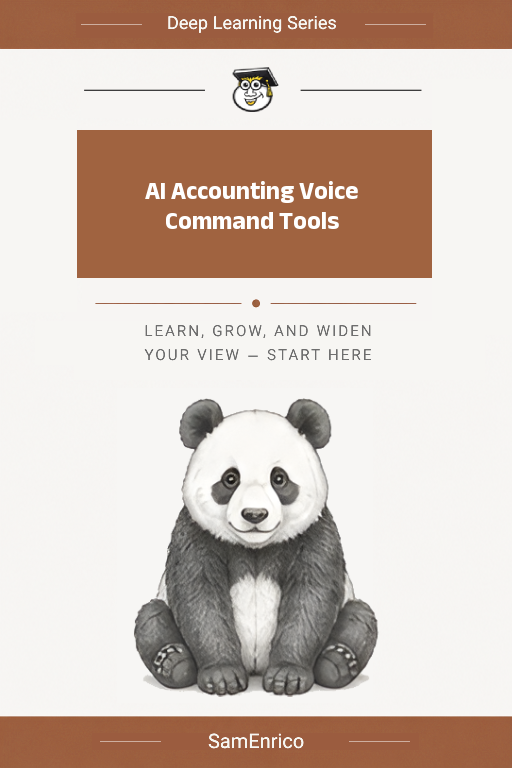
Non-FictionBusiness BriefVoice AI
AI Accounting Voice Command Tools eBook
Use voice to query your accounting system asking f
Use voice to query your accounting system asking for balances or reports hands-free.
Formats
Free sample
Chapter 1: The Silent Revolution--–- It began not with a bang, but with a frustrated sigh. Maria Chen, controller for a $200 million manufacturing firm, had just been asked the same question for the third time that day. Her CEO, standing in the doorway of her office, needed to know the company's current cash position before a 2 PM vendor negotiation. The problem wasn't the question itself—it was the ritual that followed. Open the ERP system.
Wait for the dashboard to load. Navigate to the cash management module. Select the correct bank account. Run the report. Read the number.
Close the report. Answer the CEO. By the time Maria had the answer, the CEO had already checked his phone twice, and the moment of strategic relevance had passed.That sigh, repeated millions of times per day across every finance department in every industry, is the sound of friction. It is the friction between a decision-maker needing information and the systems designed to provide it. And for the first time in the history of accounting technology, that friction is about to be eliminated—not by faster processors, not by better dashboards, but by the most natural interface ever devised: the human voice.This chapter tells the story of how we arrived at this moment.
It traces the arc of accounting interfaces from clay tablets to conversational AI, explains why 2025 represents a genuine tipping point rather than another hype cycle, and introduces the core concepts that will transform how you interact with your financial systems. By the end of this chapter, you will understand not only why voice-activated accounting is inevitable but also why waiting even six months to adopt it puts your firm at a competitive disadvantage.The Four Eras of Accounting Interfaces To understand where we are going, we must first understand where we have been. The history of accounting technology can be divided into four distinct eras, each defined not by the software itself but by the interface through which humans and systems communicate.Era One: The Paper Ledger (1300s–1970s)For nearly seven centuries, accounting was a tactile, ink-and-parchment affair. The double-entry system, codified by Luca Pacioli in 1494, required accountants to physically write each debit and credit into bound ledgers. The interface was the human hand and the quill pen.
Queries—to the extent they existed—meant manually flipping through pages, summing columns with an abacus or a calculating machine, and copying results onto separate sheets for presentation.The paper ledger era had one virtue: it forced slowness. Accountants could not generate a balance sheet on demand because doing so required hours of manual calculation. Instead, they produced reports on a schedule—monthly, quarterly, annually. Business decisions were made based on stale data because current data was literally inaccessible. The friction was baked into the medium.Era Two: The Spreadsheet (1980s–2000s)The arrival of Visi Calc in 1979, followed by Lotus 1-2-3 and eventually Microsoft Excel, revolutionized not just accounting but the entire concept of business modeling.
For the first time, accountants could create dynamic, formula-driven documents that updated automatically when inputs changed. The interface shifted from hand to keyboard and mouse.Spreadsheets dramatically reduced the time required to produce reports. A balance sheet that once took a full day could now be generated in an hour. But spreadsheets introduced new friction: formula errors, broken links, version control nightmares, and the infamous "spreadsheet risk" that has led to billions of dollars in financial misstatements. More importantly, spreadsheets were still fundamentally static.
To answer a new question, you still had to build a new model or modify an existing one. The interface had improved, but the paradigm remained: humans initiated every action, and systems waited passively for commands.Era Three: The Cloud Dashboard (2010s–2024)Cloud-based ERP systems like Quick Books Online, Xero, and Net Suite brought two transformative changes: real-time data and visual dashboards. Instead of running reports manually, accountants could log in and see key metrics displayed on a single screen. Cash balance, accounts receivable aging, profit and loss—all rendered in colorful charts that updated as transactions posted.The dashboard era reduced query time from hours to seconds. But it introduced a new problem: the tyranny of the visual interface.
Every query required navigating to the correct screen, clicking the correct filters, and reading the correct number. For a CFO on a conference call, this meant multitasking—opening a laptop, toggling between windows, and dividing attention between the conversation and the screen. For a controller in a manufacturing plant, it meant walking to a computer terminal, logging in, and interrupting workflow. The dashboard made information accessible, but it still required physical presence and visual attention.Era Four: Voice-Activated Accounting (2025–)We are now entering the fourth era, defined by a radical proposition: what if you could ask your accounting system a question the same way you ask a colleague? Not by typing, not by navigating, not by looking at a screen—but by simply speaking.Voice-activated accounting tools leverage three converging technologies: automatic speech recognition (ASR) that converts spoken words to text with near-human accuracy, natural language processing (NLP) that understands accounting-specific terminology and intent, and retrieval-augmented generation (RAG) that maps natural language questions to precise database queries.
Together, these technologies eliminate the interface as a bottleneck. The question becomes the command. The answer becomes instantaneous.Why 2025 Is the Tipping Point Voice recognition is not new. Dragon Naturally Speaking launched in 1997. Siri arrived in 2011.
For nearly three decades, voice technology has promised to replace keyboards and mice, only to fall short due to accuracy issues, latency, and poor handling of specialized vocabulary. So why should anyone believe that 2025 is different?Three specific technological breakthroughs have converged to make voice-activated accounting not just possible but production-ready.Breakthrough One: Local Processing with Whisper.cpp Historically, accurate speech recognition required sending audio to cloud servers for processing. This introduced latency (the round trip to the cloud and back) and raised privacy concerns (sensitive financial data leaving the corporate network). In 2022, Open AI released Whisper, a speech recognition model that achieved near-human accuracy. In 2023, Whisper.cpp emerged—a version of Whisper that runs entirely on local hardware, including laptops and even smartphones.Local processing means your voice commands never leave your device.
The speech-to-text conversion happens on your computer, not in some cloud data center. This eliminates both latency and privacy concerns. A command like "What's my cash balance?" can be processed and answered in under three seconds—fast enough to feel instantaneous. And because the audio never leaves your premises, firms subject to HIPAA, ITAR, or other data residency requirements can adopt voice without compliance violations.Breakthrough Two: Domain-Specific Language Models General-purpose NLP models understand everyday English but struggle with accounting terminology. Ask GPT-4 "What's my deferred revenue balance?" and it might give you a definition of deferred revenue rather than querying your database.
The breakthrough is not larger models but specialized models fine-tuned on accounting data.Companies like Docyt and Nemo have trained their models on millions of accounting transactions, charts of accounts, and financial statements. These domain-specific models understand that "AR" means accounts receivable, that "aging" refers to overdue invoices, and that "variance" implies a comparison to budget or prior…
This is the end of the free sample. Get the eBook to keep going. Buy now
About this book
Details
- Author
- Oakes Earnestine
- Publisher
- SamEnrico
- Language
- English
- Genre
- Non-Fiction, Business Brief, Voice AI
- Released
- 2026-05-29
- Pages (approx.)
- 142
- Available as
- eBook, Audiobook

Read better in the ZLOADR app
Your eBooks on your phone or tablet. Sign in with your SamEnrico account and start reading.
More by Oakes Earnestine
 Sleep Meditation For PainOakes Earnestine$11.99
 Sudden Departure Employee Theft InvestigationOakes Earnestine$11.99
 Dementia Rhythm DisturbanceOakes Earnestine$11.99
 Sugar Addiction And Migraines GuideOakes Earnestine$11.99
 Cannabis Use Disorder and PTSDOakes Earnestine$11.99
 Celebrating Sobriety Milestones GuideOakes Earnestine$11.99
 Power Pose ProtocolOakes Earnestine$11.99
 Spouse Death and AppetiteOakes Earnestine$11.99
 Abuse of Dominance PenaltiesOakes Earnestine$11.99
 Whispers in the Silk Road: A Love Defying EmpiresOakes Earnestine$11.99
 Splendid Little War: The Battle of Santiago de CubaOakes Earnestine$11.99
 How to Produce Bamboo FiberOakes Earnestine$11.99
You may also like
 Hong Kong Handover 1997Dunn Johnnie$11.99
 Zumba For Postnatal Recovery CourseNeal Christian$11.99
 Zumba for BeginnersLadner Nikia$11.99
 YouTube Comment Mining GuideHumes Pandora$12.99
 Worry Box MeditationCarlin Rudy$11.99
 Workplace Stress MeditationNguyen Lynn$11.99
 Workplace Stress and Sleep RepairHawley Ivory$11.99
 Workplace Perfectionism CureDelaney Jeffry$11.99
 Workplace Injustice Anger GuideWallen Isabelle$11.99
 Work Addiction and Burnout LinkGreenwood Ester$11.99
 Women in Yoga and WellnessBeattie Galina$11.99
 Women in Stand Up ComedyChun Evangeline$11.99