
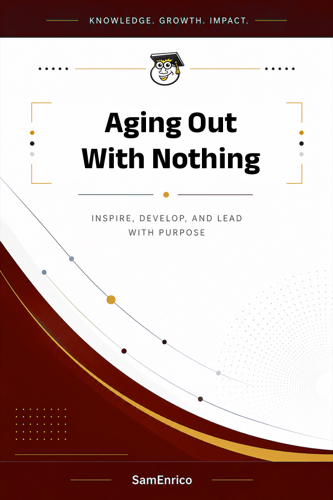
Non-FictionBiographyTransitional Age
Aging Out With Nothing eBook
Documents the terrifying moment of leaving care at
Documents the terrifying moment of leaving care at 18 with no family, savings, or safety net.
Formats
Free sample
Chapter 1: The Midnight Countdown...--–- The social worker handed me a bus pass and a garbage bag of my belongings at 4:47 PM on a Tuesday. My birthday was in six hours. She said, "You're someone else's problem now," and closed the door. That was the entire transition plan.This is how aging out really begins. Not with a ceremony, not with a savings account handoff, not with a graduation party.
It begins with a plastic trash bag, a laminated bus pass that expires in thirty days, and the sound of a deadbolt clicking behind a child who is suddenly, legally, nobody's responsibility.The clock is the most terrifying thing in a foster youth's life. Not the passage of time itself, but what the calendar represents: the exact moment the state decides you are no longer worth housing, feeding, or protecting. For eighteen years, the system told you where to sleep, when to eat, how to behave. Then, at a predetermined hour, it turns off the faucet and expects you to have saved enough water to last a lifetime.You didn't. You couldn't.
No one can.The Countdown Culture Inside group homes and transitional living facilities across America, the approach of an eighteenth birthday is marked not with celebration but with clinical detachment. Staff members circle dates on wall calendars with red marker. Caseworkers begin the paperwork of discharge weeks or months in advance, filing forms that officially sever their legal responsibility. The youth watches this happen, often in plain sight, and learns a devastating lesson: the system was never a family. It was always a timed contract.Drawing from narratives documented in Some Type of Way, we meet young people like Plato, who spent four years in a group home outside Chicago.
When asked what he planned to do after turning eighteen, Plato laughed without humor and said, "I'll probably be dead by then. Most of us are." He wasn't being dramatic. He was stating what he had observed: the older teens who aged out rarely came back to visit. They vanished into the streets, into shelters, into statistics that no one reads.The countdown culture is not accidental. It is structural.
Group homes receive funding per bed, per night. When a youth turns eighteen, that funding stops. There is no financial incentive to prepare a young person for independence, only to vacate the bed for the next paying customer. Staff members who have genuine compassion for the youth in their care are often hamstrung by agency policies that forbid extended stays, forbid co-signing leases, forbid any action that might create "ongoing dependency." The message, delivered silently through paperwork and policy, is clear: Your time is up. Don't let the door hit you on the way out.For the youth, this creates a unique form of psychological torture.
They count down the days not to freedom but to abandonment. Every passing hour brings them closer to a cliff they can see but cannot avoid. Birthdays become anniversaries of loss. Cake and candles become symbols of the system's indifference.The Neurobiology of Abandonment To understand why aging out is so devastating, we must first understand what happens inside the adolescent brain during times of extreme stress. This is not about weakness or character.
It is about biology.The "normal" adolescent brain, as developmental psychologists describe it, is still under construction. The prefrontal cortex—responsible for impulse control, long-term planning, risk assessment, and emotional regulation—does not fully mature until around age twenty-five. This is why teenagers, even those from stable, wealthy families, make impulsive decisions, struggle with foresight, and rely heavily on adult scaffolding. They are not defective. They are unfinished.Now consider the brain of a trauma survivor who has spent years in foster care.
Multiple placements, inconsistent caregivers, chronic unpredictability, and often outright abuse rewire the neural architecture. The amygdala—the brain's fear center—becomes hyperactive, constantly scanning for threats. The hippocampus, responsible for memory and context, shrinks. The prefrontal cortex, already underdeveloped due to age, is further compromised by chronic cortisol exposure. This is not a moral failing.
It is a physiological injury.When that brain is told, at eighteen, that it must suddenly become self-sufficient, the result is not independence. It is dissociation. The mind shuts down to protect itself from an impossible demand. The youth does not rise to the occasion. The youth collapses into survival mode, making choices that look irrational to outsiders but are perfectly logical given the constraints: taking any couch offered, trusting any adult who seems kind, spending money the moment it arrives because tomorrow might not come.One former foster youth, interviewed for this book, described her eighteenth birthday this way: "I sat on the curb outside the group home with my bag and just...
stopped thinking. I couldn't make a plan because my brain wouldn't work. It was like someone unplugged a computer while it was still running. I just sat there for four hours until a police officer asked what I was doing."This is not a failure to launch. This is a system that launches children from a catapult and calls it independence.The 72-Hour Window In the seventy-two hours before a foster youth turns eighteen, two things happen simultaneously: the system accelerates its abandonment, and the youth's window for last-minute preparation slams shut.For youth with cooperative caseworkers and stable placements, these seventy-two hours can be a flurry of final paperwork, document transfers, and last-minute applications for transitional housing programs.
For many, however, the window is already closed. Caseworkers who have been unresponsive for months do not suddenly become helpful in the final days. Paperwork that was never started cannot be finished. Relationships that were never built cannot be formed.This chapter acknowledges a brutal truth that most books on aging out avoid: the "72-hour survival kit" described in many transition plans is aspirational for the majority of foster youth. If you are reading this book and you still have time before your birthday, consider yourself fortunate.
Use the checklists below to prepare. But if you are reading this book and your birthday has already passed, or if your caseworker has already made clear that no help is coming, do not blame yourself for being unprepared. The system was designed to fail you. Your survival is not measured by how many items you secured beforehand. It is measured by whether you are still breathing.With that acknowledgment in place, here are two parallel paths.Path One: The Full Preparation Guide (For Youth with Cooperative Caseworkers)If you have a caseworker who returns your calls, a foster parent who seems genuinely invested, or access to an independent living program, use the following checklist in your final seventy-two hours.
Do not assume any of this will happen automatically. Assume nothing.Document Checklist:Request physical copies of your birth certificate, social security card, and state ID.Request your entire case file (or as much as they will give you).Request immunization records and any medical history.Request school transcripts and any special education records (IEP or 504 plans).Take photos of every document with your phone if possible.Financial Checklist:If you have a bank account (many foster youth do not), confirm you have sole access.If you…
This is the end of the free sample. Get the eBook to keep going. Buy now
About this book
Details
- Author
- Goebel Rosenda
- Publisher
- SamEnrico
- Language
- English
- Genre
- Non-Fiction, Biography, Transitional Age
- Released
- 2026-06-10
- Pages (approx.)
- 141
- Available as
- eBook, Audiobook

Read better in the ZLOADR app
Your eBooks on your phone or tablet. Sign in with your SamEnrico account and start reading.
More by Goebel Rosenda
 Herbal ED SupplementsGoebel Rosenda$11.99
 Depression Nutrition GuideGoebel Rosenda$11.99
 The Hope for Angry ParentsGoebel Rosenda$11.99
 The Boomer Health App GuideGoebel Rosenda$11.99
 The Silk Road Kick: How Persian Warriors Invented the Forerunner to Australian Rules FootballGoebel Rosenda$11.99
 ParamotoringGoebel Rosenda$11.99
 The Breeder's Guide to Rhode Island Red Non-industrial ChickensGoebel Rosenda$11.99
 CTO Technical Assessment GuideGoebel Rosenda$12.99
 Minority Firm Proposal WritingGoebel Rosenda$12.99
 How to Start a Design Studio Business (Beginners Guide)Goebel Rosenda$11.99
You may also like
 Hong Kong Handover 1997Dunn Johnnie$11.99
 Zumba For Postnatal Recovery CourseNeal Christian$11.99
 Zumba for BeginnersLadner Nikia$11.99
 YouTube Comment Mining GuideHumes Pandora$12.99
 Worry Box MeditationCarlin Rudy$11.99
 Workplace Stress MeditationNguyen Lynn$11.99
 Workplace Stress and Sleep RepairHawley Ivory$11.99
 Workplace Perfectionism CureDelaney Jeffry$11.99
 Workplace Injustice Anger GuideWallen Isabelle$11.99
 Work Addiction and Burnout LinkGreenwood Ester$11.99
 Women in Yoga and WellnessBeattie Galina$11.99
 Women in Stand Up ComedyChun Evangeline$11.99