
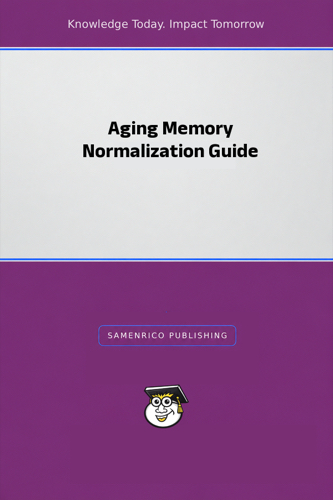
Aging Memory Normalization Guide eBook
Accept slower processing as normal, reducing self-
Accept slower processing as normal, reducing self-criticism and focusing on compensation not cure.
Formats
Free sample
Chapter 1: The Veteran Pilot--You are not losing your mind. You are upgrading to a different operating system—one that trades raw speed for pattern recognition, quick reflexes for error prevention, and instant recall for deeper wisdom. This is the single most important sentence you will read in this book, and it directly contradicts almost everything the multi-billion dollar brain-training industry wants you to believe. That industry thrives on your fear. It profits from convincing you that a 65-year-old brain should perform like a 25-year-old brain, and that anything less is the beginning of decline.
But a 65-year-old brain is not a defective 25-year-old brain. It is a different brain entirely—one that has been rewired by decades of experience, optimized for efficiency rather than speed, and calibrated to prioritize what matters over what merely happens.Consider the veteran pilot. A 25-year-old flight student has lightning-fast reaction times. They can respond to a sudden stall warning in milliseconds. Their hands move before their conscious mind registers the alarm.
But they also make catastrophic errors—because speed without pattern recognition is dangerous. They might correct the stall in the wrong direction. They might fixate on one instrument while ignoring the engine failure. They might react so quickly that they miss the underlying problem entirely. Now consider the 60-year-old captain with twenty thousand flight hours.
Their reaction time is slower—sometimes by half a second or more. But their error rate is dramatically lower. Why? Because they do not react to individual alarms. They recognize patterns.
They have seen this exact sequence of warnings before, fifteen years ago over the Atlantic, and they know—without conscious calculation—that the correct response is not to pull up but to reduce throttle and wait three seconds. Their slower response is not a bug. It is a feature. They traded speed for accuracy, and that trade saved hundreds of lives.Your aging brain is that veteran pilot. The slowing you experience—taking longer to recall a name, pausing mid-sentence to find a word, needing a few extra seconds to process a complex question—is not a sign of deterioration.
It is the signature of a brain that has stopped reacting and started recognizing. And that shift is exactly what evolution designed it to do.The Neuroscience of Slowing: A Feature, Not a Flaw To understand why slower processing is normal and adaptive, we need to look under the hood. The aging brain undergoes three predictable changes that directly affect processing speed, and none of them are diseases.First, myelin thinning. Myelin is the fatty insulation wrapped around your neurons—the biological equivalent of the plastic coating on an electrical wire. It allows signals to travel quickly and efficiently.
Beginning around age forty, myelin gradually thins, particularly in the frontal lobes and the corpus callosum (the bridge between hemispheres). This means neural signals travel ten to fifteen percent slower than they did at age twenty-five. But here is what the fear-mongering industry does not tell you: slower transmission is not the same as signal loss. The information still arrives. It just takes a few hundred milliseconds longer.
That is the difference between saying a name instantly and feeling it on the tip of your tongue for three seconds. The name is there. The circuit is intact. The transmission is just a little slower.Second, decreased dopamine. Dopamine is not just the pleasure chemical—it is the accelerator pedal for neural processing.
It speeds up the firing rate of neurons involved in working memory and task switching. By age sixty, most people have about half the dopamine receptors they had at age twenty. Again, this is not a disease. It is a programmed down-regulation, possibly evolved to reduce novelty-seeking and increase stability. The result is that your brain no longer revs its engine unnecessarily.
It takes a moment to shift gears. But once it is in gear, it drives just as well—sometimes better, because it is no longer distracted by every shiny exit ramp.Third, synaptic pruning. For decades, we were told that the aging brain only loses connections. We now know this is incomplete. The aging brain does lose some synapses, particularly those involved in rapid, reflexive responses.
But it also strengthens other synapses—those involved in pattern recognition, emotional memory, and long-term semantic knowledge. This is not decay. It is remodeling. Your brain is systematically reducing investment in fast, shallow processing and reinvesting in slow, deep processing. You cannot multitask as well at sixty-five as you could at twenty-five.
But you can recognize a manipulation tactic, solve a complex interpersonal problem, and make a high-stakes decision with far greater accuracy. That is not loss. That is trade.The Veteran Pilot Effect in Daily Life Let me make this concrete with three everyday scenarios.Scenario one: You are driving and another car swerves into your lane. A twenty-five-year-old brain reacts in 0.6 seconds—horns blaring, wheel jerked, heart pounding. A sixty-five-year-old brain might take 0.9 seconds.
But here is what happens in those extra three-tenths of a second: the older brain runs a pattern match. Have you seen this before? Yes—three times in the last ten years, and in two of those cases, the swerving car was actually avoiding a child in the road. So instead of swerving blindly, the older brain checks the side mirror first. That extra three-tenths of a second prevents a collision with the car in the next lane.
The slower response was the safer response.Scenario two: You are in a meeting and someone asks a complex question about a project that ended six months ago. A younger brain might answer immediately—fast, confident, and sometimes wrong because it grabbed the first available memory without verification. An older brain pauses. Colleagues might interpret this pause as forgetfulness. But what is actually happening is retrieval monitoring: the older brain is checking multiple memory traces, cross-referencing them, and suppressing irrelevant associations before speaking.
The pause produces a more accurate answer. Speed would have produced an error. The pause is not a symptom. It is a quality control mechanism.Scenario three: You are at a dinner party and you cannot remember the name of the person you just met thirty seconds ago. The younger brain would never have this problem because it was not distracted by six other inputs—the background music, the clinking glasses, the emotional subtext of the conversation, the worry about whether you have spinach in your teeth.
Your older brain, by contrast, was processing all of those inputs simultaneously. It prioritized social safety over name encoding. You did not forget the name because your memory is failing. You never encoded it in the first place because your brain correctly judged that scanning for threats was more important than memorizing a label. That is not a deficit.
That is a survival instinct.The Tip-of-the-Tongue State Is Not Data Loss One of the most distressing experiences for aging adults is the tip-of-the-tongue state—that agonizing moment when you know you know a word, but it will not come out. You can feel its shape, its first letter, its number of syllables. It hovers just out of reach. And then, thirty seconds later, it pops into…
This is the end of the free sample. Get the eBook to keep going. Buy now
About this book
Details
- Author
- Oldham Charolette
- Publisher
- SamEnrico
- Language
- English
- Genre
- Non-Fiction, Self-Help, Acceptance
- Released
- 2026-06-10
- Pages (approx.)
- 138
- Available as
- eBook, Audiobook

Read better in the ZLOADR app
Your eBooks on your phone or tablet. Sign in with your SamEnrico account and start reading.
More by Oldham Charolette
 Walking Meditation For Stroke Recovery GuideOldham Charolette$11.99
 Project Monte Carlo SimulationOldham Charolette$11.99
 The British East India Company FallOldham Charolette$11.99
 Restructuring Revenge FantasiesOldham Charolette$11.99
 The Lost Symphony of the Nile: Reimagining Africa's Classical Golden AgeOldham Charolette$11.99
 10 Ways to Use Cucumber (Recipe Book)Oldham Charolette$11.99
 Tug-of-War RefereeOldham Charolette$11.99
 German University for Turkish StudentsOldham Charolette$12.99
 Kanban and Production LevelingOldham Charolette$12.99
 Understanding Ocular Coloboma-imperforate AnusOldham Charolette$17.99
You may also like
 The Pain Acceptance WorkbookStover Jerrold$11.99
 Atomic Habits For AcceptanceFerrell Hassie$11.99
 Speed Limit Acceptance GuideOutlaw Tillie$11.99
 Turning the MindSinclair Adena$11.99
 Pet Loss Acceptance GuideDangelo Trent$11.99
 The Turning the Mind DBT SkillCrabtree Nannie$11.99
 Short Breath AwarenessDailey Dortha$11.99
 Rush Hour Traffic Acceptance GuideBlodgett Roseanna$11.99
 Control Release HandbookSeymore Sherryl$11.99
 Acceptance Sleep MeditationSchilling Lanita$11.99
 Open Monitoring Pain AcceptanceHerrington Garth$11.99
 Anticipatory Grief AcceptanceCyr Sha$11.99