
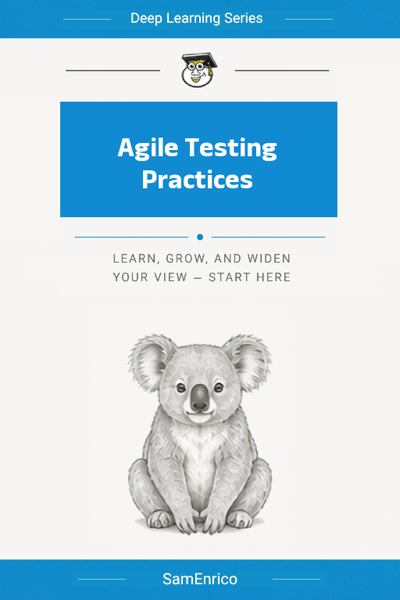
Non-FictionInformativeEducational
Agile Testing Practices eBook
A Coursebook on Agile Testing Practices
by Brown Jerome
A Coursebook on Agile Testing Practices
Formats
Free sample
Chapter 1: The $10 Million Bug--–- At 11:47 PM on a Friday, Maria Vasquez watched her company’s stock price drop nine points in seventeen minutes. She wasn’t watching the stock ticker. She was watching a different number: 2,347. That was how many customers had just been charged twice for the same subscription. The bug had been in production for six hours.
The refunds would cost $10 million. The trust would cost more. Maria was the director of quality engineering at Fin Trust, a mid-sized fintech company that had “always done testing the right way.” They had a separate QA team. They had a test phase at the end of every release cycle. They had a sign-off meeting where the QA manager stamped a physical piece of paper that said “Approved for Release.” And on that Friday, none of it mattered.This is a book about what Maria learned the hard way.
It is a book about why traditional testing fails in a world where software releases happen every day, not every quarter. And it is a book about a different way: a way where testing is not a phase at the end, but an activity that happens constantly, by everyone, from the first line of code to the last log in production.If you have ever been woken up at 2 AM by a pager alert about a production outage, keep reading. If you have ever heard someone say “we’ll test it after development is done,” keep reading. If you have ever shipped a feature that worked perfectly in the test environment but crashed immediately in production, keep reading. This chapter will dismantle everything you thought you knew about testing and rebuild it from the ground up.The Waterfall Lie Let us start with a confession.
Most software teams today claim to be “agile.” They have daily standups. They have sprints. They have Jira boards with colorful sticky notes. But when it comes to testing, many of these same teams are still doing waterfall. They just don’t know it.The waterfall model, formally described by Winston Royce in 1970 (though he actually criticized it), is a linear, phase-gated approach to software development.
You gather all requirements. Then you design the system. Then you write the code. Then you test the code. Then you deploy.
Each phase completes before the next begins. Testing happens at the end, like a quality inspection station on a factory assembly line.Here is the problem with that model in modern software development. By the time testing begins, every decision has already been made. The requirements are locked. The design is locked.
The code is written. The only thing testing can do at that point is find bugs and report them. But finding a bug at the end of a waterfall project is like discovering that you built a house on a swamp after you have already installed the kitchen cabinets. Yes, you can fix it. But the cost is enormous, the schedule slips, and everyone is angry.The waterfall testing model creates three pathological behaviors that every software professional has experienced.First, the late-disaster cycle.
Because testing happens at the end, the test team inevitably finds a large number of bugs late in the project. The project manager asks how long it will take to fix them. The development team says “two weeks.” The test team says “but then we have to retest everything, so add another two weeks.” The project manager says “we don’t have four weeks.” The team ships with known bugs. Customers complain. The next release is even more rushed.
The cycle accelerates until the product collapses under its own technical debt.Second, the adversarial handoff. In a phase-gated model, developers throw code “over the wall” to testers. The developers feel done. The testers find bugs. The developers feel criticized.
The testers feel ignored. The project manager feels like a referee. No one trusts anyone. The bug tracking system becomes a weapon rather than a tool. I have seen teams where testers and developers literally sit on different floors of the same building because “they fight too much.”Third, the quality illusion.
When testing is a separate phase, everyone else stops thinking about quality. The business analysts write requirements without considering testability. The developers write code without considering edge cases. The product managers make promises without considering regression risk. The testers are left holding the bag, expected to “ensure quality” after every other activity has already committed to a particular outcome.
But quality cannot be tested into a product. It must be built in. Testing at the end is like trying to put toothpaste back into the tube. It is possible, barely, but messy and wasteful.Maria’s team at Fin Trust was a textbook example of this pathology. They had a three-week release cycle.
Development took two weeks. Testing took one week. Every single release, the test team would find between fifty and two hundred bugs. Every single release, the development team would scramble to fix the worst ones. Every single release, the test team would retest only the fixes, not the whole system.
Every single release, the team would ship with known critical bugs. Every single release, the CEO would ask “why is this still happening?”The $10 million bug was not a technical failure. It was a process failure. The code that double-charged customers was only ten lines. A single missing validation condition.
A developer had written it on a Tuesday. A code reviewer had approved it on Wednesday. The test team had run their regression suite on Thursday. But the regression suite didn’t cover that particular edge case because no one had thought of it. Why would they?
The edge case only happened when a customer changed their subscription plan twice in the same billing cycle, then requested a refund, then reactivated, all within a forty-eight hour window. It was a rare scenario. But when you have two million customers, rare scenarios happen every day.The test team had done exactly what they were asked to do. They had followed the test plan. They had executed the test cases.
They had documented the results. They had signed off. And the product still failed in production. Because testing at the end is not enough.The Agile Manifesto’s Quiet Revolution In February 2001, seventeen software developers gathered at a ski resort in Snowbird, Utah. They represented competing methodologies: Extreme Programming, Scrum, Adaptive Software Development, Crystal, and others.
They disagreed on many things. But they agreed on four values that became the Agile Manifesto:Individuals and interactions over processes and tools Working software over comprehensive documentation Customer collaboration over contract negotiation Responding to change over following a plan These four statements changed software development forever. But their implications for testing are still misunderstood by most teams.Let us take each value and translate it into testing terms.Individuals and interactions over processes and tools means that a conversation between a tester and a developer is worth more than a fifty-page test plan. It means that the best test cases are not the ones written in a requirements document months ago; they are the ones discovered in real time as the team discusses edge cases together.…
This is the end of the free sample. Get the eBook to keep going. Buy now
About this book
Details
- Author
- Brown Jerome
- Publisher
- SamEnrico
- Language
- English
- Genre
- Non-Fiction, Informative, Educational
- Released
- 2026-06-02
- Pages (approx.)
- 151
- Available as
- eBook, Audiobook

Read better in the ZLOADR app
Your eBooks on your phone or tablet. Sign in with your SamEnrico account and start reading.
More by Brown Jerome
 LGBTQ Body Image Affirmation CourseBrown Jerome$11.99
 ICU Doctor Burnout WorkbookBrown Jerome$11.99
 Wincing as Anticipatory PainBrown Jerome$11.99
 Canyonlands DisappearancesBrown Jerome$11.99
 Beginner Meditation ChallengesBrown Jerome$11.99
 Canadian Arctic Expedition LeaderBrown Jerome$11.99
 Cohabitation Aging GuideBrown Jerome$11.99
 Freelancer Work Life BalanceBrown Jerome$11.99
 Whitney Houston: Voice and VulnerabilityBrown Jerome$11.99
 Bach: The Divine Mathematician of MusicBrown Jerome$11.99
 The Mineral Guide to AllabogdaniteBrown Jerome$11.99
 Growing Crescentia (Calabash)Brown Jerome$11.99
You may also like
 Hong Kong Handover 1997Dunn Johnnie$11.99
 Zumba For Postnatal Recovery CourseNeal Christian$11.99
 Zumba for BeginnersLadner Nikia$11.99
 YouTube Comment Mining GuideHumes Pandora$12.99
 Worry Box MeditationCarlin Rudy$11.99
 Workplace Stress MeditationNguyen Lynn$11.99
 Workplace Stress and Sleep RepairHawley Ivory$11.99
 Workplace Perfectionism CureDelaney Jeffry$11.99
 Workplace Injustice Anger GuideWallen Isabelle$11.99
 Work Addiction and Burnout LinkGreenwood Ester$11.99
 Women in Yoga and WellnessBeattie Galina$11.99
 Women in Stand Up ComedyChun Evangeline$11.99