
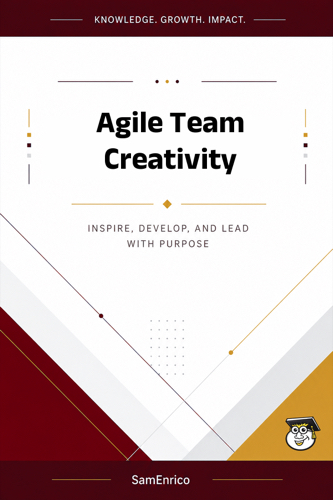
Agile Team Creativity eBook
Sprint based collaborative ideation.
Sprint based collaborative ideation.
Formats
Free sample
Chapter 1: The Velocity Trap--–- It was a Tuesday afternoon when Lisa, a product manager with twelve years of experience, realized her team had become a feature factory. The realization did not come during a dramatic failure or a post-mortem meeting. It came during a sprint review, while her team was proudly demoing a beautifully executed search filter that no user had requested, no analytics had supported, and no stakeholder could remember approving. Eight story points. Three sprints.
Two developers. One beautiful, useless filter. Lisa's team had done everything right by the Agile playbook. They had estimated accurately. They had committed and delivered.
Their velocity was consistent. Their burndown chart was a thing of beauty. And they were building features that mattered to no one.–- This is the single greatest unspoken tragedy of modern Agile: the discipline that promised to make teams adaptive has, in practice, made many teams merely efficient at building the wrong things. We have confused output with outcome, velocity with value, and activity with progress. We have created a generation of feature factories disguised as high-performing teams.
And we have done so while genuinely believing we were doing Agile right.–- This chapter is the wake-up call. It names the enemy: the Velocity Trap. It explains why traditional Agile, as practiced in most organizations, systematically kills creativity. And it introduces the solution that the rest of this book will build: the Ideation Sprint, a distinct, time-boxed framework that separates creative exploration from delivery execution.The Feature Factory Funeral–- Let us begin with a funeral. Not an actual funeral, but a metaphorical one that every Agile team should hold.
Gather your team around a whiteboard. Draw a line down the middle. On the left side, write down every feature your team has shipped in the last six months. On the right side, write down which of those features you have evidence users actually wanted, used, and valued. For most teams, the left column will be full.
The right column will be painfully sparse.–- This is not because your team is lazy or unintelligent. It is because the system rewards shipping, not learning. In most Agile implementations, the measure of success is simple: Did we deliver what we committed to? The daily standup asks, "What did you do yesterday? What will you do today?" The sprint review asks, "Did we meet our sprint goal?" The retrospective asks, "How can we deliver more reliably?" Notice what is missing from all these questions: "Did we build something that mattered?
Did we learn something surprising? Did we discover that an assumption was wrong?"–- The four creativity killers embedded in daily Scrum are so normalized that most teams no longer see them. First, estimation pressure rewards predictable, safe work. When your team is judged by how accurately you estimate, the rational response is to avoid uncertainty. Creativity is uncertain by definition.
You cannot estimate how long a novel idea will take because you do not know if it will work. So teams stop having novel ideas. Second, backlog grooming as chore treats problem-framing as overhead. The clock is ticking. There are story points to assign.
No one has time to ask, "Wait, is this even the right problem?" Third, "done means coded" equates building with solving. A feature is not "done" when it is deployed; it is "done" when it has produced validated learning. But the definition of done in most Scrum teams includes only technical completeness. And fourth, fear of failure punishes exploration. If a spike or experiment does not produce a shippable feature, it is treated as waste.
Your team learns to avoid waste. Your team learns to avoid learning.–- A simple diagnostic reveals the pathology. Ask your team this question in your next retro: "Do we spend more time discussing how to build something than why it should exist?" If the answer is yes – and for the vast majority of teams, it is – you are in the Velocity Trap. You are moving fast, but you are moving in circles.The Neuroscience of Why Agile Kills Creativity–- To understand why the Velocity Trap is so insidious, we must look at the brain. The prefrontal cortex – the region responsible for creative thinking, pattern recognition, and novel problem-solving – is exquisitely sensitive to threat.
When the brain perceives danger, it shifts resources to the amygdala and the survival circuits. Creativity shuts down. This is not a metaphor. It is a measurable neurological event.–- Now consider the typical Agile environment. Daily standups where you report progress to peers and managers.
Sprint planning where you commit to delivery under time pressure. Retrospectives where you analyze "failures." From a neurological perspective, these are threat-rich environments. The brain does not distinguish between physical danger and social danger. Being judged for missing a commitment activates the same threat responses as being chased by a predator. The prefrontal cortex goes offline.
Creativity evaporates.–- The most destructive single phrase in the Agile vocabulary is "Yes, but..." When one team member says "Yes, but..." to another's idea, the listener's amygdala activates. Cortisol floods the system. The prefrontal cortex (creative center) shuts down. The listener stops generating ideas and starts defending themselves. The damage is not just to the idea – it is to the person's willingness to share ideas in the future.
Each "Yes, but..." is a small neurological betrayal. Enough of them, and the team goes silent.–- I have watched this happen in real time. A team of eight talented engineers, designers, and product managers sits down to brainstorm. Someone offers an unusual idea. A senior engineer says, "Yes, but that would require a database migration." The room goes quiet.
Someone else offers a safer idea. The senior engineer says, "Yes, but that doesn't address the core use case." The room gets quieter. By the third "Yes, but...," the team has learned the lesson: keep your ideas to yourself. What looks like a productive critique is actually a creative massacre.–- The solution is not to eliminate critique – critique is essential for refinement. The solution is to separate critique from ideation.
You cannot critique and create at the same time. The brain literally cannot do both. Ideation requires an open, threat-free environment where the prefrontal cortex can make unusual connections. Critique requires a different cognitive mode altogether. The most common mistake in Agile teams is trying to do both in the same meeting.
The result is neither good ideas nor good critique – just a lot of mediocre, safe suggestions that no one feels passionate about.Introducing the Ideation Sprint–- The solution to the Velocity Trap is not to abandon Agile. The solution is to add a new ceremony: the Ideation Sprint. This is a distinct, time-boxed framework separate from the Delivery Sprint. Whereas Delivery Sprints focus on output – working software, story points completed, features shipped – Ideation Sprints focus on insights generated: validated learning, novel solutions, invalidated assumptions, surprising discoveries.–- The Ideation Sprint operates on a simple, sustainable rhythm: four hours per week, or ten percent of a forty-hour week. This is not a "full Monday" – that proved unsustainable in practice.
It is not a vague "spike" – that proved too easy to deprioritize. It is a recurring, protected block of…
This is the end of the free sample. Get the eBook to keep going. Buy now
About this book
Details
- Author
- Mercado Breana
- Publisher
- SamEnrico
- Language
- English
- Genre
- Non-Fiction, Self-Help, Agile
- Released
- 2026-06-05
- Pages (approx.)
- 143
- Available as
- eBook, Audiobook

Read better in the ZLOADR app
Your eBooks on your phone or tablet. Sign in with your SamEnrico account and start reading.
More by Mercado Breana
 Road Rage Affirmations Card SetMercado Breana$11.99
 Postpartum Doula Support GuideMercado Breana$11.99
 CPTSD Trigger ManagementMercado Breana$11.99
 Soothing Sound MeditationMercado Breana$11.99
 Breast Cancer Support GroupsMercado Breana$11.99
 Influence Techniques for FundraisersMercado Breana$11.99
 Anticipatory Grief For Social WorkersMercado Breana$11.99
 The Trial of the Whitechapel Widows: A Mother's Plea for JusticeMercado Breana$11.99
 The Sky Warriors of Aizu: Japan's First Aerial Clash (1868)Mercado Breana$11.99
 How to Produce Cooking WineMercado Breana$11.99
 A Collector's Handbook to the Triumph Gt6 Mk2Mercado Breana$11.99
 UNGS Argentina Student BlueprintMercado Breana$12.99
You may also like
 Hong Kong Handover 1997Dunn Johnnie$11.99
 Zumba For Postnatal Recovery CourseNeal Christian$11.99
 Zumba for BeginnersLadner Nikia$11.99
 YouTube Comment Mining GuideHumes Pandora$12.99
 Worry Box MeditationCarlin Rudy$11.99
 Workplace Stress MeditationNguyen Lynn$11.99
 Workplace Stress and Sleep RepairHawley Ivory$11.99
 Workplace Perfectionism CureDelaney Jeffry$11.99
 Workplace Injustice Anger GuideWallen Isabelle$11.99
 Work Addiction and Burnout LinkGreenwood Ester$11.99
 Women in Yoga and WellnessBeattie Galina$11.99
 Women in Stand Up ComedyChun Evangeline$11.99