
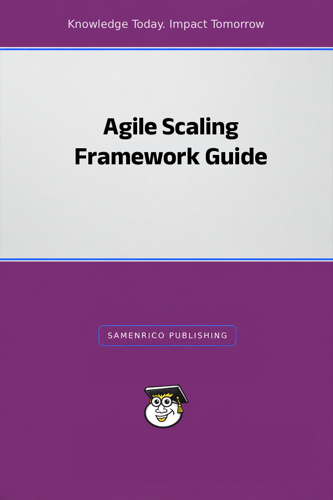
Non-FictionBusiness BriefAgile Scaling
Agile Scaling Framework Guide eBook
Use SAFe or LeSS to coordinate multiple agile team
Use SAFe or LeSS to coordinate multiple agile teams.
Formats
Free sample
Chapter 1: The Hidden Trap--–- The email arrived at 11:47 PM on a Tuesday. Sarah, the VP of Engineering at a mid-sized fintech, stared at her screen. Eighteen months ago, her company had one brilliant Scrum team. They shipped code every two weeks like clockwork. Investors were thrilled.
Morale was high. Then the company grew. Now she had eight teams. And for the third consecutive quarter, they had failed to deliver a single major feature on time.The problem wasn't talent. She had hired some of the best engineers in the city.
The problem wasn't effort. Her teams worked nights and weekends. The problem was that adding more agile teams had not increased output. It had increased chaos. Dependencies multiplied like weeds.
Integration became a multi-week death march. The daily stand-ups, once a crisp fifteen-minute sync, had bloated into hour-long status updates where nobody listened and nothing got resolved.Sarah had done everything the consultants recommended. She had implemented Scrum of Scrums. She had bought Jira enterprise licenses. She had hired agile coaches.
Yet the numbers told a brutal story: lead time had increased from 6 days to 34 days. Deployment frequency had dropped from daily to monthly. And her best engineers were updating their Linked In profiles.Sarah's story is not unusual. It is the rule.This chapter reveals why scaling agile destroys most organizations that attempt it. It names the three killers that bring multi-team environments to their knees.
It introduces a decision framework that will determine whether you should choose SAFe or Le SS. And it ends with a case study of two companies—one that failed spectacularly and one that succeeded—to illustrate that the problem is not the people but the system they inherited.If you have more than one agile team, this chapter may save you from Sarah's fate.The Paradox of More The core promise of agile is seductive: small, cross-functional teams can move faster than large, siloed departments. A single Scrum team of seven people, given a clear product owner and a supportive environment, can deliver working software every two weeks with remarkable predictability. The evidence for this is overwhelming, from the original Scrum literature to modern case studies at Google, Spotify, and Amazon.But here is the paradox that the consultants do not advertise: adding a second team does not double your output. It often cuts it in half.Consider the math.
One team of seven people has zero inter-team dependencies. Every conversation is within the team. Every integration is automatic because the team owns the entire codebase they touch. When you add a second team of seven people, you now have two teams that share a codebase, a database schema, and often a backlog. The number of communication channels increases from zero to one.
That is manageable.When you add a third team, the number of potential cross-team dependencies jumps to three. A fourth team creates six potential dependencies. A fifth team creates ten. An eighth team, like Sarah had, creates twenty-eight potential dependency points. This is not linear growth.
It is exponential.The mathematician in you might object that not every dependency materializes. That is true. But in any non-trivial product, the vast majority do. Team A needs the API that Team B is building. Team C's feature depends on a database migration that only Team D has permission to execute.
Team E discovers a bug in Team F's code and cannot proceed until it is fixed. These dependencies turn your agile organization into a distributed queueing system where most of the time is spent waiting.The result is what researchers call the "scaling penalty." A 2018 study of 1,200 software teams found that productivity per engineer declined by approximately 15 percent for every additional team added, after the first three teams. By the time an organization reached eight teams, each engineer was delivering less than half the value they had delivered when the organization was a single team.This is not a failure of agile. It is a failure of scaling.Dark Scrum: When Rituals Replace Results Sarah's organization performed every agile ritual perfectly. They had daily stand-ups.
They had sprint planning. They had sprint reviews attended by stakeholders. They had retrospectives where they dutifully wrote sticky notes about what went well and what could be improved. Yet nothing improved. This phenomenon has a name: Dark Scrum.The term was coined by agile thought leader Dave West to describe organizations that follow the letter of Scrum but violate its spirit.
The rituals become empty ceremonies. The daily stand-up becomes a status report to a manager. The sprint planning becomes a negotiation about how many story points can be crammed into two weeks. The retrospective becomes a complaint session that produces no systemic change.Dark Scrum is not a failure of discipline. It is a failure of design.
The ceremonies of Scrum were designed for a single team with end-to-end ownership of a product. When you scale to multiple teams, those ceremonies break in predictable ways.The Stand-Up Lie: In a single-team environment, the daily stand-up answers three questions: What did I do yesterday? What will I do today? What is blocking me? In a multi-team environment, the blockers are almost always cross-team.
"I am waiting for Team B's API." "I cannot test until Team C finishes their integration." The stand-up becomes a catalog of helplessness because no single team has the authority to resolve dependencies that span teams.The Planning Fallacy: In a single-team environment, sprint planning estimates are reasonably accurate because the team knows its own capacity and the complexity of the work. In a multi-team environment, any single team's plan depends on promises from other teams. Team A cannot commit to delivering feature X unless Team B commits to delivering API Y in the same sprint. But Team B has its own dependencies. The result is a cascade of broken promises.The Retrospective Theater: In a single-team environment, the retrospective is a powerful tool for continuous improvement.
The team identifies a problem and fixes it in the next sprint. In a multi-team environment, the most painful problems are systemic—slow code reviews, brittle build pipelines, conflicting priorities from leadership. No single team can fix these. So they are discussed, documented, and then ignored. After three or four sprints of this, the team stops believing that retrospectives matter.
They become theater.Dark Scrum is not inevitable. But escaping it requires abandoning the fiction that scaling is just "more of the same." It requires a different set of tools, which this book will provide. First, however, we must understand precisely what kills scaled agility.The Three Killers of Scaled Agility After studying dozens of failed scaling attempts and interviewing engineering leaders at companies ranging from startups to Fortune 50 enterprises, I have identified three recurring failure modes. I call them The Three Killers. Every organization that fails to scale agile succumbs to at least one.
Most succumb to all three.Killer One: Dependency Hell Dependency Hell is the single greatest destroyer of scaled agility. It occurs when the completion of any meaningful unit of work requires coordination across multiple teams. In a dependency-heavy environment, velocity collapses not because teams are slow but because they are waiting.Consider…
This is the end of the free sample. Get the eBook to keep going. Buy now
About this book
Details
- Author
- Salerno Florida
- Publisher
- SamEnrico
- Language
- English
- Genre
- Non-Fiction, Business Brief, Agile Scaling
- Released
- 2026-06-09
- Pages (approx.)
- 154
- Available as
- eBook, Audiobook

Read better in the ZLOADR app
Your eBooks on your phone or tablet. Sign in with your SamEnrico account and start reading.
More by Salerno Florida
 Phoenix Rising RelaxationSalerno Florida$11.99
 Meditation For Costochondritis PainSalerno Florida$11.99
 Morning Meltdown Prevention RoutineSalerno Florida$11.99
 Alcohol Craving Management HandbookSalerno Florida$11.99
 The Maori Warriors of Aotearoa: A Renaissance of Resistance and SportSalerno Florida$11.99
 Postdoctoral Research FellowSalerno Florida$11.99
 College Essay Hook LibrarySalerno Florida$12.99
 Small Business AI Tax Extension CalculatorSalerno Florida$12.99
 How to Start a Caisson Business (Beginners Guide)Salerno Florida$11.99
You may also like
 Hong Kong Handover 1997Dunn Johnnie$11.99
 Zumba For Postnatal Recovery CourseNeal Christian$11.99
 Zumba for BeginnersLadner Nikia$11.99
 YouTube Comment Mining GuideHumes Pandora$12.99
 Worry Box MeditationCarlin Rudy$11.99
 Workplace Stress MeditationNguyen Lynn$11.99
 Workplace Stress and Sleep RepairHawley Ivory$11.99
 Workplace Perfectionism CureDelaney Jeffry$11.99
 Workplace Injustice Anger GuideWallen Isabelle$11.99
 Work Addiction and Burnout LinkGreenwood Ester$11.99
 Women in Yoga and WellnessBeattie Galina$11.99
 Women in Stand Up ComedyChun Evangeline$11.99