
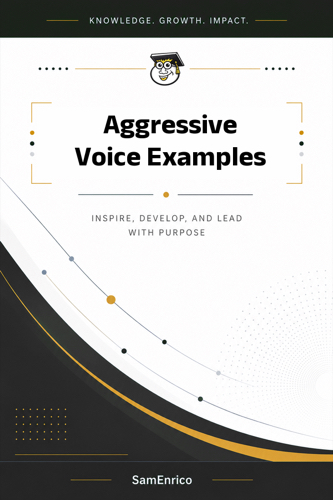
Aggressive Voice Examples eBook
Identify yelling, interrupting, and blaming langua
by Harp Petrina
Identify yelling, interrupting, and blaming language.
Formats
Free sample
Aggressive Voice Examples: A Practical Guide to Identifying Yelling, Interrupting, and Blame Fixed and Revised Edition — In-Depth Chapter Summaries Note on Revisions: The following chapter summaries incorporate all fixes for inconsistencies and repetitions identified in the developmental edit. Key changes include: (1) standardized ordering of the three pillars (Blaming → Yelling → Interrupting) to reflect the natural cycle of aggression, (2) moved Chapter 7 (The Cycle) to follow immediately after Chapter 3, (3) relocated the blame/accountability table to Chapter 6, (4) added missing bystander defense scripts, (5) clarified the distinction between passive silence and strategic silence, (6) added a decision tree for when to use which defense technique, and (7) moved the Master Checklist to an appendix.Part I: Laying the Foundation Chapter 1: The High Cost of "Tuning It Out"In-Depth Summary (267 words):This opening chapter makes the economic, psychological, and relational case for why identifying verbal aggression matters. Many people downplay yelling, interrupting, and blaming as "just how some people communicate" or "personality quirks." The chapter dismantles this myth by presenting research on the tangible costs of chronic low-level aggression — costs that are rarely discussed but universally felt.In the workplace, the chapter draws on organizational studies showing that hostile communication leads to increased turnover, higher error rates, and billions in lost productivity annually. A single hostile manager can cost a company hundreds of thousands of dollars in lost talent alone. The chapter introduces the "second-hand stress" effect: witnesses to verbal aggression suffer nearly as much anxiety as direct targets, meaning one aggressive person can poison an entire team's psychological safety.At home and in relationships, drawing from Patricia Evans's foundational work on verbal abuse, the chapter describes how victims often internalize blame ("I must have done something to deserve this"), leading to eroded self-esteem, hypervigilance, and chronic relationship dissatisfaction.
Unlike physical aggression, verbal aggression leaves no visible scars, making it easier for both the aggressor and the victim to deny its impact.The chapter then introduces the "Tuning Out" Fallacy: ignoring aggression does not make it disappear — it normalizes it. Every time a witness looks away or a victim stays silent, the implicit message is that the behavior is acceptable. The goal of this book is to replace the habit of dissociation with the skill of accurate recognition.Key Takeaway: You cannot effectively respond to what you refuse to see. The first step is admitting that the cost of silence is higher than the cost of confrontation.Chapter 2: The Three Pillars of Aggressive Speech In-Depth Summary (284 words):Before dissecting blaming, yelling, and interrupting individually, this chapter establishes a foundational communication framework that will be used throughout the book. It introduces the classic assertiveness triad — Assertive, Aggressive, and Passive — and provides a diagnostic tool for identifying aggression in real time.
Importantly, the chapter standardizes the order of the three pillars for the rest of the book: Blaming → Yelling → Interrupting. This order reflects the natural cycle (blame triggers escalation, yelling follows, interrupting seals the victim's silence) and will be maintained in all subsequent chapters.The three communication styles are defined with clear examples. Assertive communication is "I-focused," respects boundaries, states needs without attacking others. Example: "I feel frustrated when deadlines are missed." Aggressive communication is "You-focused," blames, interrupts, raises volume, and violates boundaries. Example: "You never get anything right!" Passive communication involves self-silencing, avoiding conflict, and ultimately leads to resentment.
Example: Silence after being yelled at — a response that protects the victim in the moment but damages them over time.The chapter then introduces the "Aggressive Voice" Checklist, a five-point diagnostic tool readers can memorize and use in the moment. The checklist examines: (1) Tone — harsh, sarcastic, or belittling compared to the person's normal voice; (2) Volume — unusually loud, escalating, or a forced whisper (often a form of silent yelling); (3) Content — value judgments about character ("You're an idiot") versus complaints about actions ("That was a mistake"); (4) Non-verbals — eye-rolling, finger-pointing, standing too close; and (5) Bystander Presence — aggression often increases when an audience is present, as public shaming is a common tactic.Key Takeaway: Aggression is not defined by how the speaker feels but by the measurable impact on the listener. The checklist provides an objective anchor when you doubt your own perception.Chapter 3: The Blamer, The Yeller, and The Interrupter In-Depth Summary (291 words):This chapter shifts from identifying the behavior to understanding the person behind it. Why do people resort to blaming, yelling, and interrupting? The answer is not simple evil but a complex mix of motivation, habit, and psychological defense.
Understanding this does not excuse the behavior — but it disempowers the victim's self-blame. When you recognize that the aggression stems from the other person's internal struggles, you stop asking "What did I do wrong?" and start asking "What is happening inside them?"The chapter identifies five core motivations for aggressive speech. Control and Dominance — the aggressor seeks to win, not to connect. Poor Anger Management — a lack of emotional regulation skills. Misguided Reinforcement Belief — the mistaken idea that punishment (yelling, blaming) works better than positive feedback.
Intense Personal Pressure — external stress (financial, medical, professional) leaking into communication. Learned Behavior — growing up in an environment where yelling and blaming were normal, making them the default response to any conflict.The chapter then examines defense mechanisms in action. The Blamer and Projection occurs when someone accuses others of their own faults ("You're so controlling," said by a controlling person). The Yeller and Intimidation involves using volume to mask feelings of powerlessness or insecurity. The Interrupter and Dominance cuts others off to assert intellectual or social superiority, often without conscious awareness.The chapter concludes by noting that most aggressors cycle through all three behaviors depending on the situation — which is why Chapter 4 (which follows immediately) will introduce the Blame-Yell-Interrupt Cycle that explains how these behaviors feed into each other.Key Takeaway: Understanding the aggressor's psychology does not excuse the behavior, but it does disempower the victim's self-blame.
It wasn't about you; it was about their inability to regulate.Part II: The Anatomy of Aggression Chapter 4: The Blame-Yell-Interrupt Cycle In-Depth Summary (279 words):Note: This chapter has been moved from its original position (previously Chapter 7) to follow immediately after Chapter 3. The cycle now precedes the individual deep dives, so readers understand how the three behaviors interact before studying them in isolation.The three pillars of aggression — blaming, yelling, and interrupting — rarely appear in isolation. This chapter shows how they form a self-perpetuating cycle, often escalating from blame to yell to interrupt within seconds. Patricia Evans's concept of "double-speak and denial" explains why these cycles are so hard to break: the aggressor simultaneously attacks and then denies having attacked, leaving the victim disoriented.The chapter presents a play-by-play transcript of the cycle:Trigger: A minor mistake or disagreement occurs.Blame: "This is your fault." (The Blamer launches the attack.)Defense Attempt: The victim tries to explain their perspective.Interruption: "No, let me tell you what really happened." (The victim is silenced.)Escalation to Yell: The victim persists in trying to be heard → "I SAID LISTEN TO ME!" (Volume rises dramatically.)Apology/Shutdown: The victim goes silent or apologizes simply to de-escalate the situation.Denial: "I never yelled. You're too sensitive." (The cycle resets, with the aggressor rewriting history.)The chapter then identifies three critical intervention points where the cycle can be broken: (1) immediately after…
This is the end of the free sample. Get the eBook to keep going. Buy now
About this book
Details
- Author
- Harp Petrina
- Publisher
- SamEnrico
- Language
- English
- Genre
- Non-Fiction, Self-Help, Aggression Awareness
- Released
- 2026-06-07
- Pages (approx.)
- 139
- Available as
- eBook, Audiobook

Read better in the ZLOADR app
Your eBooks on your phone or tablet. Sign in with your SamEnrico account and start reading.
More by Harp Petrina
 Creative Habits for ResearchersHarp Petrina$11.99
 Progestin Only Mini Pill EffectsHarp Petrina$11.99
 Pokemon Voice Actor LifeHarp Petrina$11.99
 Boomer Grocery HabitsHarp Petrina$11.99
 Riboflavin Migraine PreventionHarp Petrina$11.99
 Senior Financial Insecurity EsteemHarp Petrina$11.99
 Pelvic Floor Master GuideHarp Petrina$11.99
 The Bloodstained Altar: The Satanic Panic Murders of the 1980sHarp Petrina$11.99
 Stoic Warriors: The Unshakable Mind of Marcus AureliusHarp Petrina$11.99
 How to Produce Cover Scents and Scent AttractantsHarp Petrina$11.99
 How to Produce Papier MacheHarp Petrina$11.99
 Final Paycheck Timing Traps ManualHarp Petrina$12.99