
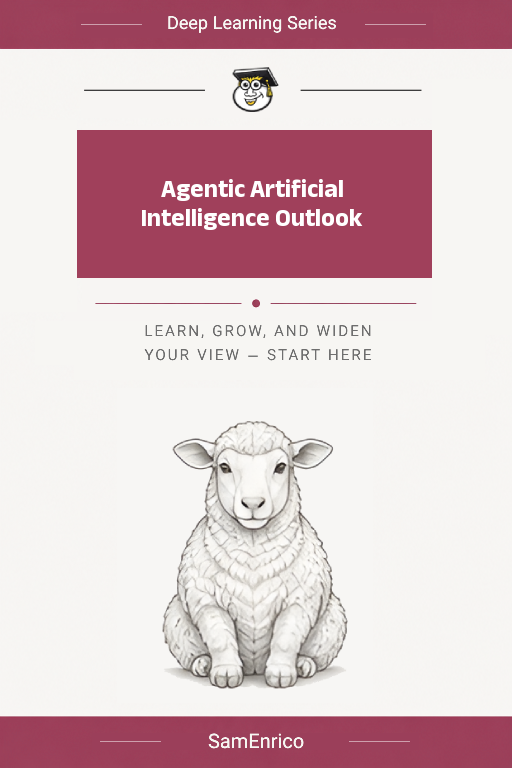
Non-FictionForecast & OutlookAutonomous Agents
Agentic Artificial Intelligence Outlook eBook
Forecast autonomous AI agents that plan, execute,
Forecast autonomous AI agents that plan, execute, and iterate on multi-step tasks, transforming workflows in software and operations.
Formats
Free sample
Chapter 1: The Silent Takeover...–- It did not arrive with a bang, a press conference, or a dystopian robot demanding your job. The most profound shift in how work gets done arrived, as most revolutions do, through a thousand invisible cracks in the daily grind. You have probably already felt it. That strange moment when you realized the chatbot not only answered your question but completed your thought—drafting an email, summarizing a contract, even writing a snippet of code. For a moment, you were impressed.
Then you moved on.But beneath that surface-level convenience, something far more consequential has been quietly assembling itself. The chatbots were just the hologram at the front of the ship. The real engine—the part that does not just talk but acts—is Agentic Artificial Intelligence. And it is about to transform every workflow, every piece of software, and every operational model you have spent years perfecting.For the past two years, the business world has been obsessed with Generative AI. Hundreds of billions of dollars have flowed toward large language models that can write poems, generate images, and pass the bar exam.
And yet, if you ask most executives what their actual return on investment has been, you will hear the same nervous phrase: "We are still experimenting." The reason is simple. Knowing more information (what Gen AI delivers) does not automatically translate into doing more work. The friction between a suggestion and an action remains stubbornly high. You still have to copy that draft into an email. You still have to approve that summary.
You still have to switch between seventeen tabs to execute the single task the AI just described to you in perfect prose.Agentic AI closes that gap. It does not answer questions. It completes objectives. It takes a goal—"reconcile last month's invoices" or "resolve tier-one support tickets" or "refactor this legacy code module"—and then autonomously plans the steps, executes the actions, verifies the results, and iterates until the job is done. It is the difference between a GPS that suggests a route and a self-driving car that actually takes you there.This book is the strategic and technical roadmap for that transition.
It is written for leaders, architects, and builders who need to move beyond the hype and into the architecture of autonomous execution. By the time you finish the final chapter, you will understand exactly how these agents think, how to deploy them safely, and how to transform your organization from a collection of tools into an economy of outcomes.But first, we must strip away the illusions. The most dangerous misconception about Agentic AI is that it is simply "a smarter chatbot." That error has already cost early adopters millions in failed pilots and frustrated teams. The second misconception is that it is a distant future technology. It is not.
As you read this sentence, thousands of autonomous agents are already refactoring code, reconciling ledgers, and negotiating shipping routes without a human hand on the wheel. The only question is whether your organization will be the one designing those systems or the one being disrupted by them.The Three Eras of Artificial Intelligence in Business To understand where we are going, we must first understand how we arrived here. The history of AI in the workplace can be neatly divided into three distinct eras, each defined not by the technology itself but by the relationship between the human and the machine.Era One: The Rule-Bound Worker (RPA and Scripting)The first era was characterized by automation without intelligence. Robotic Process Automation (RPA) tools and shell scripts could execute precisely defined, repetitive tasks—move a file from folder A to folder B, copy data from a spreadsheet to a web form, send a scheduled email. These systems were fast, reliable, and utterly brittle.
If a button moved two pixels to the left, the script broke. If a field name changed from "Total" to "Grand Total," the automation failed silently. RPA is a machine that follows instructions. It does not understand what it is doing, and it cannot adapt when the world changes.Era Two: The Knowledge Assistant (Copilots and Chatbots)The second era, which peaked roughly between 2023 and 2025, introduced generative models into the workflow. Copilots could suggest the next line of code.
Chatbots could answer customer questions by retrieving information from a knowledge base. These systems reduced the latency of answers. What used to take ten minutes of searching now took ten seconds of prompting. But the fundamental model remained one of suggestion. The human was still the operator, and the AI was still the advisor.
The final decision, the final action, the final click—all still belonged to the person holding the mouse.Era Three: The Autonomous Agent (Agentic AI)We are now entering the third era. In this model, the AI is not an assistant and not a rule-follower. It is an agent—an autonomous system that takes a high-level goal and independently plans, executes, and iterates to achieve it. The human shifts from operator to supervisor. Instead of clicking the button, you set the objective and the boundaries.
Instead of writing every line of code, you review the pull request generated by a swarm of agents. Instead of manually reconciling invoices, you monitor an exception report from an agent that handled 95% of the volume without you.The transition from Era Two to Era Three is not incremental. It is structural. It changes who owns the workflow, who bears the risk, and who captures the value. Most organizations are still building Era Two systems while claiming to pursue Era Three.
That disconnect explains the gap between the hype and the results.What Agentic AI Actually Is (And Is Not)Because the term "agent" has been overloaded by marketers, we need a clear, functional definition that will serve as the backbone for every chapter in this book.Agentic AI is a software system that, given a high-level goal, autonomously:Plans – It decomposes the goal into a sequence of sub-tasks, determining dependencies, priorities, and success criteria.Executes – It takes actions in the digital world by invoking tools: APIs, databases, user interfaces, other agents, or code execution.Evaluates – It assesses the outcome of each action against the expected result, detecting success, failure, or partial progress.Iterates – It uses the evaluation to update its plan and try again, looping until the goal is achieved or a stopping condition is met.This loop—Plan, Execute, Evaluate, Iterate—is the fundamental pattern of agentic reasoning. Every agent you will build, every framework you will evaluate, and every failure you will debug will trace back to one of these four phases.Now, let us be equally clear about what Agentic AI is not.Technology What It Does Why It Is Not Agentic Chatbot / RAGRetrieves and synthesizes information from a knowledge base.No action. No execution. No loop. It answers then stops.Copilot Suggests the next action or completes a partial input.The human remains the executor.
The system does not act autonomously.RPA Script Follows a rigid, pre-defined sequence of steps.No planning. No adaptation. If the script does not specify it, it cannot do it.Workflow Automation (e.g., Zapier, IFTTT)Executes "if this…
This is the end of the free sample. Get the eBook to keep going. Buy now
About this book
Details
- Author
- Rivas Tonette
- Publisher
- SamEnrico
- Language
- English
- Genre
- Non-Fiction, Forecast & Outlook, Autonomous Agents
- Released
- 2026-05-26
- Pages (approx.)
- 144
- Available as
- eBook, Audiobook

Read better in the ZLOADR app
Your eBooks on your phone or tablet. Sign in with your SamEnrico account and start reading.
More by Rivas Tonette
 The VAK Induction SystemRivas Tonette$11.99
 Iranian Revolution PhotographyRivas Tonette$11.99
 GAD PTSD Overlap GuideRivas Tonette$11.99
 API Ecosystem MapRivas Tonette$11.99
 ABCDE for Digital DeclutterRivas Tonette$11.99
 Frozen in Time: The Last Echoes of Franklin's Lost ExpeditionRivas Tonette$11.99
 The Clay Tablet ConspiracyRivas Tonette$11.99
 College Application Essay That Opens DoorsRivas Tonette$12.99
 Understanding Halal SyndromeRivas Tonette$17.99
 Wafer BondingRivas Tonette$11.99
 A Beginners Guide to Careers (Volume 1)Rivas Tonette$11.99
You may also like
 Hong Kong Handover 1997Dunn Johnnie$11.99
 Zumba For Postnatal Recovery CourseNeal Christian$11.99
 Zumba for BeginnersLadner Nikia$11.99
 YouTube Comment Mining GuideHumes Pandora$12.99
 Worry Box MeditationCarlin Rudy$11.99
 Workplace Stress MeditationNguyen Lynn$11.99
 Workplace Stress and Sleep RepairHawley Ivory$11.99
 Workplace Perfectionism CureDelaney Jeffry$11.99
 Workplace Injustice Anger GuideWallen Isabelle$11.99
 Work Addiction and Burnout LinkGreenwood Ester$11.99
 Women in Yoga and WellnessBeattie Galina$11.99
 Women in Stand Up ComedyChun Evangeline$11.99