
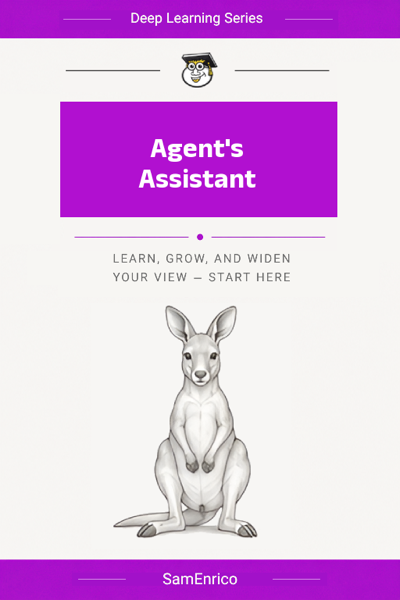
Non-FictionInformativeEducational
Agent's Assistant eBook
A Coursebook on Agent's Assistant
A Coursebook on Agent's Assistant
Formats
Free sample
Chapter 1: The Hybrid Awakening...--–- On a Tuesday morning in March, a 24-year-old named Maya stared at her inbox: 287 unread queries, three submission deadlines, a royalty statement that made no sense, and a Slack message from her agent that read simply, “Got a minute?” Her stomach dropped. She had been an assistant at a mid-sized literary agency for eleven months, and she was already burning out. The job she had dreamed about through three internships and a master’s degree had become a relentless grind of triage, templates, and apologies. She loved discovering new voices. She loved the thrill of a manuscript that crackled with possibility.
But she spent 80 percent of her time on tasks that had nothing to do with discovery: sorting, filing, chasing, and formatting. That Tuesday, Maya made a decision. She would either find a smarter way to work, or she would leave publishing forever. What she discovered over the following ninety days became the template for this book. And it started with a single question: What if the assistant had an assistant?This chapter dismantles the outdated stereotype of the literary assistant as a coffee-fetcher, calendar-keeper, and emotional sponge.
Instead, it repositions the modern agent’s assistant as a strategic hybrid: part literary scout, part data analyst, and part AI workflow designer. You will learn why the old model of assistance is collapsing, what three economic forces are reshaping literary agencies, and how a new framework called the Three-Tier Human/AI Matrix can save your career. By the end of this chapter, you will have a clear roadmap for accelerating your promotion from assistant to junior agent in eighteen to twenty-four months instead of the traditional three to five years. More importantly, you will understand that the question is not whether AI will replace assistants, but rather which assistants will use AI to replace the drudgery that currently consumes their lives.The Myth of the Coffee-Fetcher For nearly a century, the literary assistant has been trapped in a narrative that benefits everyone except the assistant. In popular culture, from The Devil Wears Prada to Younger, the assistant is portrayed as a beleaguered gatekeeper whose primary skills are endurance, loyalty, and the ability to anticipate an agent’s coffee order.
This narrative persists because it serves a purpose: it justifies low pay, long hours, and the expectation that assistants should “pay their dues” for three to five years before being considered for promotion. But the narrative is built on a foundation that no longer exists.In the mid-twentieth century, literary agents were powerful gatekeepers who discovered authors at cocktail parties, industry lunches, and personal referrals. An agent might receive ten to twenty queries per week, each one typed on paper and mailed in a self-addressed stamped envelope. The assistant’s job was administrative: opening envelopes, logging submissions, and occasionally reading a promising partial manuscript. The volume was manageable.
The pace was human. The assistant could learn by osmosis, watching the agent negotiate deals over long lunches and handwritten letters.That world is gone. It has been replaced by something far more demanding and far less romantic.The Three Economic Pressures Reshaping Literary Agencies Every literary agency in the English-speaking world is currently grappling with three interconnected economic pressures. Understanding these pressures is not optional for the modern assistant; it is the foundation of strategic thinking.Pressure One: The Volume Explosion The shift from paper submissions to email, combined with the democratization of publishing tools, has created an avalanche of queries. A mid-list literary agent today receives between 250 and 300 queries per week during standard periods.
During peak seasons—January, after New Year’s resolutions to write a novel, and September, after summer writing retreats—that number can spike to 500 or more. To put that in perspective, an agent who spends just three minutes on each query would need twelve and a half hours per week exclusively for triage. That is before reading a single full manuscript, before negotiating a single contract, before responding to a single existing client.The assistant bears the brunt of this volume. The expectation is that the assistant will triage the slush pile, identify the rare gems, and protect the agent’s time. But with 300 queries per week, even a highly efficient assistant would spend fifteen to twenty hours on triage alone.
That leaves little time for the higher-value work that actually leads to promotion: reading manuscripts deeply, researching market trends, and learning negotiation.Pressure Two: Shrinking Margins The traditional agency model operates on a 15 percent commission for domestic book rights and 20 to 25 percent for translation and film rights. These percentages have not changed significantly in decades. What has changed is the advance size. While celebrity memoirs and surefire bestsellers still command seven-figure advances, the median advance for a debut novelist has fallen or stagnated in real terms. According to data from Publisher’s Marketplace, the median advance for a first-time author in commercial fiction was 15,000in2024—barelychangedfrom15,000 in 2024—barely changed from 15,000in2024—barelychangedfrom12,000 in 2004 when adjusted for inflation.Smaller advances mean smaller commissions, which mean agencies must do more volume to maintain revenue.
A single agent who sells ten books per year at a 15,000averageadvancegenerates15,000 average advance generates 15,000averageadvancegenerates22,500 in commission. That is not a sustainable income in New York or Los Angeles. Therefore, agents must sell more books, rep more clients, and work faster. The assistant is expected to enable this velocity without additional resources.Pressure Three: Author Expectations Twenty years ago, an author might wait three to six months for a response to a query. Today, thanks to online forums, Twitter pitch events, and real-time submission trackers, authors expect a response in four to six weeks.
Many agents publicly post their response times, and failure to meet those times damages reputation and reduces inbound quality. The assistant is on the front line of this expectation management. Every delay, every lost query, every forgotten follow-up becomes the assistant’s responsibility.These three pressures create a perfect storm. Agents cannot work harder; they are already at capacity. Agencies cannot hire more assistantsthey barely afford the ones they have.
The only variable left is productivity. And productivity, in the modern era, means one thing: leveraging AI to handle the tasks that do not require human judgment.The Core Concept: Agentic Workflow Before we build solutions, we need a shared vocabulary. The most important term in this book is agentic workflow. In the context of AI, an agent is a software system that acts autonomously to achieve a goal. Unlike a simple automation (e.g., “if email subject contains ‘query,’ move to folder X”), an agentic workflow involves planning, memory, and iteration.
An AI agent can read an email, extract key information, compare it against a set of rules, draft a response, and then ask for human approval. It can track multiple submissions simultaneously, nudging editors at predetermined intervals. It can scan a contract for non-standard clauses and flag them for review.Crucially, an agentic workflow is not a replacement for the human assistant. It is an augmentation. The human assistant sets the goals, defines the rules, reviews the outputs, and makes the final decisions.
The AI handles the repetition, the volume, and the tedium. This distinction is not semantic; it is the entire premise…
This is the end of the free sample. Get the eBook to keep going. Buy now
About this book
Details
- Author
- Baines Margarette
- Publisher
- SamEnrico
- Language
- English
- Genre
- Non-Fiction, Informative, Educational
- Released
- 2026-05-04
- Pages (approx.)
- 138
- Available as
- eBook, Audiobook

Read better in the ZLOADR app
Your eBooks on your phone or tablet. Sign in with your SamEnrico account and start reading.
More by Baines Margarette
 Values And Mission Alignment Recognition And Rewards CourseBaines Margarette$11.99
 Customer Rage De Escalation GuideBaines Margarette$11.99
 Workplace Anxiety WorkbookBaines Margarette$11.99
 Letting Go of Anger StepsBaines Margarette$11.99
 The Restless Leg Menopause GuideBaines Margarette$11.99
 The Silent Maestro of the Han Dynasty: How a Forgotten Court Musician Shaped China’s First 'Soundtracks'Baines Margarette$11.99
 One Page Plan for Team AlignmentBaines Margarette$12.99
 Online Competitor Analysis GuideBaines Margarette$12.99
 How to Become a Leather CleanerBaines Margarette$11.99
 Understanding Triatrial HeartBaines Margarette$17.99
You may also like
 Hong Kong Handover 1997Dunn Johnnie$11.99
 Zumba For Postnatal Recovery CourseNeal Christian$11.99
 Zumba for BeginnersLadner Nikia$11.99
 YouTube Comment Mining GuideHumes Pandora$12.99
 Worry Box MeditationCarlin Rudy$11.99
 Workplace Stress MeditationNguyen Lynn$11.99
 Workplace Stress and Sleep RepairHawley Ivory$11.99
 Workplace Perfectionism CureDelaney Jeffry$11.99
 Workplace Injustice Anger GuideWallen Isabelle$11.99
 Work Addiction and Burnout LinkGreenwood Ester$11.99
 Women in Yoga and WellnessBeattie Galina$11.99
 Women in Stand Up ComedyChun Evangeline$11.99