
Non-FictionSelf-HelpRetrospective
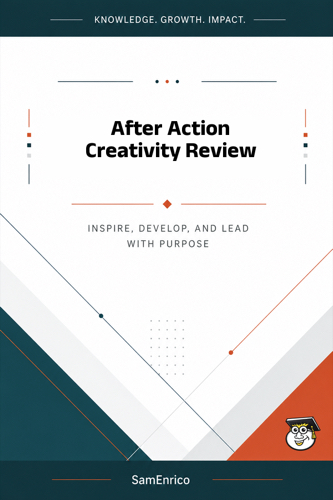
After Action Creativity Review eBook
Debrief what worked and failed in group ideation s
by Dunn Clyde
Debrief what worked and failed in group ideation sessions.
Formats
Free sample
Chapter 1: The Safety Paradox--–- Most creative meetings don’t die from a lack of good ideas. They die from a lack of honest conversation afterward.You have felt it. The room clears. Someone says, “Well, that was productive,” with the hollow enthusiasm of a weather report about a hurricane. Heads nod.
Notebooks close. And within fifteen minutes, every meaningful insight from the past two hours has been replaced by a single, useless summary: “It went fine.”This is the great unspoken crisis of group creativity. Organizations pour billions into brainstorming frameworks, design thinking workshops, innovation labs, and creative collaboration tools. They train facilitators, buy whiteboards the size of walls, and schedule “ideation offsites” with catered lunches and color-coded sticky notes. And yet, after the last marker cap is clicked shut, the learning stops.
Not because people are lazy or stupid. Because they are afraid.The fear is rarely dramatic. No one thinks, “I am terrified of this debrief.” Instead, it shows up as a low-grade anxiety—a sense that saying what actually happened might sound like complaining, or blaming, or bragging, or whining. It might sound like you are calling out the boss. It might sound like you are covering for yourself.
It might just sound like you are the kind of person who takes things too seriously. So you say nothing. Or worse, you say the safe thing. “Good session.” “Lots of energy.” “Some interesting directions.”And the data dies.This chapter is about why that happens and what to do about it. But before we get to the tools and scripts and checklists, we have to sit with an uncomfortable truth: psychological safety is not a soft skill.
It is a forensic prerequisite. Without it, every after-action review is just performance art.The Myth of the Natural Debrief Most professionals believe they are good at giving feedback. They are wrong.Research spanning four decades, from Chris Argyris to Amy Edmondson, has consistently shown that teams overestimate their own candor by a staggering margin. In study after study, when asked “Does your team speak openly about failures?” more than eighty percent of members say yes. But when observers code actual meetings, honest disclosure of mistakes or disagreements occurs in fewer than fifteen percent of sessions.
The gap is not malice. It is self-deception.We think we are being honest because we compare ourselves to an imagined worst-case scenario—the screaming match, the public shaming, the brutal performance review. By that standard, our muted, polite, vaguely positive debrief feels like radical transparency. But radical transparency it is not.Consider a typical ideation debrief. The facilitator asks, “What worked well?” Someone mentions a specific technique—the reverse brainstorming exercise, say.
Others nod. The facilitator asks, “What could we improve?” Pause. Someone offers a safe critique: “Maybe we could have started ten minutes earlier.” Laughter. Everyone moves on. The meeting ends.What actually happened?
Maybe the reverse brainstorming exercise was a disaster—half the group misunderstood it, one person dominated, and the output was useless. But no one said that because the person who suggested the exercise is senior. Maybe the real problem was that the creative brief was ambiguous, but pointing that out would imply the person who wrote it (also in the room) failed. Maybe the biggest issue was that three people said nothing at all, but naming that feels like an accusation.So instead, we talk about starting ten minutes earlier.This is not a failure of character. It is a failure of structure.
Humans are exquisitely sensitive to social threat—for good evolutionary reason. Being expelled from the tribe was a death sentence for our ancestors. Our brains have not caught up to the fact that naming a facilitator’s blind spot in a conference room will not, in fact, get us eaten by wolves. But the neural circuitry doesn’t know that. It just knows: danger.The Learning Review vs.
The Performance Review To understand why standard debriefs fail, we have to distinguish two fundamentally different modes of evaluation: the performance review and the learning review. They look similar. They are not.A performance review asks: Did we meet the goal? Who contributed? What was the outcome?
These are not bad questions. But they are backward-looking and judgmental. They implicitly ask for a verdict. And when people feel they are being judged, they perform defense, not analysis.A learning review asks: What happened? Why did it happen?
What can we learn? Notice the absence of “good” or “bad.” Notice the absence of “who.” The learning review is forward-looking and mechanistic. It treats the session as a natural phenomenon to be understood, not a test to be passed.Here is the crucial insight: the same meeting can be a performance review or a learning review depending entirely on the frame you set before you ask a single question.Imagine you are in a room. The facilitator says, “Let’s go around and share what we think went well and what didn’t.” Your brain instantly categorizes this as a performance review. You scan for threats.
If you say something didn’t go well, will you look negative? If you say something did go well, will you look like a suck-up? You self-edit. You hedge. You survive.Now imagine a different opening.
The facilitator says, “Before we say anything, let’s agree: we are not here to judge anyone. We are here to build a model of how creativity works in this group. Every observation is data. Every failure is a clue. No one will be blamed for anything that happened in the session.
Our only goal is to understand.”The difference is not cosmetic. It is neurological. The first opening triggers the amygdala—the brain’s threat-detection system. The second opening, if delivered credibly, activates the prefrontal cortex—the seat of analysis and curiosity. One makes you dumber.
One makes you smarter.Psychological Safety: More Than a Buzzword The term “psychological safety” has become so overused that it risks meaning nothing. So let us be precise. Psychological safety is the shared belief that the team is safe for interpersonal risk-taking. It is not about being nice. It is not about avoiding conflict.
It is not about everyone agreeing. In fact, psychologically safe teams disagree constantly. But they disagree without fear of humiliation or punishment.Amy Edmondson’s seminal research at Harvard Business School demonstrated that psychological safety is the single strongest predictor of team learning—and team learning is the single strongest predictor of performance. Teams with high psychological safety report more failures. Not because they fail more often, but because they are willing to admit failures, which means they can learn from them.
Teams with low psychological safety report fewer failures but actually make more of them. They just hide the evidence.This is the safety paradox: teams that feel safe look messier on paper because their data is honest. Teams that feel unsafe look cleaner because their data is censored. But the unsafe team is not actually performing better. It is just lying—politely, professionally, and catastrophically.Nowhere is this more destructive than in creative debriefs.
Creativity is inherently uncertain. You do not know if an idea will work until you try it. You do not…
This is the end of the free sample. Get the eBook to keep going. Buy now
About this book
Details
- Author
- Dunn Clyde
- Publisher
- SamEnrico
- Language
- English
- Genre
- Non-Fiction, Self-Help, Retrospective
- Released
- 2026-06-07
- Pages (approx.)
- 152
- Available as
- eBook, Audiobook

Read better in the ZLOADR app
Your eBooks on your phone or tablet. Sign in with your SamEnrico account and start reading.
More by Dunn Clyde
 Muscle Relaxation SleepDunn Clyde$11.99
 ABCDE For OverwhelmDunn Clyde$11.99
 Detox Medication Error PreventionDunn Clyde$11.99
 Remote Work for ManagersDunn Clyde$11.99
 Napoleon s Exile to ElbaDunn Clyde$11.99
 Empathy for NeurodivergentDunn Clyde$11.99
 Child CPR GuideDunn Clyde$11.99
 The Siege of Rhodes: Suleiman the Magnificent's Unstoppable ForceDunn Clyde$11.99
 Leiden's Starvation: The Siege That Ignited a Nation (1573-1574)Dunn Clyde$11.99
 Ultimate Handbook Guide to Essen : (Germany) Travel GuideDunn Clyde$11.99
 How to Produce ICE PacksDunn Clyde$11.99
 Environmental Science GuideDunn Clyde$12.99
You may also like
 Hong Kong Handover 1997Dunn Johnnie$11.99
 Zumba For Postnatal Recovery CourseNeal Christian$11.99
 Zumba for BeginnersLadner Nikia$11.99
 YouTube Comment Mining GuideHumes Pandora$12.99
 Worry Box MeditationCarlin Rudy$11.99
 Workplace Stress MeditationNguyen Lynn$11.99
 Workplace Stress and Sleep RepairHawley Ivory$11.99
 Workplace Perfectionism CureDelaney Jeffry$11.99
 Workplace Injustice Anger GuideWallen Isabelle$11.99
 Work Addiction and Burnout LinkGreenwood Ester$11.99
 Women in Yoga and WellnessBeattie Galina$11.99
 Women in Stand Up ComedyChun Evangeline$11.99