
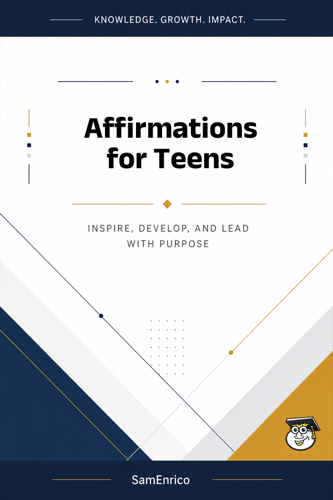
Affirmations for Teens eBook
Supports adolescent identity formation with age-ap
by Agee Eryn
Supports adolescent identity formation with age-appropriate affirmations.
Formats
Free sample
Chapter 1: The Yuck Voice--–- You are sitting in your room. It’s quiet. Maybe too quiet. Your phone is face-down because you just saw something that made your stomach clench—a story from a party you weren’t invited to, a comment that could mean nothing or everything, a photo of someone who seems to be living the life you were supposed to have. Your brain, instead of letting it go, does what it always does.
It starts talking.Not out loud. Inside. And what it says is not kind.Why did you say that in class today? Everyone thinks you’re weird now.You’re the only one who didn’t get invited.You always mess things up.What’s wrong with you?The voice doesn’t stop. It doesn’t get tired.
It doesn’t care that you’re trying to fall asleep, or study, or just exist without feeling like you’re doing everything wrong. It has opinions about your body, your friendships, your grades, your future, your past, your silence, your words, your outfit, your laugh, your lack of laugh, the way you walked down the hallway, the way you didn’t say hello to someone, the way you said hello too loudly.And here is the part that feels the most unfair: you believe it.Not because you’re weak. Not because you’re broken. Not because you’re “too sensitive” or “dramatic” or any of the other words people have used to describe you when you couldn’t just shake it off. You believe it because your brain is doing exactly what it evolved to do—and evolution did not have your happiness in mind.This chapter is about that voice.
The one that sounds like you but isn’t really you. The one that has a name in this book: the Yuck Voice. By the time you finish these pages, you will know where it comes from, why it lies so convincingly, how to catch it in the act, and—most importantly—how to stop confusing its opinions with the truth about who you are.The Voice That Lives in Your Head Rent-Free Let’s start with a radical idea: you are not your thoughts.Read that again. Out loud if you need to. You are not your thoughts.Most teens grow up assuming that whatever pops into their head is an accurate reflection of reality—especially the negative thoughts.
If your brain says “I’m stupid,” you assume there must be evidence for that conclusion. If your brain says “nobody likes me,” you start scanning your memory for proof. This is called thought-action fusion, and it is one of the most common psychological traps in adolescence.Here’s what’s actually happening. Your brain generates between 6,000 and 60,000 thoughts per day. Most of them are random.
Many of them are contradictory. Some of them are factually incorrect. And a significant percentage—especially during the teenage years—are aggressively, almost comedically, negative.That last part is not a bug. It’s a feature. A feature that evolution installed millions of years ago to keep your ancestors from getting eaten by predators.Your Brain Is Not Broken—It’s Just Outdated To understand the Yuck Voice, you need to understand the teenager’s brain.
Not in a boring textbook way, but in a “why does everything feel so intense” way.The human brain develops from back to front. The back parts handle basic survival—breathing, sleeping, reacting to threats. The front parts handle complex reasoning, impulse control, long-term planning, and emotional regulation. That front part is called the prefrontal cortex, and here’s the problem: it is the last part of your brain to finish developing. It doesn’t fully mature until around age twenty-five.Meanwhile, the emotional alarm system—a small, almond-shaped cluster of neurons called the amygdala—is fully online and firing at full power by the time you hit puberty.
The amygdala’s job is to detect threats. Not logical threats, like “I should study for this test.” Primal threats, like “rejection might get me exiled from the tribe, and exile meant death for my ancestors.”Here’s what that means for you. When you experience social embarrassment, exclusion, criticism, or even the possibility of those things, your amygdala reacts as if a lion is charging at you. Your heart races. Your palms sweat.
Your stomach knots. And your prefrontal cortex—the part that could say “actually, this is just a text message, not a lion”—is too underdeveloped and too slow to override the alarm in real time.So you feel everything. Hard. And then your brain, desperate to make sense of the alarm, generates a story to explain why you feel so terrible. That story is the Yuck Voice.The Yuck Voice is not the problem.
The Yuck Voice is the symptom of an alarm system that can’t tell the difference between social rejection and physical danger.Situational Doubt vs. Identity Attacks Not all negative thoughts are created equal. The Yuck Voice uses two very different kinds of ammunition, and learning to tell them apart is the first step toward disarming it.Situational Doubt Situational doubt sounds like this:“I failed that test.”“I tripped in the hallway.”“I said something awkward in the group chat.”“I didn’t get invited to the party.”“I bombed that presentation.”Notice what these statements have in common. They describe a specific event in a specific time and place. They are observations about what happened.
They might be painful, but they are contained. They don’t claim anything about who you are as a person. They just report what occurred.Situational doubt is actually useful. It tells you where to focus your energy. “I failed that test” can lead to “I need to study differently next time.” “I said something awkward” can lead to “I’ll think before I speak next time.” Situational doubt is data.
It hurts, but it helps.Identity Attacks Identity attacks sound like this:“I am stupid.”“I am clumsy.”“I am socially awkward.”“I am unlikeable.”“I am a failure.”These statements do not describe events. They describe essences. They claim something permanent and unchangeable about who you are. Where situational doubt says “this happened,” identity attacks say “this is who I am.”Here’s the secret that changes everything: identity attacks are almost always lies. Not gentle exaggerations.
Straight-up, factually incorrect lies. Because no single event—not a failed test, not a rejected invitation, not an awkward silence—can determine your entire identity. Identities are built over thousands of moments, not destroyed by one.The Yuck Voice is a master of the bait-and-switch. It takes a painful but containable situation (“I failed that math quiz”) and instantly translates it into a catastrophic identity attack (“I am stupid and I will never succeed at anything”). It does this so fast that you don’t even notice the switch.
You just feel the shame.Your homework for this entire book: learn to see the switch. Learn to say, “That was a situation. It is not my identity.”Why You Believe the Yuck Voice (Even When You Know Better)You might…
This is the end of the free sample. Get the eBook to keep going. Buy now
About this book
Details
- Author
- Agee Eryn
- Publisher
- SamEnrico
- Language
- English
- Genre
- Non-Fiction, Self-Help / Teen
- Released
- 2026-06-08
- Pages (approx.)
- 157
- Available as
- eBook, Audiobook

Read better in the ZLOADR app
Your eBooks on your phone or tablet. Sign in with your SamEnrico account and start reading.
More by Agee Eryn
 In Law Stress Boundary GuideAgee Eryn$11.99
 Vaginal Dryness Solutions GuideAgee Eryn$11.99
 Second Career Success After FiftyAgee Eryn$11.99
 Space Station Orbit CalmAgee Eryn$11.99
 The Focus Technology StackAgee Eryn$11.99
 Lacrosse Player's HypnosisAgee Eryn$11.99
 Eisenhower Matrix for AccountantsAgee Eryn$11.99
 Ashes to Ashes: The Phoenix King Who Defied TimeAgee Eryn$11.99
 Baba Yaga's Bone House: The Witch Who Tests the WorthyAgee Eryn$11.99
 A Collector's Handbook to the Wolseley Series Iii 16HP, 21HP, 25HPAgee Eryn$11.99
 10 Ways to Use Aristida Pungens (Recipe Book)Agee Eryn$11.99
 Cooperatives Merger and RestructuringAgee Eryn$12.99
You may also like
 Hong Kong Handover 1997Dunn Johnnie$11.99
 Zumba For Postnatal Recovery CourseNeal Christian$11.99
 Zumba for BeginnersLadner Nikia$11.99
 YouTube Comment Mining GuideHumes Pandora$12.99
 Worry Box MeditationCarlin Rudy$11.99
 Workplace Stress MeditationNguyen Lynn$11.99
 Workplace Stress and Sleep RepairHawley Ivory$11.99
 Workplace Perfectionism CureDelaney Jeffry$11.99
 Workplace Injustice Anger GuideWallen Isabelle$11.99
 Work Addiction and Burnout LinkGreenwood Ester$11.99
 Women in Yoga and WellnessBeattie Galina$11.99
 Women in Stand Up ComedyChun Evangeline$11.99