
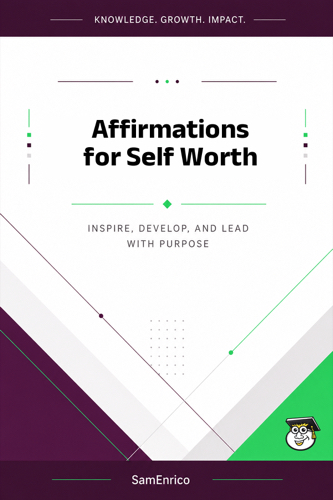
Non-FictionSelf-HelpSelf Worth
Affirmations for Self Worth eBook
Rewrite core beliefs about your value with deep le
Rewrite core beliefs about your value with deep level self talk work.
Formats
Free sample
Chapter 1: The Empty Mirror--I want you to try something real quick. Stand up, go to a mirror – or just imagine one for now – look yourself in the eyes, and say out loud: “I am worthy. I am enough. I love myself exactly as I am.”How did that feel?If you’re like most people who have tried this, something in your chest probably tightened. Maybe you felt a little ridiculous.
Maybe a voice in your head immediately shot back with something like, “That’s a lie,” or “You don’t really believe that,” or “Who are you trying to fool?”Congratulations. You just discovered the single biggest problem with standard positive affirmations – and the exact reason this book exists.The Empty Affirmation Trap Let me name something that almost no other self-help book will admit out loud: most affirmations don’t work. Not because affirmations are bad or useless, but because the way we’ve been taught to use them is fundamentally backwards.Walk into any bookstore, and you’ll find entire shelves filled with books of affirmations. “I am confident.” “I am successful.” “I am loved.” Page after page of beautiful, positive statements that you’re supposed to repeat until they sink in. The assumption is simple: say something enough times, and eventually you’ll believe it.But here’s what actually happens.
You wake up feeling anxious about work. You look in the mirror and see someone you don’t quite like. You replay a mistake from three years ago that still makes you cringe. And then you’re supposed to say, “I love myself unconditionally”? Your brain isn’t stupid.
It knows the difference between what you want to believe and what you actually believe. And when you feed it a statement that contradicts every piece of evidence it has stored about you, it doesn’t just reject the affirmation – it reinforces the opposite.This is what I call the Empty Affirmation Trap.The trap works like this: You try an affirmation. It feels false. You feel worse because now you’re not only unworthy, but you’re also failing at the thing that’s supposed to fix your unworthiness. So you try harder.
You say it louder, more often, with more forced emotion. But the gap between the affirmation and your actual belief only grows wider. Eventually, you conclude that affirmations are nonsense, self-help is a scam, and you’re probably just broken beyond repair.You are not broken. You were just given the wrong tool for the job.The Iceberg Model of the Mind To understand why standard affirmations fail, we need to look at how your mind actually works. And for that, I want you to picture an iceberg.Above the waterline – the part everyone can see – is your conscious mind.
This is where your rational thoughts live. It’s the part of you that says, “I know I’m worthy” or “I want to feel better about myself.” This is also where your standard affirmations operate. You consciously repeat a statement, and your conscious mind nods along. So far, so good.But below the waterline – the vast, hidden mass of the iceberg – is your subconscious mind. This is where your core beliefs live.
And here’s the critical fact that changes everything: your subconscious mind is about ninety percent of who you are. The conscious mind? Maybe ten percent.Your subconscious doesn’t speak in words. It speaks in feelings, patterns, and deeply ingrained scripts that were written long before you had the ability to choose them. It runs on autopilot.
It keeps you breathing, keeps your heart beating, and – for better or worse – keeps running the same emotional programs it has always run, whether those programs are helping you or destroying you.When you stand in front of that mirror and say, “I am worthy,” your conscious mind hears a hopeful statement. But your subconscious mind – the ninety percent that actually runs the show – hears a direct contradiction to everything it believes about you. And because the subconscious is far more powerful than the conscious mind, the subconscious always wins.This isn’t a flaw. It’s a survival mechanism. Your subconscious is designed to keep you safe by maintaining consistency.
If it believes you are unworthy, it will reject any information that suggests otherwise, because inconsistency feels dangerous to the primitive parts of your brain. Changing a core belief isn’t like updating a contact in your phone. It’s like trying to convince your body that fire is cold. The resistance you feel isn’t weakness – it’s your brain trying to protect you from what it perceives as a threat to your identity.So what do we do about this? We stop fighting the subconscious and start working with it.
We stop trying to overwrite our beliefs with surface-level positivity and start doing the deep work of understanding, clearing, and rewriting the actual scripts that run beneath the surface.The Inner Critic Is Not Your Enemy Before we go any further, I need to introduce you to a character who will appear throughout this entire book. You already know her – or him, or them. Let’s call this character the Inner Critic.The Inner Critic is that voice in your head that says things like, “You’re not good enough,” “Who do you think you are?” “You always mess things up,” “See? They’re all better than you,” and the classic, “What’s wrong with you?”Most people hate their Inner Critic. They try to silence it, fight it, or pretend it doesn’t exist.
They think of it as an enemy that needs to be destroyed.But here’s a perspective shift that will change everything: your Inner Critic is not trying to hurt you. It is trying to protect you.I know that sounds crazy. Let me explain.Your Inner Critic developed in childhood as a survival mechanism. When you were young, you depended entirely on the adults around you for safety, food, and love. If those adults were critical, unpredictable, or withholding, your young brain had to figure out how to keep you safe.
And the solution it landed on was this: if I criticize myself first, maybe they won’t. If I stay small, maybe I won’t get hurt. If I never try, I never fail. If I expect rejection, it won’t surprise me.The Inner Critic is not malicious. It is a well-meaning but deeply misguided protector who learned that keeping you small kept you safe.
And it has been running that same program every single day since.Think about it. When you’re about to take a risk – ask someone out, speak up in a meeting, share something vulnerable – what does the Inner Critic do? It floods you with reasons not to do it. “You’ll embarrass yourself.” “They’ll reject you.” “You’re not ready.” And if you listen, you stay safe. You don’t risk rejection.
You don’t risk failure. You stay in the familiar pain of not trying, rather than the unfamiliar pain of trying and failing.The Inner Critic isn’t wrong about the risk. It’s wrong about…
This is the end of the free sample. Get the eBook to keep going. Buy now
About this book
Details
- Author
- Villa Imogene
- Publisher
- SamEnrico
- Language
- English
- Genre
- Non-Fiction, Self-Help, Self Worth
- Released
- 2026-06-09
- Pages (approx.)
- 134
- Available as
- eBook, Audiobook

Read better in the ZLOADR app
Your eBooks on your phone or tablet. Sign in with your SamEnrico account and start reading.
More by Villa Imogene
 Five Senses Mindfulness ResetVilla Imogene$11.99
 The One In One Out RuleVilla Imogene$11.99
 Cluster of Cues InterpretationVilla Imogene$11.99
 Metta for PerfectionistsVilla Imogene$11.99
 Stanley DruckenmillerVilla Imogene$11.99
 The Nobel Physics FamilyVilla Imogene$11.99
 Anapanasati for WalkingVilla Imogene$11.99
 Sarajevo Under Siege: The City That Would Not Fall (1992-1996)Villa Imogene$11.99
 The Taylor Swift Ticketmaster Fiasco: A Viral MeltdownVilla Imogene$11.99
 The Iron Genius of the Nok: Forging a CivilizationVilla Imogene$11.99
 Growing ColvilleaVilla Imogene$11.99
 How to Produce a Bluetooth Car KitVilla Imogene$11.99
You may also like
 Hong Kong Handover 1997Dunn Johnnie$11.99
 Zumba For Postnatal Recovery CourseNeal Christian$11.99
 Zumba for BeginnersLadner Nikia$11.99
 YouTube Comment Mining GuideHumes Pandora$12.99
 Worry Box MeditationCarlin Rudy$11.99
 Workplace Stress MeditationNguyen Lynn$11.99
 Workplace Stress and Sleep RepairHawley Ivory$11.99
 Workplace Perfectionism CureDelaney Jeffry$11.99
 Workplace Injustice Anger GuideWallen Isabelle$11.99
 Work Addiction and Burnout LinkGreenwood Ester$11.99
 Women in Yoga and WellnessBeattie Galina$11.99
 Women in Stand Up ComedyChun Evangeline$11.99