
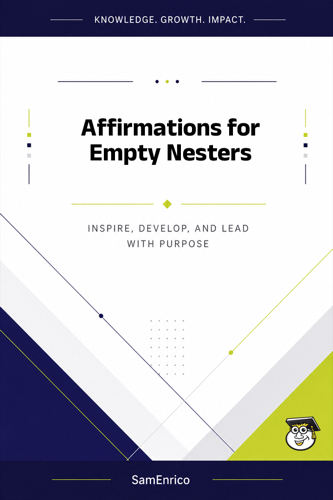
Non-FictionSelf-HelpEmpty Nest
Affirmations for Empty Nesters eBook
Rewires identity loss after children leave home.
by Rico Lavina
Rewires identity loss after children leave home.
Formats
Free sample
Chapter 1: The Silent Shift...--–- The cardboard box sat on my passenger seat for three hours. I had driven away from my son’s dormitory at 9:14 AM. By noon, I had circled the same Target parking lot four times. I wasn’t shopping. I wasn’t lost.
I was trying to postpone the moment when I would walk into my own house and find it empty.The box held the last things I forgot to give him: a phone charger, a winter coat he swore he didn’t need, a bag of his favorite trail mix. I told myself I was being helpful. But at 1:47 PM, still parked outside the Target, I admitted the truth. I was holding onto the box because handing it over would mean the goodbye was real. As long as I had his charger, he was still coming home tonight.That was six years ago.
I have since spoken to thousands of empty nesters – mothers, fathers, grandparents, stepparents, guardians – and every single one of them has a version of that box. For some, it is the bedroom they can’t bring themselves to rearrange. For others, it is the extra plate they still set at the dinner table. For a few, it is the haunting sound of a front door that never opens at 6 PM anymore.This book is not a collection of platitudes about how you will finally have time for yourself. This book is not a cheerful guide to taking up pottery or joining a hiking group.
Those things may come. But first, we have to sit with the box in the passenger seat. First, we have to name what you are actually feeling – not what society tells you to feel, not what your well-meaning friends want you to feel, but the messy, contradictory, sometimes humiliating truth of losing a role that defined you for eighteen years or more.You are not ungrateful. You are not weak. You are not the only person who has ever felt phantom limb pain for a child who is still alive.
And you are not broken.Let us begin.The Radical Disconnect Between External Expectations and Internal Reality When a child leaves home for college, work, military service, or independent living, society responds with a script. “Congratulations!” “You must be so excited to have your life back!” “Finally, some peace and quiet!” “Now you can focus on yourself for a change!” These phrases are offered with genuine goodwill. Your neighbor is not trying to hurt you. Your coworker is not mocking your grief. But the gap between what they say and what you feel can feel like gaslighting.Here is what you might actually be feeling: a dull, persistent ache that has no clear location.
An urge to pack lunches for no one. The habit of listening for a key in the door long after bedtime. A sudden, inexplicable wave of tears in the grocery store because you saw a box of the cereal your child used to eat. Irritation at happy couples whose children are still small. Guilt for feeling irritated.
Guilt for not being happier. Guilt for the relief that occasionally breaks through the grief, followed by more guilt because how dare you feel relieved?This is not a sign of emotional dysfunction. This is a sign of role bereavement – the mourning of an identity that consumed thousands of hours of your life.I want you to consider something radical: your grief is not a lack of gratitude. It is not a failure to appreciate that your child is healthy, launched, and thriving. Grief and gratitude can and do coexist.
You can be proud of the adult your child is becoming while also mourning the child they used to be. You can celebrate their independence while grieving your own irrelevance to their daily life. These are not contradictions. They are the two sides of a love that was always supposed to end in goodbye.Ambiguous Loss: Why This Grief Has No Name Dr. Pauline Boss, the pioneering family therapist who coined the term “ambiguous loss,” identified a specific type of grief that has no closure.
Most grief rituals are designed for death. We have funerals, sympathy cards, bereavement leave, and a clear social script: someone died, you cry, eventually you heal. But ambiguous loss – the loss of someone who is alive but absent – has no ritual. There is no funeral for the child who moved across the country. No one sends sympathy cards when your last child graduates high school.
Your employer does not offer bereavement leave for the empty nest.This ambiguity makes the grief harder to process. With death, the person is gone, and you eventually accept that they are not coming back. With the empty nest, your child is gone but could return – for holidays, for summers, for emergencies. The door is not permanently closed. It is perpetually ajar.
And that ajar door keeps your brain in a state of alert. You cannot fully grieve because the loss is not final. You cannot fully move on because the role might be needed again.One empty nester described it this way: “It’s like my brain is stuck buffering. I know he’s not coming home tonight. But some tiny part of me still listens for his footsteps at 11 PM.
And every night, the silence is a fresh disappointment.”This is not a flaw in your character. This is a predictable neurological response to ambiguous loss. Your brain’s prediction machinery – the same system that anticipates where a moving object will land – is calibrated to expect your child’s presence in certain spaces at certain times. When that expectation is violated repeatedly (the chair is empty, the door does not open, the bathroom has no steam), your brain does not immediately recalibrate. It keeps predicting.
It keeps hoping. It keeps hurting.The good news is that the brain can be rewired. Not overnight. Not by positive thinking alone. But by a combination of validation (this hurts because it is supposed to hurt), naming (this grief has a name, and the name is ambiguous loss), and small, repeated actions that teach your brain a new prediction: the quiet is coming.
And that is not a threat.The Phantom Limb of Parenting In the 1990s, neuroscientist V.S. Ramachandran discovered that amputees often feel pain in limbs that no longer exist. A man whose arm had been removed twenty years earlier could still feel his fingers clenching. A woman whose leg was amputated could still feel her toes burning. This phenomenon, called phantom limb pain, occurs because the brain’s map of the body still includes the missing limb.
The neural pathways are still firing, even though there is no limb to receive the signal.The empty nest is a phantom limb. For eighteen years, your brain mapped your daily life around your child’s presence. You woke up at a certain time because they needed to get to school. You grocery shopped for their favorite snacks. You checked your phone for their texts.
You planned your weekends around their activities. Your neural pathways – the actual physical structure of your brain – were shaped…
This is the end of the free sample. Get the eBook to keep going. Buy now
About this book
Details
- Author
- Rico Lavina
- Publisher
- SamEnrico
- Language
- English
- Genre
- Non-Fiction, Self-Help, Empty Nest
- Released
- 2026-06-08
- Pages (approx.)
- 146
- Available as
- eBook, Audiobook

Read better in the ZLOADR app
Your eBooks on your phone or tablet. Sign in with your SamEnrico account and start reading.
More by Rico Lavina
 The Family Trafficked GirlRico Lavina$11.99
 Hundred Days Offensive BreakdownRico Lavina$11.99
 Disrupt Then Reframe GuideRico Lavina$11.99
 Breaking the Gambling Trance StateRico Lavina$11.99
 Craft Supply HoardingRico Lavina$11.99
 Monsoon Trekking ProtocolRico Lavina$11.99
 Antidepressant RisksRico Lavina$11.99
 The Sky Wolves of the Himalayas: How the Mustang Aviators Defied the Gods (1915-1918)Rico Lavina$11.99
 The Shadow of the Snowy River: Australia's Coldest Case CrackedRico Lavina$11.99
 How to Produce Hooks, Buckles and FastenersRico Lavina$11.99
 GlobalGAP Export Certification GuideRico Lavina$12.99
 Meta Remote Internship GuideRico Lavina$12.99
You may also like
 Hong Kong Handover 1997Dunn Johnnie$11.99
 Zumba For Postnatal Recovery CourseNeal Christian$11.99
 Zumba for BeginnersLadner Nikia$11.99
 YouTube Comment Mining GuideHumes Pandora$12.99
 Worry Box MeditationCarlin Rudy$11.99
 Workplace Stress MeditationNguyen Lynn$11.99
 Workplace Stress and Sleep RepairHawley Ivory$11.99
 Workplace Perfectionism CureDelaney Jeffry$11.99
 Workplace Injustice Anger GuideWallen Isabelle$11.99
 Work Addiction and Burnout LinkGreenwood Ester$11.99
 Women in Yoga and WellnessBeattie Galina$11.99
 Women in Stand Up ComedyChun Evangeline$11.99