
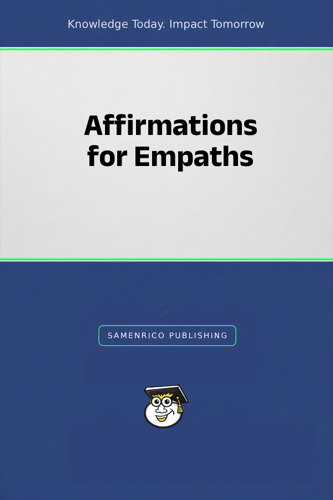
Affirmations for Empaths
Protect your energy with boundary-setting internal
Protect your energy with boundary-setting internal statements.
Formats
About this book
Free sample
Chapter 1: The Porous Self...--For most of her life, Sarah thought she was simply "too much." Too emotional. Too reactive. Too exhausted for no reason. She would wake up some mornings already feeling heavy, though nothing had happened yet. She would walk into a room and suddenly feel anxious—only to discover that two people had been arguing moments before she entered.
She would answer the phone, listen to a friend describe a bad day, and hang up feeling as though she had lived through that bad day herself.Sarah was not broken. She was not weak. She was not "too sensitive" in the way people meant it as an insult.Sarah was porous.And until she learned the difference between what was hers and what she was carrying for everyone else, she would continue to drown in borrowed water.This chapter is the foundation of everything that follows. Before you can build a boundary—before you can say a single affirmation that actually works—you must first understand where the wall is broken. You must learn to distinguish between your authentic emotional core and the endless stream of external energy you have been unconsciously absorbing since childhood.This is not a metaphor.
This is neurology.The Science of Porousness: Why Your Brain Can't Tell Where You End Every human brain contains a remarkable system called mirror neurons. Discovered accidentally by Italian neuroscientists in the 1990s, these neurons fire both when you perform an action and when you observe someone else performing that same action. When you watch someone smile, the neurons that control smiling fire in your own brain. When you see someone cry, your brain's pain and grief networks activate as if you were crying yourself.For most people, this system creates empathy and social bonding. For empaths, however, this system is hyperactive.
Studies using f MRI technology have shown that highly sensitive people (the clinical term for empaths) have significantly more activity in the insula and anterior cingulate cortex—brain regions responsible for interoception, or the ability to sense what is happening inside your own body.Here is what…
This is the end of the free sample. Get the eBook to keep going. Buy now
Contents
- Chapter 1
- Chapter 2
- Chapter 3
- Chapter 4
- Chapter 5
- Chapter 6
- Chapter 7
- Chapter 8
- Chapter 9
- Chapter 10
- Chapter 11
- Chapter 12
Details
- Author
- Foote Aleisha
- Publisher
- SamEnrico
- Language
- English
- Genre
- Non-Fiction, Self-Help, Empath
- Released
- 2026-06-06
- Pages (approx.)
- 150
- Available as
- eBook, Audiobook

Read better in the ZLOADR app
Your eBooks on your phone or tablet. Sign in with your SamEnrico account and start reading.
More by Foote Aleisha
 Twitter Validation SeekingFoote Aleisha$11.99
 Trust Protector Roles And Powers HandbookFoote Aleisha$11.99
 Influencer Disclosure For AutosFoote Aleisha$11.99
 Menopause and Heart Disease PreventionFoote Aleisha$11.99
 Merlin's Lost Lyre: The Enchanted Ballads of CamelotFoote Aleisha$11.99
 Understanding Johnston–aarons–schelley SyndromeFoote Aleisha$17.99
 Task Switching Transition ManualFoote Aleisha$12.99
 Real Estate Investment GuideFoote Aleisha$12.99
 Making PaperFoote Aleisha$11.99
 How to Become a Lacquer-dipping-machine OperatorFoote Aleisha$11.99
You may also like
 DBT for EmpathsSteel Eldora$11.99
 The Letting Go for EmpathsRayford Rashad$11.99
 Affirmations for Empath ProtectionCollier Emmett$11.99
 Loving Kindness for EmpathsRamsey Bessie$11.99
 Self Hypnosis for EmpathsDrake Kristen$11.99
 Self Esteem For EmpathsMahan Foster$11.99
 Boundary Setting for EmpathsHaney Tania$11.99
 Imposter Syndrome For EmpathsThornburg Laveta$11.99