
Non-FictionSelf-HelpCreativity
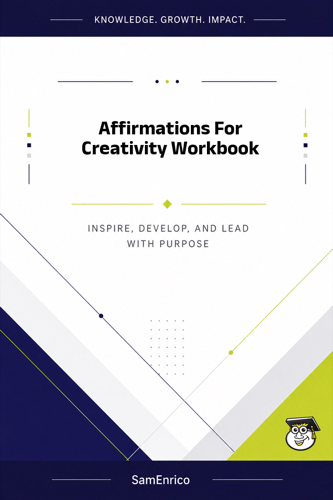
Affirmations For Creativity Workbook eBook
Rewires self-doubt about creative abilities.
by Shea Jodie
Rewires self-doubt about creative abilities.
Formats
Free sample
Chapter 1: The Borrowed Voice...--–- The first time someone told you that you weren't creative, you believed them. That is not your fault. You were probably seven years old, or twelve, or twenty-two—some age before you learned that adults lie, teachers have blind spots, and parents repeat what their own parents told them. The sentence landed somewhere soft: in your chest, behind your ribs, in that part of your stomach that still remembers every humiliation. And because it landed in soft ground, it took root.
Now, years later, the voice that says "I'm not creative" or "Who do I think I am?" or "I should leave this to the real artists" does not sound like that teacher, that parent, that partner, that culture. It sounds like you. That is the trick of the inner critic. It steals voices, internalizes them, and then pretends to be your own.This chapter is called The Borrowed Voice because that is the first and most important thing you need to understand: your self-doubt is rarely original. It is rented.
It is inherited. It was installed in you before you had the cognitive ability to say, "Wait, is that actually true?" The goal of this chapter is not to kill your inner critic—that would be like trying to kill your shadow. The goal is to separate your own authentic creative voice from the internalized voices of everyone who ever made you feel small. You are going to become an archaeologist of your own doubt. You are going to dig down through the layers of sediment—parental voices, educational trauma, cultural myths, workplace humiliation—and you are going to find the original source of the recording.
And once you find it, you are going to discover something astonishing: it was never about you.The Archaeology of Self-Doubt Let us start with a radical proposition. Every time you feel a surge of creative self-doubt—before an empty page, a blank canvas, an untouched block of clay, a silent piano—you are not hearing truth. You are hearing a recording. And every recording was once a live performance. Somewhere, at some specific moment in your past, a real person said something real (or did something real—a laugh, an eye roll, a silence) that taught your nervous system that creative expression was dangerous.
That moment is the original performance. Everything since has been a replay.This is not metaphor. This is neuroscience. Your brain is wired to prioritize survival over expression. When you experienced creative humiliation as a child—a teacher laughing at your drawing, a parent dismissing your story, a peer mocking your singing—your amygdala (the brain's alarm system) filed that experience under "danger." Not "mild social discomfort." Danger.
Because to a child's brain, social rejection feels like a threat to survival. We are herd animals. Exile from the tribe meant death, evolutionarily speaking. So your brain did what it was designed to do: it created a warning system. Every time you approach a creative act, that alarm system checks its files.
If it finds a file marked "danger," it sounds the alarm. The alarm sounds like self-doubt. "Don't do that. Last time you did that, it hurt. Stay safe.
Stay small. Stay silent."The problem is that your alarm system cannot tell the difference between a saber-toothed tiger and a third-grade art teacher. It cannot distinguish between mortal danger and the risk of looking foolish. It just knows: last time we did this thing, bad things happened. Do not do the thing again.Your self-doubt is not a character flaw.
It is a survival mechanism that has outlived its usefulness.The difference between the blocked creator and the prolific creator is not that one has self-doubt and the other does not. Both have it. The difference is that one believes the self-doubt is truth, and the other recognizes it as a recording. The prolific creator hears the alarm and says, "Ah, there is the old recording. Interesting.
I am going to create anyway." The blocked creator hears the alarm and says, "You are right. I should stop. I am not good enough."Your job in this chapter is not to silence the alarm. Your job is to learn to recognize it as an alarm, not as a weather report.The Observer Self and the Critical Self To do this work, you need to meet two characters who live inside your head. The first is the Critical Self.
This is the voice that says "that is stupid," "you are not talented," "who do you think you are," "you should have started earlier," "you are too old," "you are too young," "real artists do not do it that way." The Critical Self is loud. It is confident. It speaks in complete sentences, often in the second person ("you are not good enough") or the first person ("I am not creative"). The Critical Self is the recording. It is the parrot.
It is not original, no matter how much it sounds like you.The second character is the Observer Self. This is the part of you that can watch the Critical Self without becoming it. The Observer Self does not argue. It does not try to convince the Critical Self to be quiet. It simply notices.
It says, "Ah, the Critical Self is speaking again. It is saying that I am not talented. Interesting. I wonder where that came from." The Observer Self is curious, not combative. It is calm, not reactive.
It is the part of you that remains when you stop identifying with every thought that passes through your head.Most people live their entire lives assuming that every thought they have is true. If the Critical Self says "you are a fraud," they believe they are a fraud. This is like believing that every song on the radio was written specifically about your life. Thoughts are not commands. Thoughts are not facts.
Thoughts are mental events—they arise, they linger, they pass. Your job is not to control your thoughts. Your job is to choose which ones you act on.The Observer Self is the part of you that can say, "I notice I am having the thought that I am not creative. That is interesting. I am going to write a sentence anyway." This single skill—the ability to observe your thoughts without automatically believing them—is the foundation of every creative practice.
It is the difference between being ruled by your inner critic and being in conversation with it.The Shadow Artist Phenomenon Julia Cameron, in her seminal work The Artist's Way, introduced a concept called "shadow artists." These are people who are deeply creative but who express that creativity through proximity to other artists rather than through their own work. The shadow artist hangs out in bands but does not play an instrument. The shadow artist dates painters but does not pick up a brush. The shadow artist works in publishing but does not write. The shadow artist goes to open mics but never gets on stage.The shadow artist is not lazy.
The shadow artist is terrified. At some point, the shadow artist internalized the message that their own creative expression is…
This is the end of the free sample. Get the eBook to keep going. Buy now
About this book
Details
- Author
- Shea Jodie
- Publisher
- SamEnrico
- Language
- English
- Genre
- Non-Fiction, Self-Help, Creativity
- Released
- 2026-06-09
- Pages (approx.)
- 155
- Available as
- eBook, Audiobook

Read better in the ZLOADR app
Your eBooks on your phone or tablet. Sign in with your SamEnrico account and start reading.
More by Shea Jodie
 Murophobia Mouse FearShea Jodie$11.99
 Estate Planning for Art CollectionsShea Jodie$11.99
 Remote Review Time Zone GuideShea Jodie$11.99
 The GIVE DBT Relationship SkillShea Jodie$11.99
 The Ghost Ships of the Sargasso: A Deep-Sea Detective StoryShea Jodie$11.99
 Understanding Pancreatic Islet Cell NeoplasmShea Jodie$17.99
 Customer Service AdvisorShea Jodie$11.99
 Reels Ad First Campaign GuideShea Jodie$12.99
 Mustafa Suleyman GuideShea Jodie$12.99
 How to Start a Permanent Magnets (ceramic and Ferrite) Business (Beginners Guide)Shea Jodie$11.99
You may also like
 Hong Kong Handover 1997Dunn Johnnie$11.99
 Zumba For Postnatal Recovery CourseNeal Christian$11.99
 Zumba for BeginnersLadner Nikia$11.99
 YouTube Comment Mining GuideHumes Pandora$12.99
 Worry Box MeditationCarlin Rudy$11.99
 Workplace Stress MeditationNguyen Lynn$11.99
 Workplace Stress and Sleep RepairHawley Ivory$11.99
 Workplace Perfectionism CureDelaney Jeffry$11.99
 Workplace Injustice Anger GuideWallen Isabelle$11.99
 Work Addiction and Burnout LinkGreenwood Ester$11.99
 Women in Yoga and WellnessBeattie Galina$11.99
 Women in Stand Up ComedyChun Evangeline$11.99