
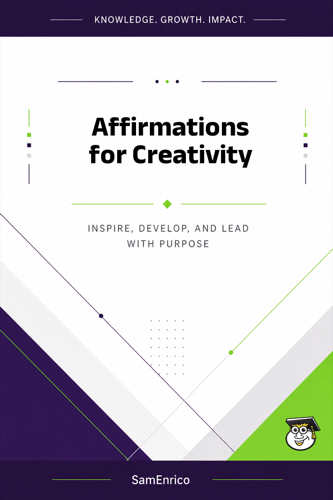
Affirmations for Creativity eBook
Unblock self-expression with permission-giving int
by Vinson Pei
Unblock self-expression with permission-giving internal statements.
Formats
Free sample
Chapter 1: The Permission Deficit--The first time someone told me I should write a book about creativity, I froze. Not because I lacked ideas—my notebooks were overflowing with them. Not because I lacked skill—I had been teaching creative writing for over a decade. I froze because I was waiting for someone to give me permission.That someone never came.For two years, I told myself the story that every blocked artist tells: I need more research. I need the right conditions.
I need to finish this other project first. I need someone important to say that I am qualified. I need a sign. I need to feel ready. I need to not be so terrified.What I actually needed was a permission slip.The Confession This Book Makes Here is the unsettling truth that most creativity books dance around but rarely state directly: You already know how to be creative.
You have the ideas. You have the skills. You have the desire. What you do not have is a permission slip.Think about the last time you abandoned a creative project. Not the one you finished—the one you started with excitement and then slowly, quietly, let die in a drawer, a hard drive, or a corner of your studio.
Ask yourself honestly: Did you lack talent? Did you lack the technical ability? Or did you simply never give yourself explicit, undeniable, written-down permission to continue?If you are like the thousands of artists, writers, musicians, and entrepreneurs I have worked with over the years, the answer is the latter.Talent is rarely the problem. Skill deficits can be addressed with practice and study. But a permission deficit—the chronic, unconscious habit of waiting for an external authority to say "Go"—is a structural problem that no amount of talent can overcome.This book is not another collection of pretty phrases designed to make you feel momentarily inspired before you return to your paralysis.
This book is a legal document. It is a stack of permission slips, each one signed by the only authority who has ever had the power to unblock you: yourself.Why "I Am Creative" Fails Before we go any further, I need to make a confession about the title of this book. The word "affirmations" is, frankly, a problem.Traditional affirmations—the ones you see on Pinterest boards and Instagram posts, the ones that tell you to repeat "I am confident, I am worthy, I am creative" until you believe them—have a dirty secret. They do not work for most people. And the reason they fail is not because you are doing them wrong.
It is because your brain is doing its job.Let me explain.When you stand in front of a mirror and say "I am creative," your brain immediately scans your recent history for evidence. Have you created anything noteworthy in the past month? In the past year? If the answer is no—and for most blocked artists, it is—your brain does not say, "Ah, thank you for that positive input, I will now believe the opposite of what the evidence suggests." Your brain says, "That is a lie. Do not trust that statement.
Feel worse now."This is not pessimism. This is pattern recognition. Your brain is designed to keep you oriented in reality, not to make you feel good. When you tell it something that contradicts observable evidence, it raises an alarm. The result is not inspiration.
It is resistance, shame, and a deepening sense of fraudulence.Permission slips work differently.A permission slip does not demand that you believe something false about yourself. It acknowledges the truth—the fear, the inexperience, the lack of evidence, the very real possibility of failure—and then grants permission to act anyway.Compare:Affirmation: "I am a brilliant artist."Permission slip: "I give myself permission to make something imperfect today."Affirmation: "I am fearless."Permission slip: "I give myself permission to be terrified and still begin."Affirmation: "My work changes lives."Permission slip: "I give myself permission to create something that only one person—maybe just me—needs to see."Do you feel the difference? The affirmation demands a leap that your brain refuses to take. The permission slip asks for a much smaller leap—or no leap at all. It simply removes a barrier.
It says: you are allowed.That is the technology this book will teach you. Not how to trick yourself into feeling good. How to give yourself explicit, actionable, reality-based permission to do the thing you are already qualified to do.The Anatomy of a Permission Deficit Let us name the enemy.A permission deficit is the gap between your creative desire and your creative action, caused by the unconscious belief that you need someone else's approval before you can proceed.Permission deficits are not laziness. They are not procrastination in the usual sense. They are structural waiting.
You are not avoiding the work because you would rather watch television. You are avoiding the work because you are waiting for a signal that never arrives.Here is what a permission deficit sounds like in real life:"I will start writing as soon as I finish reading these five craft books.""I will share my music when I find the right producer.""I will paint again when I have a proper studio.""I will apply for the residency when I have more credentials.""I will call myself an artist when someone buys something."Notice the pattern. In every case, the condition for beginning is placed outside your control. You are waiting for a book to be read, a space to appear, a person to validate you. These conditions may be reasonable in themselves.
But when they become prerequisites for action, they are no longer preparation. They are cages.The cruel irony of a permission deficit is that the external permission you are waiting for will never come—because external permission is not designed to come. No one is going to knock on your door and announce that you are now officially allowed to be creative. No committee is reviewing your readiness. No authority is tracking your progress and will, at the appropriate moment, grant you a license to begin.You are waiting for a bus that does not run.The Passenger on the Bus Before we go further, I want to introduce a metaphor that will appear throughout this book.
It comes from Elizabeth Gilbert's Big Magic, and it is the most useful framework I have found for understanding the role of fear in creative work.Imagine you are the driver of a bus. The bus is your creative life. Your job is to keep the bus moving toward your chosen destination—a finished novel, a body of paintings, a recorded album, a business launched.On this bus, there are passengers. Some of them are helpful: curiosity, discipline, playfulness, love. And one of them is fear.Fear is a passenger.
It has a seat on the bus. It has opinions. It may shout, cry, throw things, or tell you that you are about to drive off a cliff. But here is the crucial thing: fear does not have…
This is the end of the free sample. Get the eBook to keep going. Buy now
About this book
Details
- Author
- Vinson Pei
- Publisher
- SamEnrico
- Language
- English
- Genre
- Non-Fiction, Self-Help, Creativity
- Released
- 2026-06-09
- Pages (approx.)
- 122
- Available as
- eBook, Audiobook

Read better in the ZLOADR app
Your eBooks on your phone or tablet. Sign in with your SamEnrico account and start reading.
More by Vinson Pei
 Influencer Disclosure For GamblingVinson Pei$11.99
 Digital Assets Estate Planning GuideVinson Pei$11.99
 Twitch Streamer ComparisonVinson Pei$11.99
 Early Menopause Causes and Care GuideVinson Pei$11.99
 The Vanishing Billionaire: The Untold Story of Carlos Slim’s DisappearanceVinson Pei$11.99
 Tech Investment Regional GuideVinson Pei$12.99
 TikTok Scroll Interruption PlanVinson Pei$12.99
 Understanding Jorgenson–lenz SyndromeVinson Pei$17.99
 Material Handling Shop TechnicianVinson Pei$11.99
 How to Become a Dowel PointerVinson Pei$11.99
You may also like
 Trance for Creativity BoostEngel Colene$11.99
 Self Hypnosis for Creativity HabitsGerman Bernetta$11.99
 Mindfulness Meditation for Creativity BlockPage Duane$11.99
 Joyful Creativity Through GratitudeJacob Antoine$11.99
 Ideation Techniques For SolutionsKim Vincent$11.99
 Fear Of Failure In CreativityCrean Fairy$11.99
 EQ For Creative Professionals GuideGilley Elanor$11.99
 Creative Legacy GuideHooker Georgiana$11.99
 Alcoholism Recovery for Creative Souls WorkbookCompton Leota$11.99
 Creativity Trance MethodLy Morgan$11.99
 Creative Morning Routine GuideBetancourt Jacquelynn$11.99
 Walking Meditation For Creative BlockStevens Irvin$11.99